


Spiral flow and particle separation in a cyclone
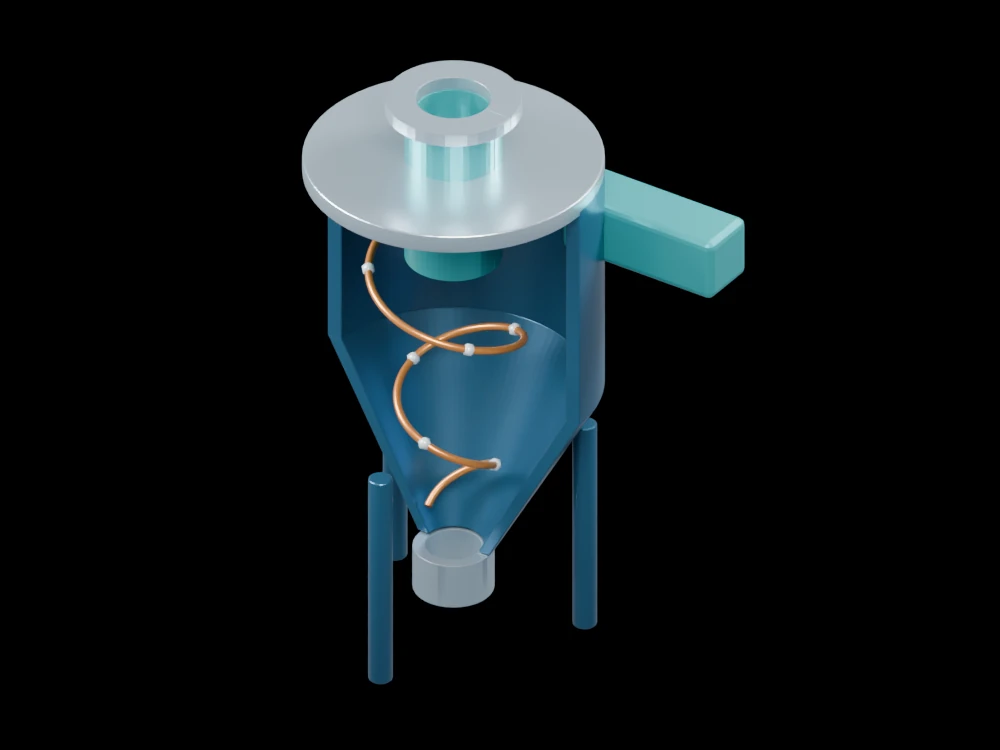
A half-open barrel and cone reveal the relationship between the tangential inlet, central gas outlet and lower solids outlet. A copper spiral illustrates a possible descending path.
Inside the assembly
The upper cylindrical chamber narrows into a cone. A central vortex finder extends into the chamber from the top, while the dust outlet sits beneath the cone. Small pale spheres mark a schematic particle path. The drawn spiral is an explanatory guide and does not come from computational fluid dynamics.
Scientific explanation
A cyclone uses swirling flow and particle inertia to separate solids from gas. Circular motion has an acceleration scale equal to tangential speed squared divided by radius. Actual collection efficiency depends on drag, particle size and density, gas properties and the internal flow field.
- ar
- Magnitude of radial acceleration for circular motion (m/s²)
- vθ, r
- Tangential speed (m/s) and curvature radius (m)
Local circular-motion scale only. The particle path, collection efficiency and pressure drop are not predicted by this static model.
References
U.S. EPA · Cyclone control techniqueExplore the model
- Compare the tangential inlet with the central outlet.
- Follow the illustrative descending spiral towards the cone.
- Locate the solids outlet below the narrowed section.
From geometry to engineering
A separator study requires a particle-size distribution, gas flow and collection target, with pressure-loss and erosion checks appropriate to the application.