


A tetrahedral network: the diamond cubic lattice
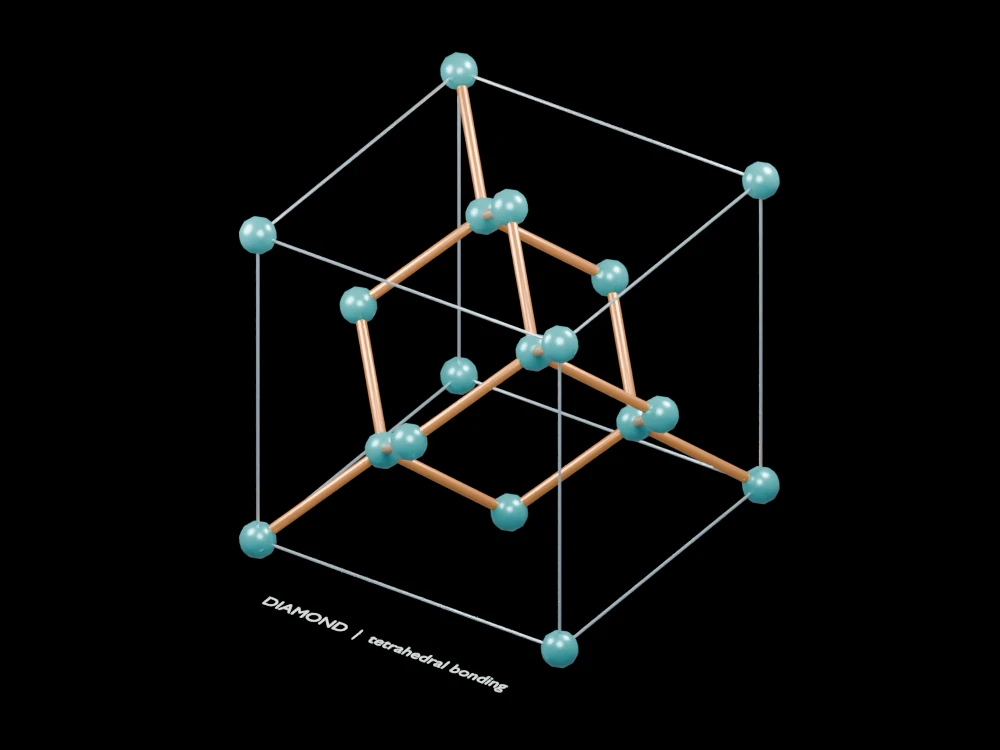
Carbon sites and short connecting rods expose a three-dimensional covalent network. Looking through the cell helps reveal tetrahedral coordination that a flat diagram can obscure.
Inside the assembly
Teal markers occupy the conventional diamond-cubic positions, with copper rods joining nearest neighbours present inside the displayed cell. A fine cube outlines the cell boundary. Four sites lie entirely inside, while corner and face-centre sites are shared with neighbouring cells. The model uses enlarged bonds and atom markers.
Scientific explanation
Diamond's structure can be described as an FCC lattice with a two-atom basis offset by one quarter of the cell edge along each axis. Each carbon has four tetrahedrally arranged nearest neighbours in the complete lattice. The conventional cell contains eight carbon atoms after boundary sharing.
- a
- Conventional cubic cell edge length
- dNN
- Nearest-neighbour distance
- Four neighbours
- Tetrahedral coordination in the extended crystal
Ideal diamond cubic geometry. Boundary bonds continue into neighbouring cells; the display gives no measured bond energy or mechanical property.
References
OpenStax · Bonding in crystalline solidsExplore the model
- Choose an internal site and trace its four bonds.
- Identify shared boundary sites and the four internal sites.
- Rotate the cell to see the nonplanar tetrahedral arrangement.
From geometry to engineering
Repeat the cell in three directions, compare coordination with graphite, and use measured lattice data for a quantitative crystal model.