


Repeated contact: inside a tray distillation column
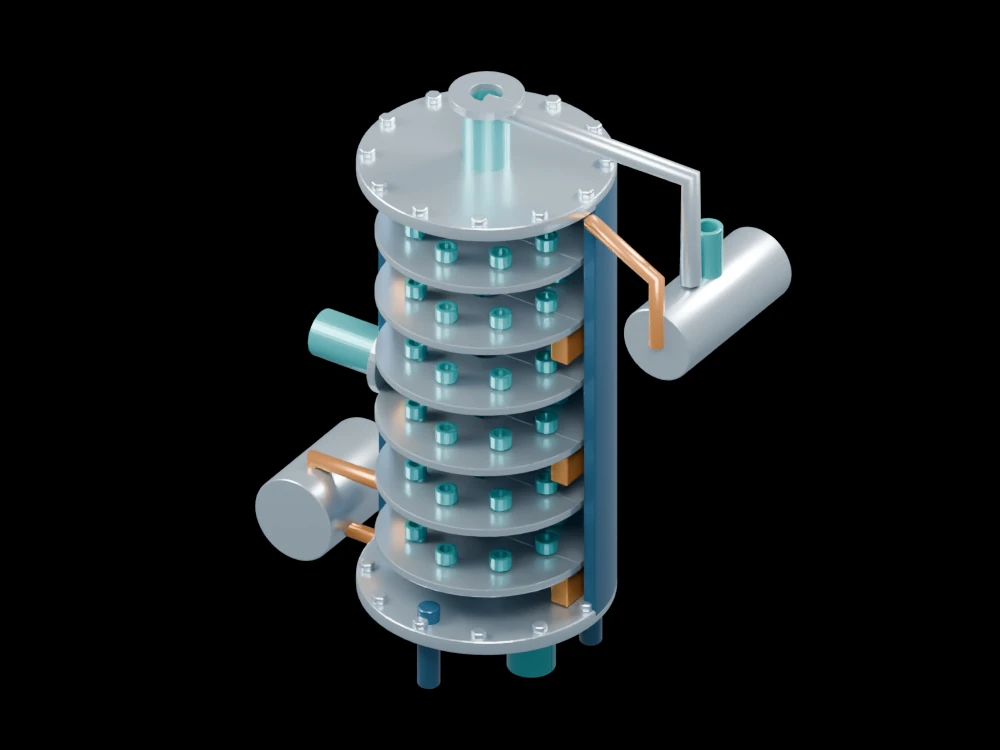
An open column reveals six contacting levels and the equipment around them. Following the external pipework makes the feed, overhead system and bottom circulation easier to distinguish.
Inside the assembly
Six trays sit inside a half-open shell. Small caps and alternating downcomers illustrate vapour and liquid contacting features. An overhead line reaches a condenser on one side, with a reflux return near the top. A second barrel represents the reboiler beside the column base. Ports and tray shapes are teaching geometry, not process specifications.
Scientific explanation
Distillation uses differences in volatility to separate a mixture through repeated vapour-liquid contact. A steady column with one feed and two product streams obeys overall and component material balances. These balances constrain the product rates but do not determine the number of stages or energy duty.
- F, D, B
- Feed, distillate and bottoms molar flow rates (mol/s)
- zF, xD, xB
- Mole fraction of one component in each corresponding stream
Steady operation, no reaction, no accumulation and no additional outlet streams. The rendered assembly does not calculate equilibrium, flooding or tray efficiency.
Explore the model
- Count the contacting levels and locate alternating downcomers.
- Follow the overhead line to the condenser and reflux return.
- Compare the bottom circulation with the mid-column feed connection.
From geometry to engineering
Choose the mixture, pressure, recovery and purity targets before performing equilibrium-stage and energy calculations, followed by hydraulic and mechanical design.