


Helium-4: a compact nucleus and a filled 1s orbital
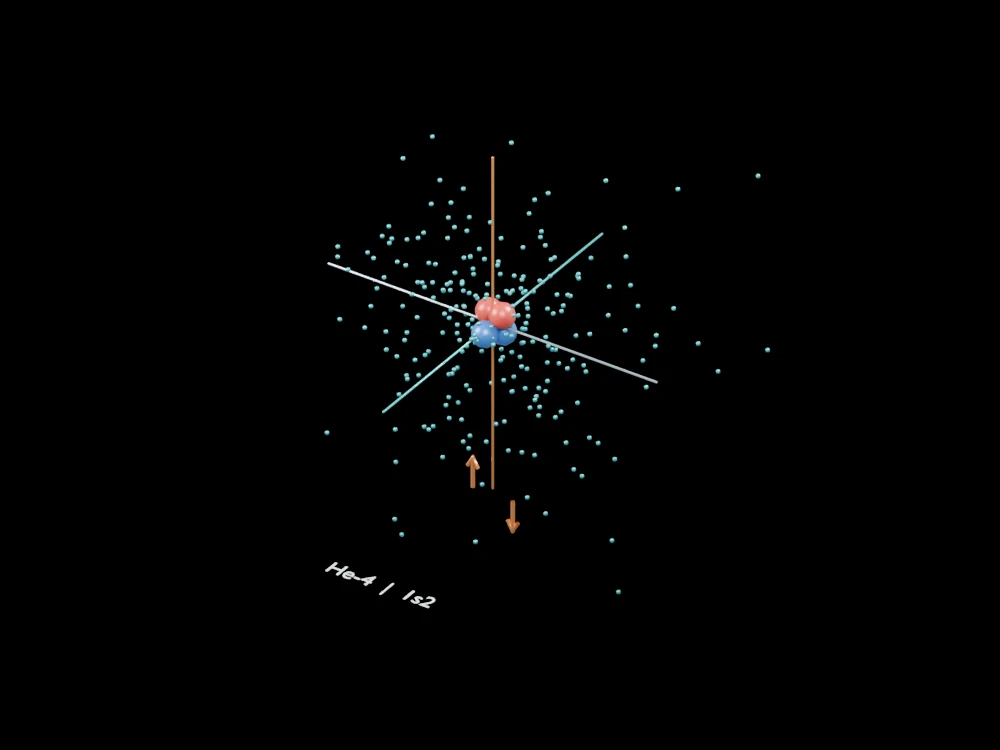
A four-particle nucleus sits inside a schematic spherical electron cloud. The model brings together isotope composition and orbital occupation while keeping their meanings distinct.
Inside the assembly
Two red proton markers and two blue neutron markers form an enlarged helium-4 nucleus. Teal points indicate a qualitative electron cloud, and two opposed arrows serve as spin-occupation symbols. The cloud is a teaching shape, not a computed two-electron wavefunction. The nucleus and cloud are shown at unrelated magnifications.
Scientific explanation
Neutral helium has two electrons. In its ground state they occupy the 1s orbital with opposite spin projections, consistent with the Pauli exclusion principle. Helium-4 contains two protons and two neutrons; the isotope label concerns the nucleus rather than electron occupation.
- 1s²
- Two electrons occupying the 1s subshell
- p, n
- Proton and neutron markers
- Opposed arrows
- Spin-projection symbols, not literal spinning paths
Qualitative ground-state description of neutral helium-4. Electron-electron correlation and nuclear structure are not calculated.
Explore the model
- Count the proton and neutron markers separately.
- Find the opposed occupation arrows beneath the cloud.
- Compare the spherical cloud with the hydrogen examples without inferring relative atomic size.
From geometry to engineering
Compare one-electron hydrogen with helium's two-electron problem and the approximations needed to account for electron interaction.