


Lungs and bronchial tree: structure in three dimensions
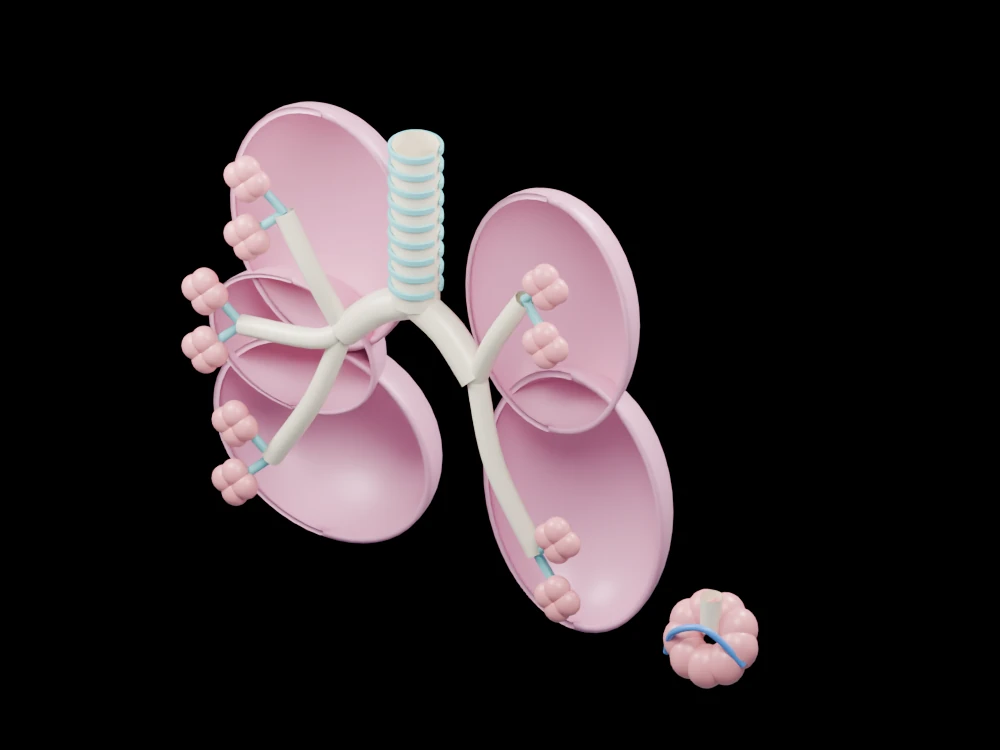
Follow a branching airway through open lung lobes and compare it with a separate enlarged alveolar inset. The open geometry makes selected relationships visible from several angles.
Inside the assembly
The five open pink shells indicate lung lobes. Pale airway tubes branch from a central trachea into selected lobar and smaller branches; these deliberately omit most of the real branching tree. Small terminal clusters indicate where an airway transitions to an exchange region. The larger cluster at the right is an inset, separated spatially so its enlarged scale is explicit.
Scientific explanation
Air reaches the lungs through the conducting airways and then the alveoli. Gas exchange occurs across the thin alveolar interface with surrounding capillaries. The right lung has three lobes and the left has two.
- Conducting airway
- Passage carrying air towards the exchange region
- Alveolus
- An air sac participating in gas exchange
Branch counts and alveolar counts are greatly reduced. The model is static and does not measure lung volume, diffusion or breathing mechanics. Colours and proportions are teaching conventions. This original schematic is not patient-derived or clinically validated, and is not a molecular simulation or a manufacturing specification.
References
NHLBI: respiratory systemExplore the model
- Count three lobes on anatomical right and two on anatomical left.
- Follow the pale central airway into each retained lobe.
- Compare the small terminal clusters with the separate enlarged inset.
From geometry to engineering
Rotate the model, compare its named structures with the references, then use the article to distinguish what is represented from what is simplified.