


Hydrogen without a circular orbit: the 1s probability cloud
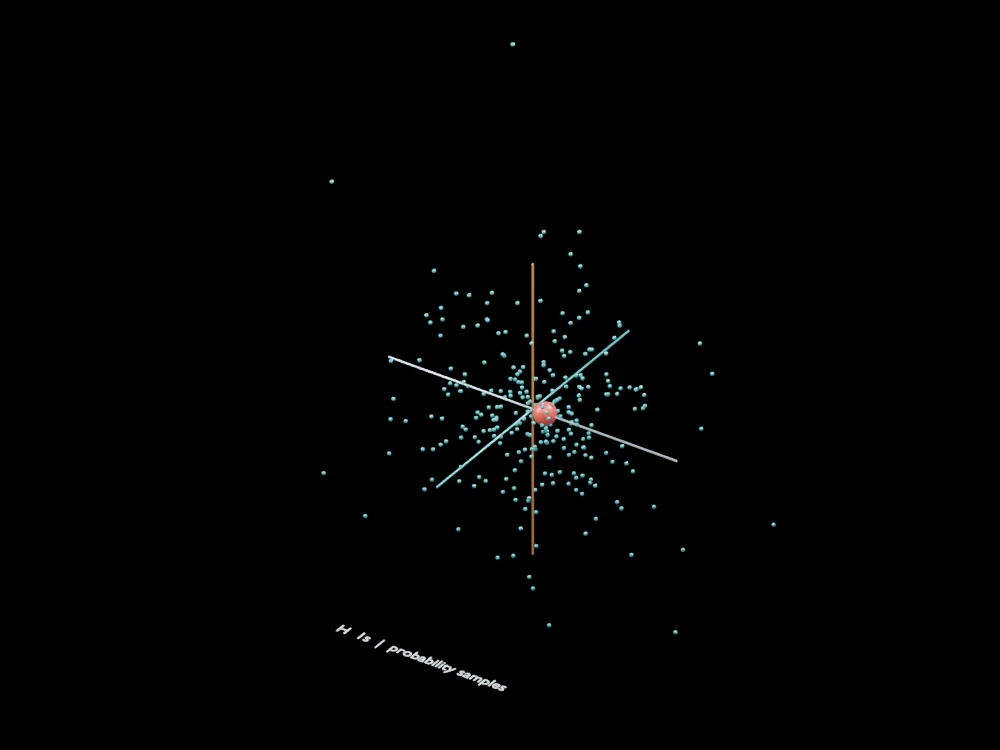
A cloud of small sample markers surrounds an enlarged proton. The sample pattern visualises the spherical symmetry of the hydrogen ground state instead of drawing an electron trajectory.
Inside the assembly
The central red sphere marks the proton, and thin axes provide orientation. The teal dots are deterministic samples of the ideal 1s spatial probability distribution, shown in enlarged display units. Each marker represents a sampled position from repeated measurements, not a separate electron. The nucleus is enlarged independently for visibility.
Scientific explanation
For a nonrelativistic hydrogen atom, the ground-state probability density decreases exponentially with distance from the nucleus. The radial distribution also includes the volume of a spherical shell. Consequently, density at a point and probability within a radial interval are different quantities.
- ψ1s
- Ground-state spatial wavefunction
- r, a0
- Distance from the nucleus and Bohr radius, in matching length units
Ideal nonrelativistic one-electron atom. Finite samples are illustrative and do not define a boundary; axes, marker sizes and nucleus size are not atomic scale.
References
OpenStax · The hydrogen atomExplore the model
- Rotate the cloud to check its overall spherical symmetry.
- Compare the dense central region with the sparse outer region.
- Distinguish sample markers from the single enlarged proton.
From geometry to engineering
Compare the point density with the radial probability distribution 4πr²|ψ|², then explore how other quantum numbers change the shape.