


Inside a planetary gearbox: one axis, several moving parts
An open housing makes a compact gearbox easier to understand. This model separates the central sun, three surrounding planets and the carrier so you can follow how the parts fit around a shared axis.
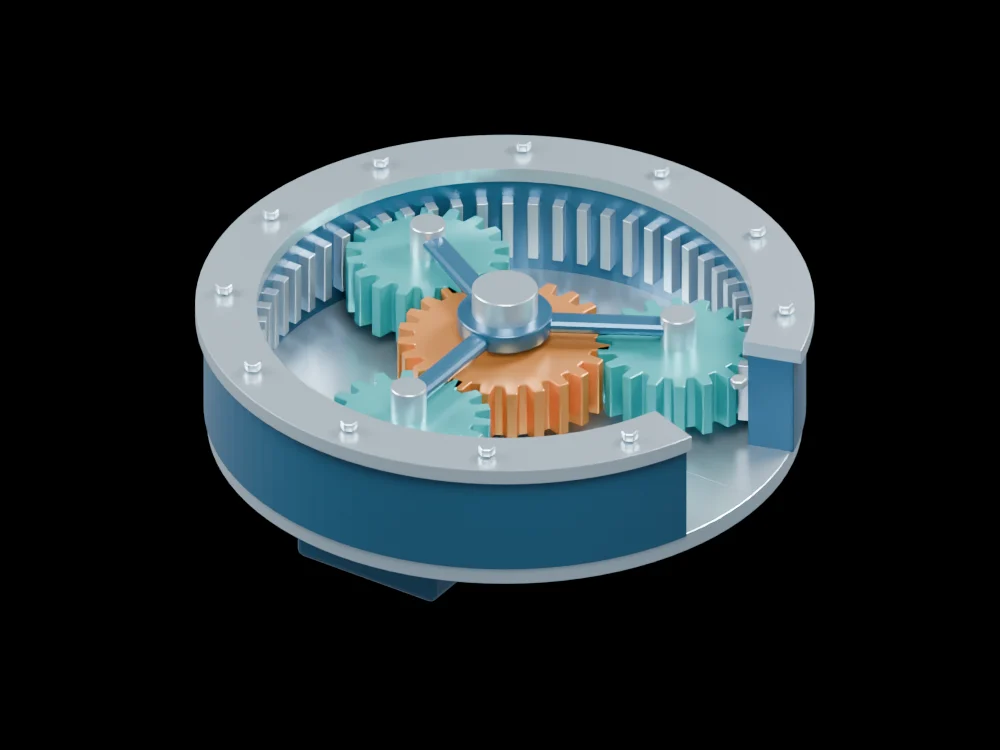
Inside the assembly
The copper sun sits at the centre of three teal planet gears. Pins locate the planets on the carrier, while an opening in the outer housing exposes the inward-facing ring teeth. Turn the model over to inspect the shaft and bearing arrangement. The missing housing sector is a viewing cutaway.
Scientific explanation
With the ring held still, a driven sun makes the planets rotate on their pins and carry the output around the central axis. The ideal speed reduction depends on the ring and sun tooth counts. This relationship describes kinematics; it does not establish the load capacity or efficiency of a particular gearbox.
- i
- Input-to-output speed ratio
- nₛ, n꜀
- Sun and carrier rotational speeds
- Zᵣ, Zₛ
- Ring and sun tooth counts
Ring fixed; sun input; carrier output; ideal gear engagement. Tooth shapes and clearances in this display model are simplified.
Explore the model
- Locate the three planet pins and follow their connection to the carrier.
- Compare the outward-facing sun teeth with the inward-facing ring teeth.
- Look through the cutaway to distinguish the housing from the rotating carrier.
From geometry to engineering
A detailed design would need involute tooth geometry, backlash, bearing selection, lubrication and a load case before tooth stresses or service life could be assessed.