


Plant cell cutaway: structure in three dimensions
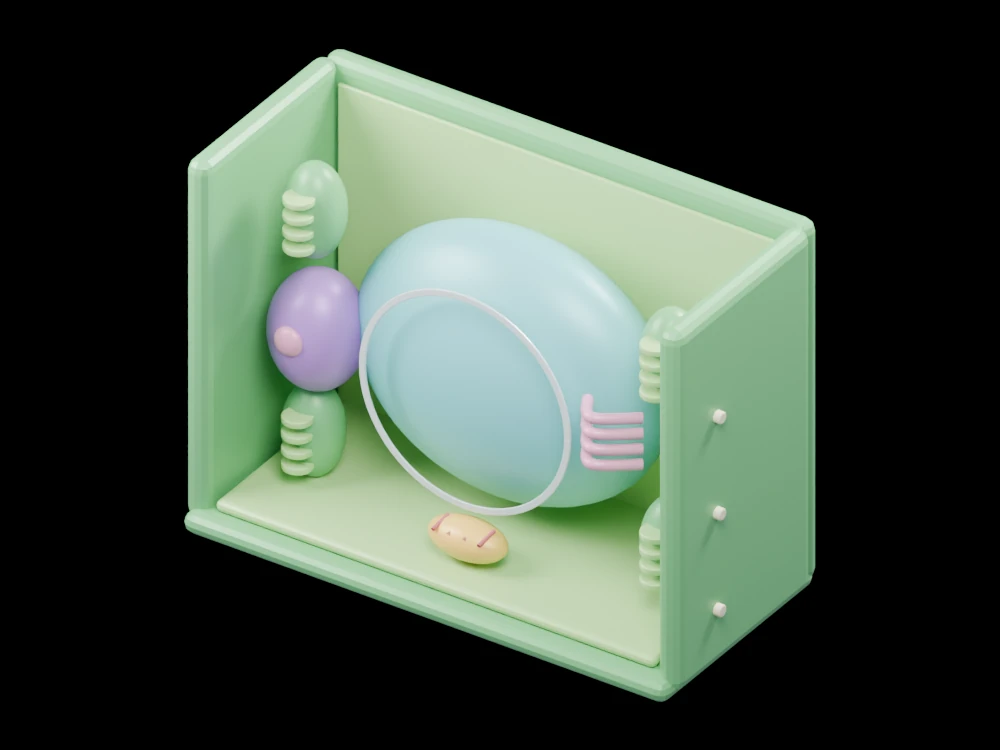
Explore a walled plant-cell schematic with a central vacuole, peripheral nucleus and chloroplasts. The open geometry makes selected relationships visible from several angles.
Inside the assembly
The front and upper walls are removed from a green box-like enclosure. A large teal oval occupies the central vacuolar region, leaving the purple nucleus and green chloroplast symbols around its edge. Pale stacks inside selected chloroplasts distinguish them from the smaller orange mitochondrion. The pore symbols crossing the side wall represent cell-to-cell communication routes; neighbouring cells are not shown.
Scientific explanation
Plant cells have a cell wall outside the plasma membrane and commonly a large central vacuole. Photosynthetic plant cells contain chloroplasts. They also contain a nucleus and other eukaryotic organelles, including mitochondria.
- Cell wall
- Outer supporting layer
- Vacuole
- Membrane-bounded central compartment
- Chloroplast
- Organelle associated with photosynthesis
This is a generic photosynthetic plant cell, not every plant-cell type. Vacuole size, wall pores, organelle positions and tissue context are simplified. Colours and proportions are teaching conventions. This original schematic is not patient-derived or clinically validated, and is not a molecular simulation or a manufacturing specification.
Explore the model
- Identify the thick wall and thinner inner membrane.
- Compare the large central vacuole with the peripheral nucleus.
- Locate chloroplasts around the vacuole and the separate mitochondrion.
From geometry to engineering
Rotate the model, compare its named structures with the references, then use the article to distinguish what is represented from what is simplified.