


Reading a robotic arm from base to gripper
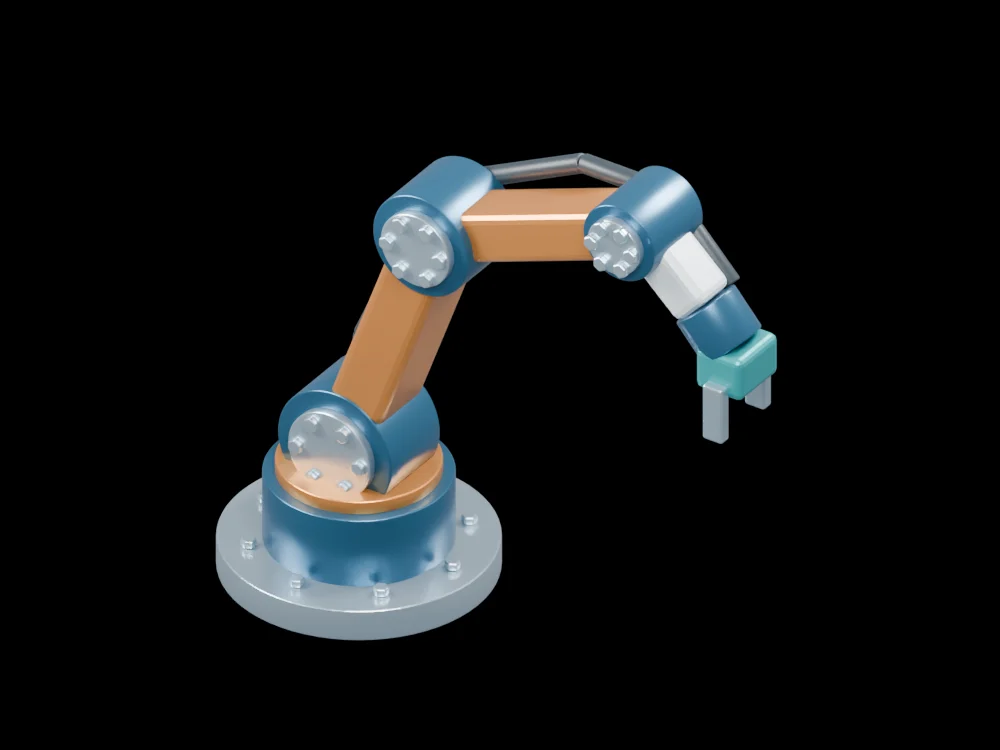
The shape of an articulated arm tells a story about links, joints and tool access. This posed model exposes the joint housings and gripper so you can inspect that chain from several viewpoints.
Inside the assembly
A circular base supports the lower arm, elbow and wrist assembly. Blue joint housings contrast with copper link members, while a visible conduit follows part of the structure. At the end, a parallel gripper represents the tool interface. The pose is fixed; rotating the view does not command the joints.
Scientific explanation
Robot pose includes both position and orientation. A homogeneous transformation represents them together. Multiplying successive link transformations in order expresses the tool frame relative to the base. Each factor depends on the chosen frames and joint configuration, so a visible arm shape alone is not a calibrated kinematic model.
- T
- A 4 × 4 homogeneous transformation containing rotation and translation
- 0 … n
- Ordered frames from the base to the tool
- Tbase,tool
- Tool pose expressed in the base frame
Rigid links and consistently defined coordinate frames. This conceptual arm has no declared axis calibration, joint limits or payload rating.
Explore the model
- Trace the structural chain from the base to the wrist.
- Inspect the space between the gripper jaws and the nearby wrist housing.
- Orbit behind the arm to see the conduit and joint covers.
From geometry to engineering
A functional robot model would add measured joint axes, link dimensions, motion limits and collision geometry. Those inputs support forward and inverse kinematics before trajectory and controller design.