

Atomic research · Research insights
Hydrogen spectroscopy sharpens agreement on the proton's size
A precise 2026 hydrogen measurement tests quantum electrodynamics. Use the 1s probability model to understand why a simple atom reveals so much.
Hydrogen has a simple-looking composition: one proton and one electron. That simplicity makes it unusually useful for comparing a precise calculation with a precise measurement. The challenge is not to observe an electron travelling around a tiny orbit, but to determine the energy relationships between quantum states.
Latest breakthrough
A February 2026 Nature paper measures the hydrogen 2S–6P transition and combines it with established spectroscopy to infer the proton's charge radius. The result agrees with the muonic-hydrogen value and tests the Standard Model prediction at 0.7 parts per trillion. The advance is a particularly stringent consistency test, rather than evidence that the theory failed. The experiment does not image the 1s electron cloud; the ground-state model supplies conceptual background for understanding the atom.
Maisenbacher and colleagues. Nature (2026). Read the original study.
How the method works
Spectroscopy measures the frequency associated with a transition between allowed atomic states. Quantum electrodynamics relates those frequencies to physical quantities, including contributions sensitive to the proton's finite size. The researchers combined their hydrogen 2S–6P measurement with established spectroscopy to infer a radius and assess agreement with other evidence. The radius is therefore obtained through a measurement-and-theory comparison, not by looking through a microscope at a proton's edge. The quoted precision concerns a particular consistency test and should not be attached indiscriminately to every inferred quantity.
A simple analogy
A bell's note carries information about the bell, even when you cannot inspect its interior directly. An atom's measured transition frequency also constrains properties through a physical model. The analogy stops at the mechanism: atomic transitions are quantum energy differences, not the vibration of a tiny solid bell or an electron following a circular track.
Why a probability cloud is the right starting point
The 1s state has spherical symmetry. A cloud representation indicates where measurements of the electron's position are likely to occur, rather than drawing a flight path. The electron is not a planet moving along the surface of that cloud. This distinction matters because spectroscopy measures energy differences associated with quantum states, not the speed of a miniature orbiting object.
Precision reveals the assumptions
At ordinary accuracy, a simplified atomic picture can be sufficient for teaching. At extreme accuracy, small physical contributions become measurable. Our interpretation is that this makes hydrogen a valuable meeting point between experimental craftsmanship and theoretical accounting. Agreement across independent approaches is informative because each approach has different possible sources of systematic error.
Why society benefits from basic measurement
The immediate outcome is improved confidence in a fundamental comparison, rather than a new consumer device. More broadly, precision research develops ways to control lasers, measure frequency and investigate uncertainty. Those capabilities form part of the scientific infrastructure used in many technologies. Any specific downstream application requires its own evidence; the value of a foundational result should not depend on inventing an immediate commercial promise. The same experiment's state labels and measured energy differences are explained in the companion hydrogen-transition article.
Read the cloud without inventing an orbit
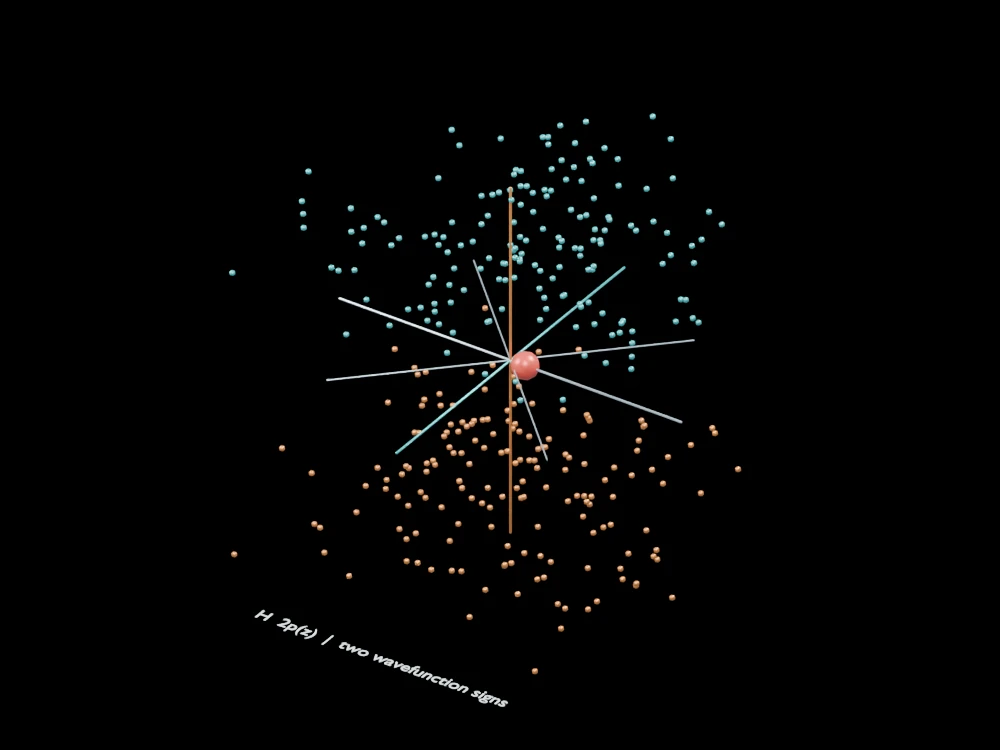
Open the hydrogen 1s model and examine its spherical distribution and coordinate axes. The displayed points are deterministic teaching samples, not a recording of an individual electron. Compare their spatial distribution with the two-lobed 2p model. This gives a visual vocabulary for discussing states while keeping the research result, which comes from spectroscopy, separate from the illustration.
Related articles
 An atomic transition pushes the precision of hydrogen spectroscopy
 A table-top experiment reconstructs molecular orbitals in 3D
 Helium droplets speed up a reaction on a femtosecond timescale
 Researchers recover thin diamond made from graphene
 Salt helps some airborne particles form ice in a cloud chamber
Explore the models
Sources and further reading
- Sub-part-per-trillion test of the Standard Model with atomic hydrogen Published 11 Feb 2026