

Atomic research · Research insights
An atomic transition pushes the precision of hydrogen spectroscopy
A 2026 hydrogen experiment provides a way to discuss orbital labels, selection and energy differences. Learn what the two colours in a 2p model mean.
The two lobes of a p orbital are among the most recognisable images in chemistry. Their shape is useful, but it can encourage a mistaken picture of an electron switching between two little compartments. Quantum-state labels describe a wavefunction and its symmetry; experiments access that information through specific observables.
Latest breakthrough
The selected February 2026 Nature study uses the 2S–6P transition in atomic hydrogen for a high-precision test of quantum electrodynamics. It is a transition to a 6P state, not a direct measurement of the gallery's 2p state. Its relevance here is the experimental importance of distinguishing state labels and measured energy differences. This article and the companion 1s review discuss different teaching aspects of the same research paper, rather than presenting two independent discoveries.
Maisenbacher and colleagues. Nature (2026). Read the original study.
How the method works
The technical starting point is the identification of two quantum states and the frequency separating them. State labels encode information that affects allowed transitions and theoretical energy predictions. In the selected experiment the upper state is 6P; the gallery's 2p orbital is a teaching example of a related label, not the state measured in that experiment. Comparing a precisely measured transition with the theoretical prediction tests the complete chain of assumptions and corrections. An orbital picture alone cannot supply that measured frequency or its uncertainty.
A simple analogy
A diagram of one floor in a building can explain what a room label means, but it cannot tell you the measured height between two different floors. Similarly, the 2p picture helps explain state notation while the spectroscopy experiment measures a different transition. Atoms do not have physical floors; the comparison only separates a useful illustration from an actual measurement.
What the lobe colours represent
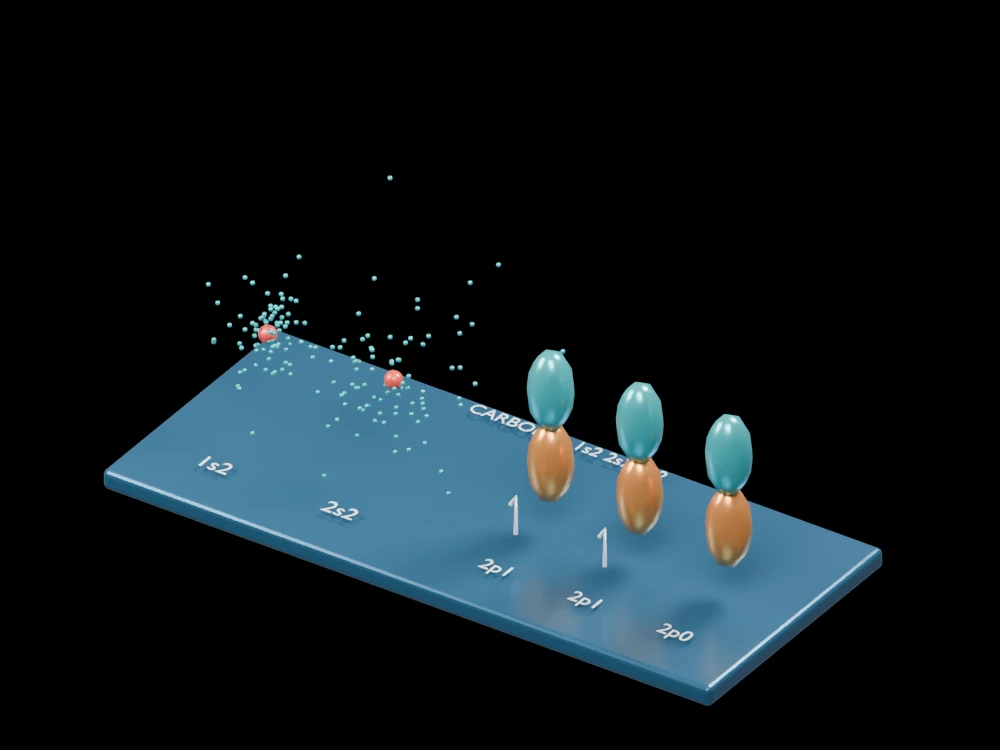
In the gallery representation, the colours indicate opposite signs of the wavefunction. They do not indicate positive and negative electric charge. The probability density depends on the squared magnitude, so both lobes can contain a nonzero probability of detecting the electron. The nodal plane between them marks a feature of the state, not a physical wall inside the atom.
A transition is an energy comparison
Light can exchange energy with an atom when the relevant transition conditions are satisfied. The measured frequency tells an experimenter about an energy difference. An orbital drawing helps describe symmetry, but it does not itself provide the full experimental prediction. Keeping geometry, probability and energy separate makes it easier to understand why spectroscopy needs both careful measurement and a theoretical model.
Why this is an important scientific habit
Our interpretation is that the study is a strong example of testing a detailed prediction rather than treating a familiar diagram as the result. This habit is useful across research: identify the observable, state what the model predicts and examine uncertainty. The societal contribution of precision atomic work is foundational. It supports measurement knowledge and scientific training without implying that a particular orbital picture immediately produces a new technology. For the other side of this same result, read how the measurement tests the proton's inferred charge radius.
Compare the two hydrogen models
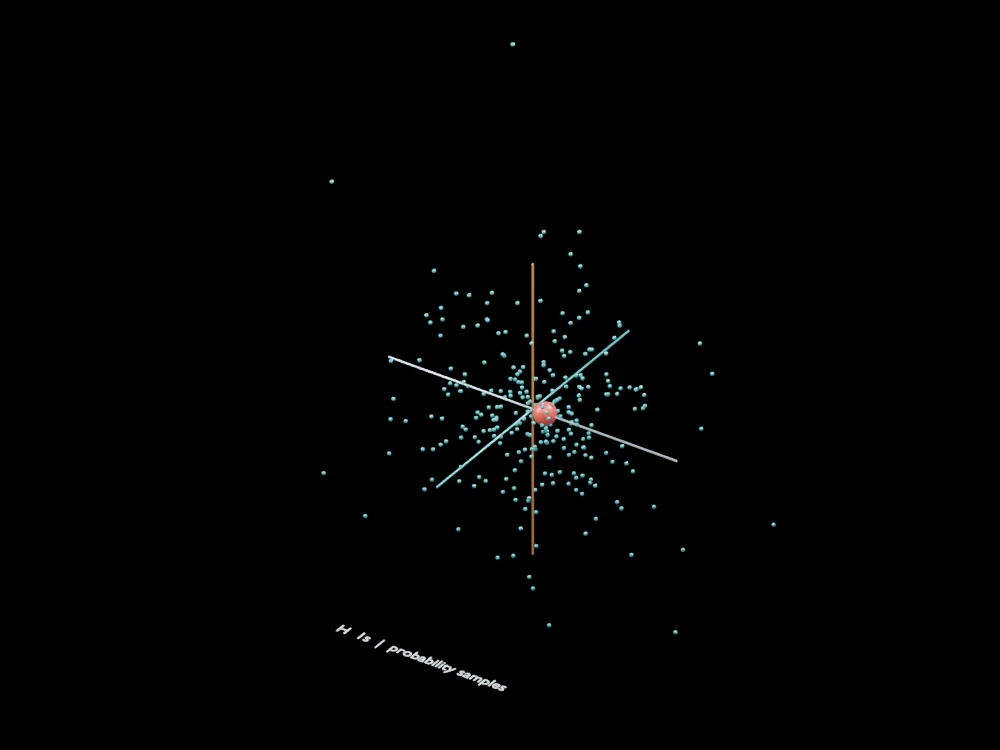
Rotate the 2p model to see the nodal-plane reference, then compare it with the spherical 1s cloud. The visible probability samples are an illustration of a chosen state. They do not show an electron trajectory, the laser apparatus or the 6P wavefunction studied in the paper. Use the pair to build a correct vocabulary before reading the experimental details.
Related articles
Explore the models
Sources and further reading
- Sub-part-per-trillion test of the Standard Model with atomic hydrogen Published 11 Feb 2026