

Biological research · Research insights
A protein helps explain how developing leaf veins find direction
A 2026 study identifies a role for PAX in coordinating developing leaf veins. Explore how cell polarity connects a single cell to a tissue pattern.
A leaf's vein network is an organised pattern built from many cells. Producing that pattern requires cells to acquire direction, align with neighbours and change their behaviour in a coordinated way. The problem connects the internal organisation of one cell with the architecture of a whole tissue.
Latest breakthrough
An August 2026 Nature Plants paper identifies a role for the polar protein PAX during formation of procambial strands, the developing cellular routes associated with veins. The authors describe an auxin-guided establishment of cell and tissue polarity that precedes, and can be distinguished from, the polarity of PIN auxin transporters. The result revises the ordering of events in an existing developmental explanation. It is a mechanistic plant-biology advance, rather than a demonstrated increase in crop yield or a complete account of every leaf-vein pattern.
Bassukas and colleagues. Nature Plants (2026). Read the original study.
How the method works
The study examines the timing and relationship of polarity signals as developing leaf-vein strands form. Polarity means that different sides of a cell or tissue acquire different properties. By relating PAX behaviour to auxin-guided organisation and to PIN transporter polarity, the work tests the order in which a proposed developmental explanation operates. Sequence matters: an event that reliably occurs earlier may change how a later pattern should be explained. The result concerns the formation of particular developing structures, rather than a direct measurement of crop productivity.
A simple analogy
A road network needs directional planning before every transport route is fully operating. Observing when the guidance appears can change an explanation of how the network forms. Plant cells do not follow a central road plan, however; local molecular signals produce the organisation. The analogy highlights order and direction without implying a conscious designer.
Direction is information inside a cell
A cell can distribute proteins or activities unevenly across its boundaries. That asymmetry can influence how it grows, communicates or transports material. When neighbouring cells coordinate their orientations, a tissue-level route can emerge. Understanding which event comes first is important because correlation between two patterns does not establish which one organises the other.
Why developmental sequence matters
Our interpretation is that clarifying the sequence gives researchers better experiments to design. They can ask whether changing an early polarity step alters later tissue organisation, and whether the same relationship holds in other contexts. The broader value is a more precise account of how plants build transport networks. Possible applications in agriculture need additional work linking the mechanism to useful whole-plant traits.
A mechanism is not yet a field outcome
A result in a studied developmental system should not be assumed to produce the same effect across species, environments or life stages. Leaf function also depends on photosynthesis, water availability and many other features. The paper supports a revised explanation of pattern formation; it does not establish a ready agricultural intervention or an environmental benefit. Developmental organisation is a different route to understanding plants from changing Rubisco's catalytic performance, which focuses on photosynthesis.
Read the single cell as part of a tissue
In the plant-cell cutaway, inspect the wall, inner membrane, large vacuole, peripheral nucleus and communication-pore symbols. Consider how a boundary can support both structure and communication with neighbours. The model illustrates a generic plant cell. It does not show measured PAX distributions or a developing vein, but it supplies a spatial starting point for understanding cellular polarity.
Related articles
 Rubisco changes improve photosynthesis in experimental plants
 Evo 2 reads a million DNA letters at once: why that matters
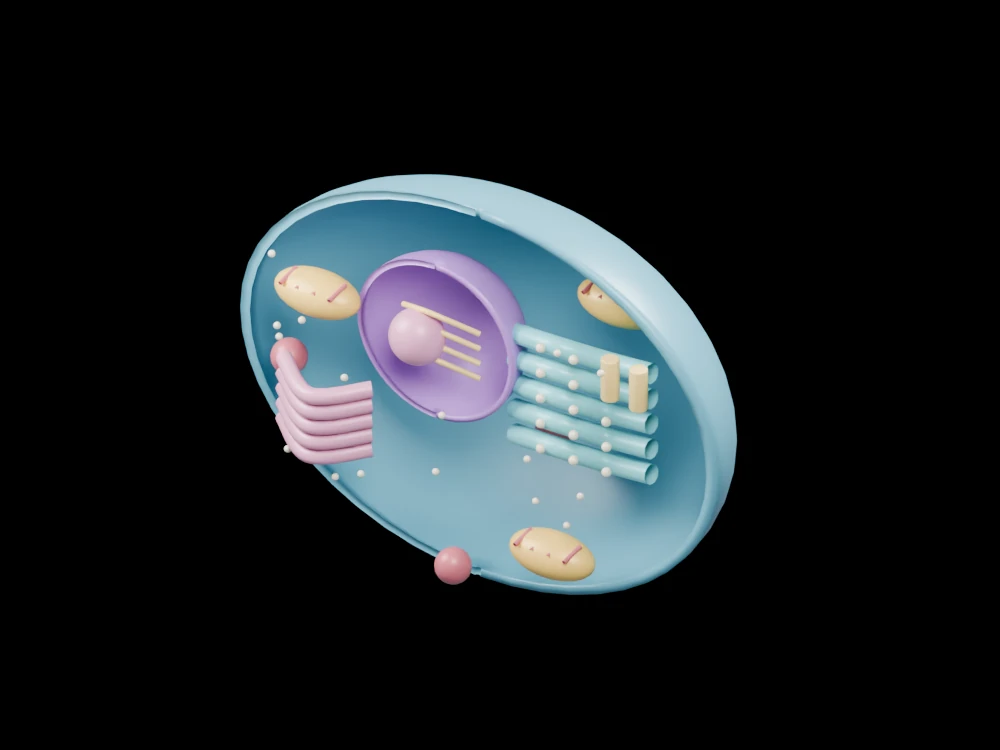 AI maps 36 million cells into a shared biological reference
 A three-person study explores a new angle on recurring UTIs
 A flexible protein gate may explain traffic inside mitochondria
Explore the models
Sources and further reading
- PAX-regulated self-organizing polarity drives procambial strand formation Published 27 Aug 2026