

Civil research · Research insights
Shape-memory metal closes cracks in experimental concrete beams
A 2026 bending study combines shape-memory fibres and bars. Learn the difference between closing a crack and proving long-term structural recovery.
A crack in reinforced concrete is both a mechanical event and a possible route for moisture to enter. Researchers are exploring reinforcement that can actively pull cracks towards closure after damage. The challenge is to connect that visible closure with meaningful recovery of structural behaviour.
Latest breakthrough
An October 2026 Construction and Building Materials paper combines nickel-titanium shape-memory-alloy fibres with pre-tensioned shape-memory bars in concrete beams. Four-point bending and thermal-activation tests investigate their complementary roles. The authors report crack-healing rates of 47.7–73.0% under their test conditions. Fibres restrain smaller cracks, while activated bars provide forces that close larger cracks. In this paper, 'self-healing' describes an activated mechanical crack-closure process. It should not be interpreted as ordinary concrete spontaneously regenerating its original material structure without intervention.
Shi and colleagues. Construction and Building Materials (2026). Read the original study.
How the method works
Four-point bending applies loads in a way that allows researchers to study a region of the beam under bending. The team combined these tests with thermal activation of shape-memory components. Fibres and pre-tensioned bars act at different scales, so the experiment examines their complementary contributions to restricting and closing cracks. A reported crack-healing rate is tied to the study's measurement and activation conditions. A smaller visible crack does not, by itself, prove that all stiffness, durability and long-term load-carrying properties have returned to their original values.
A simple analogy
Small stitches can restrain an opening while a stronger drawstring pulls its edges closer together. That is a useful picture of the different roles of fibres and bars. Concrete is not fabric, and closing a gap does not recreate every broken material connection. The analogy helps explain complementary forces while keeping crack closure distinct from complete restoration.
Two scales of reinforcement
Dispersed fibres can bridge developing cracks at many locations. Longitudinal bars act over a larger distance and transfer substantial tensile force through the member. Combining the two invites a useful question: can local crack control make a larger restoring force more effective? It also introduces interactions with anchorage, concrete cover and transverse reinforcement that a simple material demonstration cannot settle.
Why recoverability is worth studying
Our interpretation is that designing for repair and recovery could eventually reduce some replacement work after damage. That would matter for disruption, material use and the service life of infrastructure. The useful evidence would include repeated loading, durability and the energy needed for activation. A narrower crack is encouraging, but the structure must also retain appropriate strength and deformation capacity.
Visible closure has limits as a metric
A crack can appear smaller while internal damage or changes in bond remain. Results from a controlled beam test therefore need to be followed by broader structural and environmental testing. The paper does not provide an approved repair prescription for an existing building. Its contribution is evidence about a hybrid reinforcement concept and the trade-offs within that concept. Closing cracks differs from controlling the motion of a whole structure, as considered in the self-centering frame study.
Inspect the conventional reinforcement first
Open the reinforced-beam model and locate the longitudinal bars, closed stirrups and surrounding concrete cover. Follow the tension path between the supports and notice how different reinforcement directions serve different purposes. The model contains conventional illustrative reinforcement, not the experimental shape-memory material. It helps explain where the proposed mechanisms act without implying a tested capacity for the gallery mesh.
Related articles
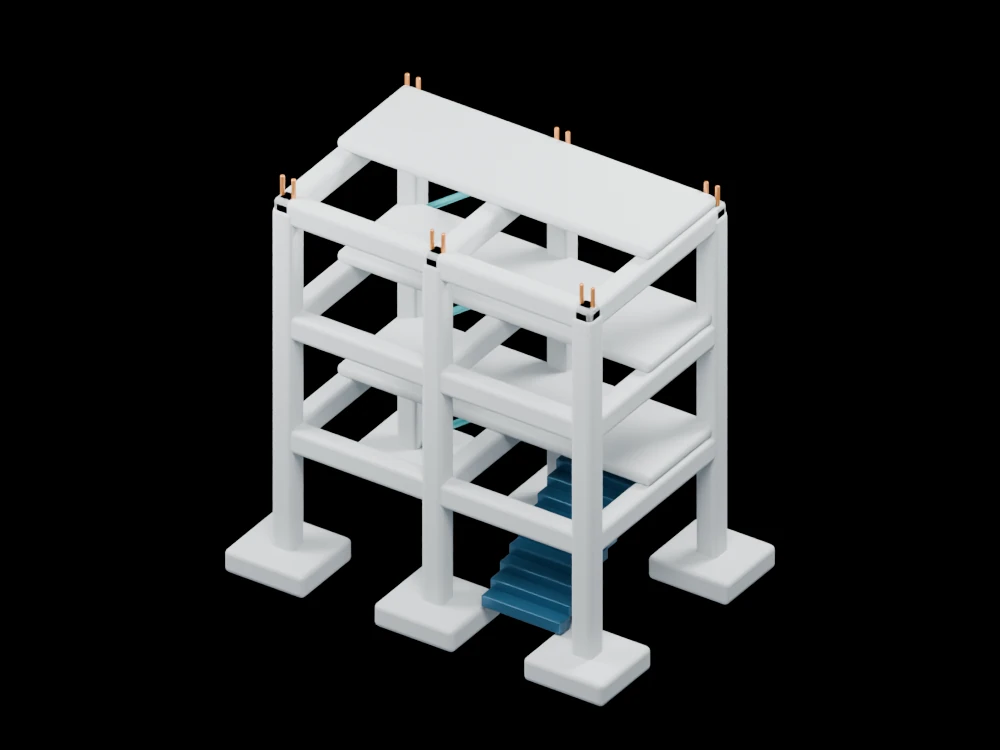 What happens when a self-centering frame loses a steel strand?
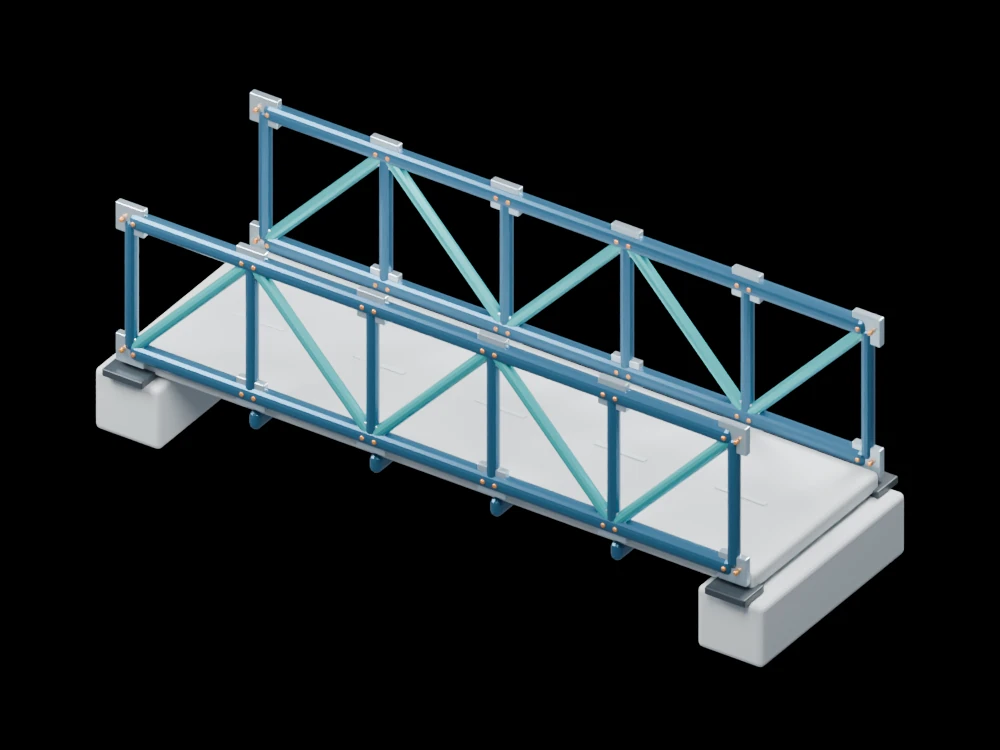 A damaged bridge truss reveals how forces find another route
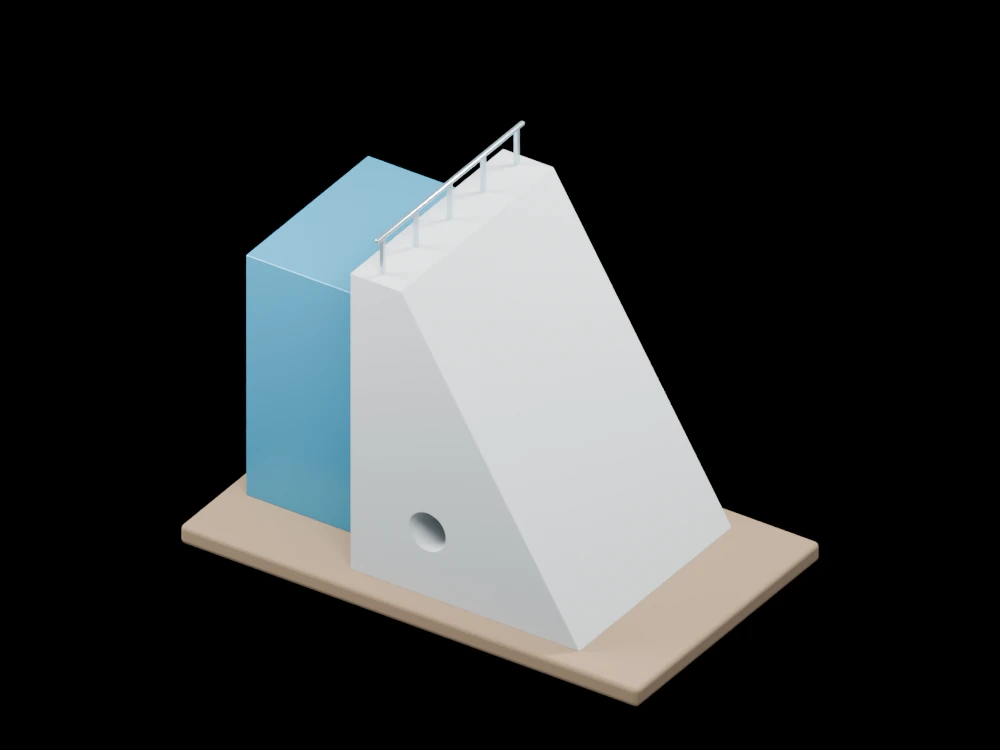 A laboratory dam model shows how drain placement changes uplift
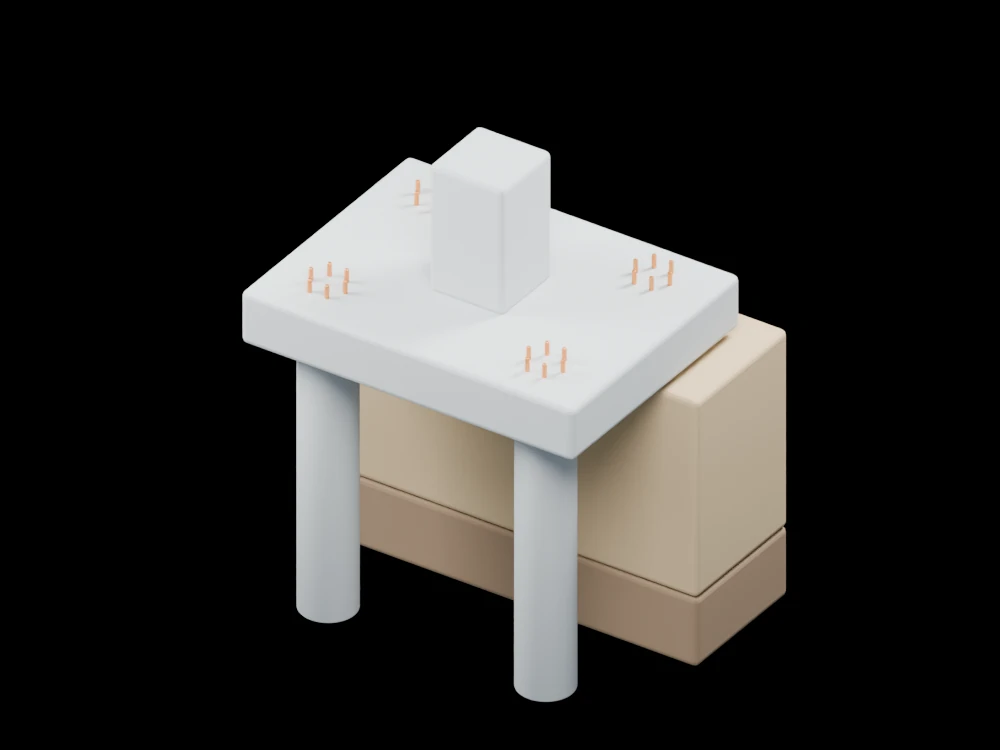 A water-tank study captures scour and pile movement together
 A seismic model brings soil continuity into retaining-wall analysis