

Civil research · Research insights
What happens when a self-centering frame loses a steel strand?
A 2026 study examines a prefabricated frame with friction devices and restoring forces. Learn why recovery and local failure both matter.
A building can avoid collapse during an earthquake and still be difficult to use afterwards if it retains a large permanent deformation. Self-centering systems aim to provide a restoring tendency as well as energy dissipation. The combination is promising, but its response when a component fails deserves close attention.
Latest breakthrough
A May 2026 Journal of Building Engineering paper examines a prefabricated self-centering frame with reinforced-concrete beams, concrete-filled double-skin steel-tube columns and web friction devices. It considers dynamic behaviour before and after steel-strand failure and develops algorithms for the immediate response. The study identifies concentrated effects near strand anchorages and rapid decay of the transient response in its analysed system. The significance is the explicit examination of a component-failure event, rather than discussing self-centering behaviour only while every restoring element remains intact.
Yu and colleagues. Journal of Building Engineering (2026). Read the original study.
How the method works
The study analyses a self-centering structural system before and after failure of a steel strand. It combines reinforced-concrete beams, double-skin steel-tube columns and friction devices, then considers the immediate dynamic response to the failure event. Self-centering refers to a tendency to return towards an initial position, which depends on the restoring system remaining effective. Examining anchorage regions and the decay of the transient response addresses what changes when part of that system is lost. Conclusions are conditional on the analysed configuration and its mathematical representation.
A simple analogy
A door held near its resting position by a tensioned return mechanism will behave differently if part of that mechanism suddenly breaks. The first movement after failure can matter as much as the later resting position. Buildings have many interacting members and vibration modes, so the door analogy explains the question rather than predicting structural safety.
Dissipation and restoration have different jobs
A friction device can consume energy through controlled movement. A restoring system provides a tendency to return towards the original position. A useful design must coordinate those functions: too little resistance may allow excessive motion, while a poorly balanced resistance can prevent recentering. The connections through which these forces enter the frame are therefore central to its behaviour.
Why post-event usability matters
Our interpretation is that recoverability belongs beside strength when discussing resilient buildings. Reduced residual deformation could potentially make inspection and repair more manageable. However, functional recovery also depends on floors, façades, equipment and services. A structural system can improve one part of that problem without ensuring that the whole building is immediately usable.
Local failures cannot be ignored
A strand or anchorage event changes the force balance rapidly. The paper's treatment of that event is useful, but its conclusions remain tied to the analysed system and assumptions. Other geometries and connection details need their own evidence. The study does not establish a universal earthquake performance level or replace the applicable structural design and verification process. The wider question of force redistribution after damage is examined experimentally in the steel-truss bridge study.
Read the frame as a connected system
The gallery building shows beams, columns, floor cutaways, rear braces and footings. Trace a horizontal force from a floor into the vertical system and down to the foundation. The model supplies that structural context. It does not include the paper's specialised self-centering connections, friction devices or strand-failure simulation, and its geometry carries no building-safety certification.
Related articles
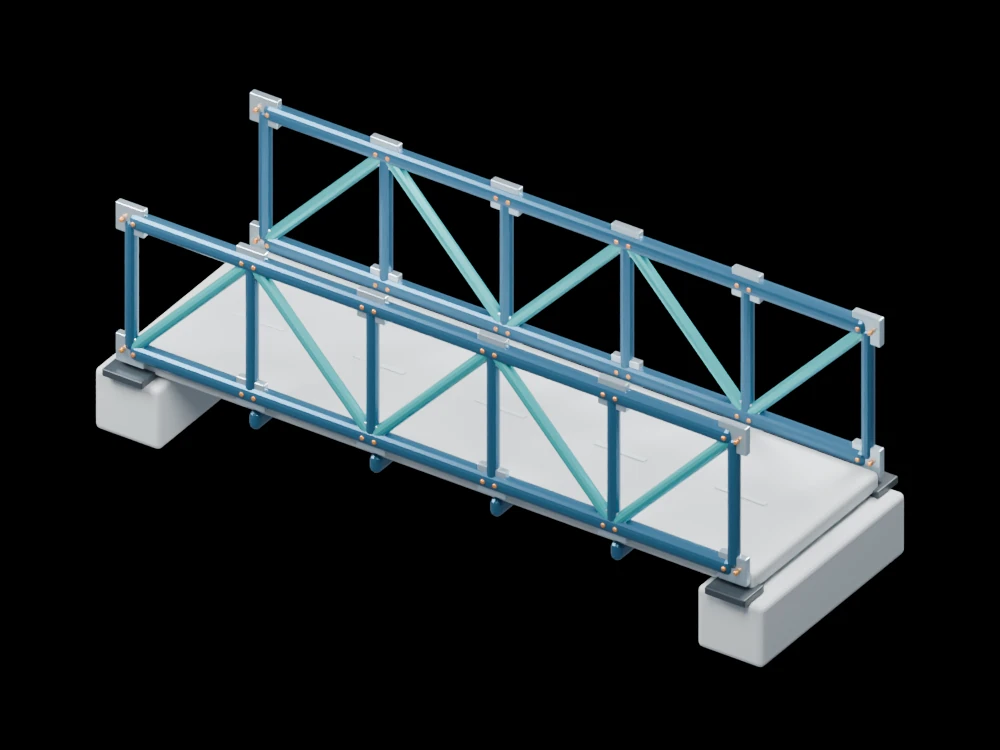 A damaged bridge truss reveals how forces find another route
 Shape-memory metal closes cracks in experimental concrete beams
 A water-tank study captures scour and pile movement together
 A seismic model brings soil continuity into retaining-wall analysis
 A laboratory dam model shows how drain placement changes uplift