

Rotating machinery · Research insights
Hydrogen can damage hot turbine alloys through a hidden chemical reaction
A 2026 Nature Materials study identifies a chemical route to hydrogen damage in nickel superalloys, sharpening the challenge of hydrogen-fuelled turbines.
Study published: 27 July 2026 · Nature Materials. Original research commentary by NPT Research.
A turbine blade must survive heat, centrifugal loading and an aggressive gas environment at the same time. Changing the fuel can therefore change the materials problem. New research identifies why hydrogen damage at elevated temperature cannot always be understood by extending room-temperature rules.
Latest breakthrough
The researchers found that hydrogen can become trapped in carbon vacancies within carbide particles in a nickel-based superalloy. At elevated temperature, this drives partial carbide decomposition and local methane formation at the particle–matrix interface. The resulting interface becomes more vulnerable to damage during deformation.
Read the original study: Hydrogen-induced damage in Ni-based superalloys at elevated temperatures.
How the study worked
The team combined near-atomic-scale characterization with first-principles calculations. Observations located the chemical and structural changes; calculations tested how hydrogen interacts with the available atomic sites. Together, these approaches connect the chemistry of small internal features to a larger material failure mechanism.
The idea in everyday terms
Picture a reinforced wall whose joints are altered by a chemical reaction. The wall can retain its overall shape while the connections that transfer force become weaker. Carbides are not bricks and hydrogen is not mortar solvent, but the analogy explains why inspecting only the outside of an alloy can miss an important vulnerability.
Why it matters
The practical opportunity is better materials selection and testing for hydrogen-related machinery. A designer needs to understand how the fuel environment changes the load-bearing material, alongside the aerodynamic efficiency of the blades. This complements work on reflective thermal protection, which addresses heat arriving at the surface.
What the evidence does not establish
This is a mechanistic study in a particular alloy system, not proof that every hydrogen turbine will fail or that a replacement alloy is already qualified. Pressure, temperature, exposure time and microstructure must all be represented in application-specific testing. No fleet-level lifetime improvement follows directly from identifying the mechanism.
Explore the device
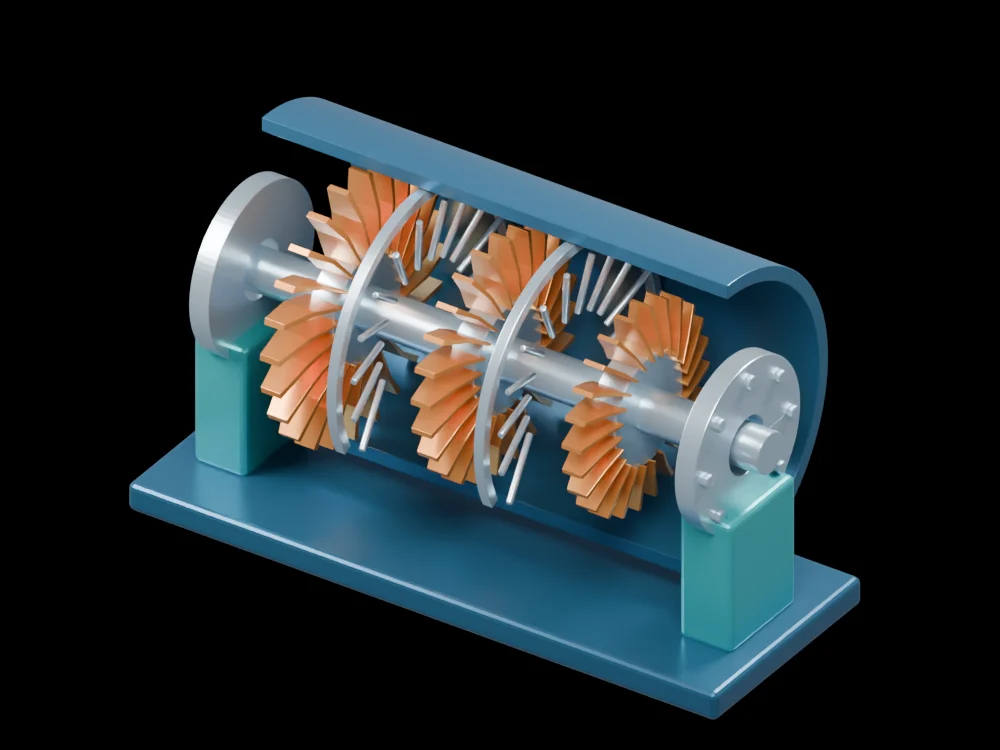
In the axial turbine model, follow the blade rows and their attachment to the rotor. Those shapes show where loads travel; the paper concerns the microscopic material carrying those loads. Watching crystals during laser processing offers another view of why an apparently sound component can contain important internal differences.
Explore the Axial turbine assembly model and its description, or read our earlier device-focused research explanation.
Primary citation: Shuai Kong, Xizhen Dong, Zheng Zhong et al.. Hydrogen-induced damage in Ni-based superalloys at elevated temperatures. Nature Materials (2026). 10.1038/s41563-026-02680-w.
Related articles
 Printed ceramic coatings reflect heat from curved metal surfacesX-rays catch crystals turning while a turbine alloy is laser-remeltedPrinted lattices strengthen turbine cooling in controlled rig testsA superalloy’s oxide layer becomes a lubricant at extreme temperatures
 Cooling channels built with the electronics remove heat closer to its sourceA liquid-metal cooling elastomer changes shape to improve thermal contactA structured water film suppresses boiling bubbles while cooling hot airflowHeat drives a shape-memory cooling cycle in a small prototype
 An accordion-inspired pump recreates complex flow waveformsA stretchable fibre becomes a pump that can be woven into clothingA soft pump runs on energy collected by a triboelectric generatorA soft pump moves liquid without a rotating impeller
 A rotating magnetic field steers crystallisation toward finer soft magnetsAn alloy becomes mechanically strong while remaining magnetically softTiny manufacturing deformations can disturb the magnetic structure of motor steelNanoprecipitates push ductile soft magnets toward two-gigapascal strengthPhysics-guided AI tracks pump cavitation as flow conditions change
 A pilot heat pump reuses distillation heat and reveals a trade-offMatched motor tests connect higher efficiency with lower heatA numerical design twists exchanger walls to improve heat transfer
Explore the models
Sources and further reading
- Hydrogen-induced damage in Ni-based superalloys at elevated temperatures Published 27 Jul 2026