

Electrical machines · Research insights
Nanoprecipitates push ductile soft magnets toward two-gigapascal strength
Researchers use deformation-assisted precipitation to strengthen a soft magnetic alloy while retaining ductility and a useful magnetic response.
Study published: 22 November 2024 · Nature Communications. Original research commentary by NPT Research.
Faster electrical machines place greater mechanical demands on their magnetic materials. Simply making an alloy harder can increase resistance to magnetic reversal. Researchers explored whether a carefully shaped nanoscale structure could support heavier loads without abandoning useful magnetic behaviour.
Latest breakthrough
The study introduced anisotropic nanoprecipitates into an iron–nickel–cobalt–tantalum alloy through deformation followed by heat treatment. It achieved a pathway to approximately two-gigapascal strength with ductility. The work explicitly accepts a moderate coercivity increase in exchange for a substantial mechanical improvement.
Read the original study: Two-gigapascal-strong ductile soft magnets.
How the study worked
The team used dislocation-driven precipitation to control particle density, spacing and dimensions. Keeping the precipitate dimensions below the magnetic-domain-wall width helped manage their magnetic influence, while their distribution impeded mechanical dislocation motion. Mechanical and magnetic measurements evaluated the combined result.
The idea in everyday terms
A climbing rope must carry a load while still bending around a route. Improving only one requirement can make the whole system less useful. Here the competing requirements are strength, ductility and magnetic response. The material does not eliminate the trade-off; it offers a more useful balance for selected conditions.
Why it matters
This is relevant wherever stronger magnetic material could enable a different machine design. It extends the question raised by the earlier strong, low-coercivity alloy rather than proving one universal winner. The best choice depends on the particular electrical and mechanical duty.
What the evidence does not establish
The reported strength does not establish a higher safe rotor speed or longer motor lifetime by itself. Coercivity, core loss, fatigue, thermal exposure and processing into real components remain necessary considerations. The comparison should retain the study’s acknowledgement of increased coercivity.
Explore the device
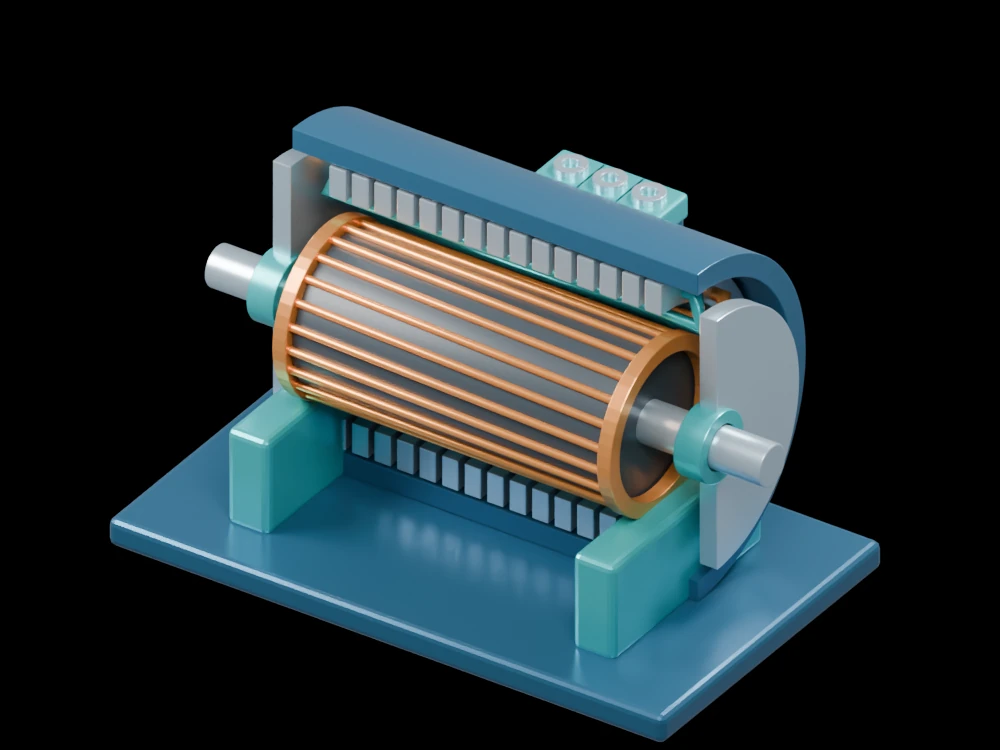
The induction-motor model provides the structural setting: rotating parts and a magnetic path must coexist in one assembly. The research addresses material selection within that setting. Microscopic manufacturing damage shows why even a good starting material can change after it is shaped.
Explore the Three-phase induction motor model and its description, or read our earlier device-focused research explanation.
Primary citation: Liuliu Han, Nicolas J. Peter, Fernando Maccari et al.. Two-gigapascal-strong ductile soft magnets. Nature Communications (2024). 10.1038/s41467-024-53793-2.
Related articles
 An alloy becomes mechanically strong while remaining magnetically softTiny manufacturing deformations can disturb the magnetic structure of motor steelMatched motor tests connect higher efficiency with lower heatA rotating magnetic field steers crystallisation toward finer soft magnets
 A magnetic composite tackles eddy-current and hysteresis losses togetherNarrow magnetic domains help an iron-rich ribbon waste less energyMagnetic-domain motion can send energy into the crystal latticeEngineered interfaces let magnetic particles couple without the usual loss penalty
 Physics-guided AI tracks pump cavitation as flow conditions changeAn accordion-inspired pump recreates complex flow waveforms
 Boron arsenide draws heat from working GaN transistorsA stretchable fibre becomes a pump that can be woven into clothingComplementary GaN logic puts both transistor types on one substrate
 A superalloy’s oxide layer becomes a lubricant at extreme temperaturesHydrogen can damage hot turbine alloys through a hidden chemical reaction
 Cooling channels built with the electronics remove heat closer to its sourceA vibrating resonator helps a DC converter step down voltage efficientlyBuilt-in crystal polarization helps GaN switches withstand higher voltagePrinted ceramic coatings reflect heat from curved metal surfacesA soft pump runs on energy collected by a triboelectric generatorA liquid-metal cooling elastomer changes shape to improve thermal contact
 Nanoscale spin rectifiers turn weak radio signals into useful powerA soft pump moves liquid without a rotating impellerA structured water film suppresses boiling bubbles while cooling hot airflowA superconducting chip brings full-wave rectification into the coldElemental tellurium turns radio signals into a tunable room-temperature outputTin telluride rectifies signals from megahertz to terahertz without external biasHeat drives a shape-memory cooling cycle in a small prototypeX-rays catch crystals turning while a turbine alloy is laser-remelted
 An electrically heated foam brings heat inside a catalyst bed
 Gearbox vibrations reveal clues to efficiency during operationA 100 kW solid-state transformer reaches 98.57% efficiency in testing
 A redesigned magnetic path cuts opening time in a solenoid study
 A DNA clutch lets a magnetic nanomotor engage and disengage its rotorElectric current drives a molecular rotor and changes its conductanceMicroscopy reveals which internal features hold a permanent magnet’s directionFriction consolidates brittle magnetic powders in a single processing step
Explore the models
Sources and further reading
- Two-gigapascal-strong ductile soft magnets Published 22 Nov 2024