

Fluid machinery · Research insights
A soft pump runs on energy collected by a triboelectric generator
Researchers combine energy harvesting, power management and electrohydrodynamic pumping in a self-powered fluidic system.
Study published: 3 February 2025 · Nature Communications. Original research commentary by NPT Research.
Making a pump flexible solves only part of the portability problem. The electrical supply can still be the heaviest or least convenient component. This study asks whether a generator that collects mechanical energy can provide the high-voltage drive required by a soft pump.
Latest breakthrough
The team paired a triboelectric nanogenerator with an electrohydrodynamic pump. Power management, geometric optimisation and stacking enabled reported maxima of 4.49 kPa pressure and 502 mL per minute flow. Demonstrations included soft actuation, microfluidic oil transport and oil purification.
Read the original study: A self-powered soft triboelectric-electrohydrodynamic pump.
How the study worked
The researchers integrated the generator and pump as an energy-transfer chain, then adjusted the circuit and geometry to improve the match. Measuring the resulting pressure and flow tested more than an isolated harvesting element: it checked whether collected energy could produce useful fluid motion.
The idea in everyday terms
A hand-powered torch collects intermittent human effort and turns it into a useful electrical output. Here the useful output is fluid movement, and the generator works through contact electrification. The comparison explains self-powered operation: energy still enters from the environment or applied motion, so the system is not a perpetual pump.
Why it matters
Combining a pressure source with energy harvesting could help selected portable devices operate without a conventional external supply. It also exposes the importance of matching sources to loads. Wearable fibre pumps solve a packaging problem; this work tackles the supply side of a related fluidic challenge.
What the evidence does not establish
Maximum pressure and maximum flow are separate performance limits unless a complete operating curve establishes otherwise. Available output depends on the energy-harvesting input, fluid and setup. The results do not imply continuous industrial pumping from arbitrarily weak ambient movement.
Explore the device
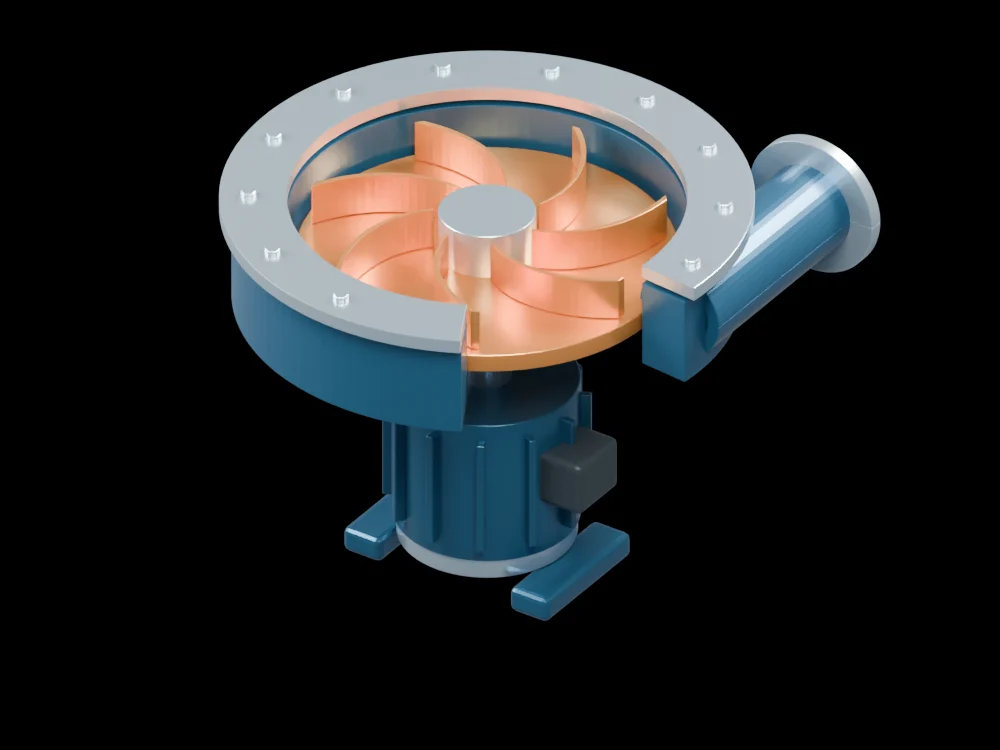
The centrifugal-pump model makes the energy path visible: a drive supplies torque, and an impeller transfers energy into liquid. This research changes both the drive and pumping mechanism. The earlier soft-pump architecture helps explain the fluid-driving principle before adding the energy-harvesting stage.
Explore the Centrifugal pump model and its description, or read our earlier device-focused research explanation.
Primary citation: Fangming Li, Shuowen Sun, Xingfu Wan et al.. A self-powered soft triboelectric-electrohydrodynamic pump. Nature Communications (2025). 10.1038/s41467-025-56679-z.
Related articles
 A stretchable fibre becomes a pump that can be woven into clothingA soft pump moves liquid without a rotating impellerPhysics-guided AI tracks pump cavitation as flow conditions changeAn accordion-inspired pump recreates complex flow waveforms
 A superalloy’s oxide layer becomes a lubricant at extreme temperaturesHydrogen can damage hot turbine alloys through a hidden chemical reaction
 Cooling channels built with the electronics remove heat closer to its sourcePrinted ceramic coatings reflect heat from curved metal surfacesA liquid-metal cooling elastomer changes shape to improve thermal contactA structured water film suppresses boiling bubbles while cooling hot airflowHeat drives a shape-memory cooling cycle in a small prototypeX-rays catch crystals turning while a turbine alloy is laser-remelted
 Dense liquid-metal coils combine soft actuation, sensing and communication
 A DNA clutch lets a magnetic nanomotor engage and disengage its rotorElastic electromagnetic mechanisms give small robots muscle-like motionElectric current drives a molecular rotor and changes its conductance
 An engineered environment changes a microscopic engine’s power–efficiency trade-off
 Nanotextured surfaces help graphite maintain an extremely low-friction contactProjected light assembles and drives reconfigurable microscopic machinesLiquid-metal networks turn a flat elastomer into programmable 3D surfacesMagnetic measurements expose early fatigue changes in tested metalsMicroscopy reveals which internal features hold a permanent magnet’s directionLight drives microscopic gear trains through patterned metasurfacesChanging the character of noise shifts a microscopic engine’s best operating speed
 A rotating magnetic field steers crystallisation toward finer soft magnetsSoft robots steer their shape by combining local electromagnetic vectorsFriction consolidates brittle magnetic powders in a single processing stepA soft robot arm stays bendable while transmitting continuous torqueAn alloy becomes mechanically strong while remaining magnetically softTiny manufacturing deformations can disturb the magnetic structure of motor steelNanoprecipitates push ductile soft magnets toward two-gigapascal strengthSwitching between unstable modes can stabilise a mechanical oscillatorPrinted lattices strengthen turbine cooling in controlled rig testsChanging a motor's magnetic geometry tackles a narrow noise peak
 A pilot heat pump reuses distillation heat and reveals a trade-offMatched motor tests connect higher efficiency with lower heatA numerical design twists exchanger walls to improve heat transferA configurable joint reveals how small gaps turn motion into impacts
Explore the models
Sources and further reading
- A self-powered soft triboelectric-electrohydrodynamic pump Published 3 Feb 2025