

Electrical machines · Research insights
An alloy becomes mechanically strong while remaining magnetically soft
A Nature study designs nanoparticles that strengthen an alloy while limiting their interference with magnetic-domain motion.
Study published: 10 August 2022 · Nature. Original research commentary by NPT Research.
The word soft has a special meaning in magnetism: a magnetically soft material changes its magnetisation readily. That can save energy in a motor core, but the material must still survive mechanical loading. A 2022 study tackled these two requirements together.
Latest breakthrough
The team designed a multicomponent alloy containing a ferromagnetic matrix and coherent nanoparticles. The particles obstruct dislocation motion while producing limited magnetic-domain pinning. The alloy combined reported tensile strength of 1,336 MPa, substantial elongation and low coercivity under the study’s measurements.
Read the original study: A mechanically strong and ductile soft magnet with extremely low coercivity.
How the study worked
The researchers engineered the particles’ size, volume fraction and interaction with the matrix, then measured mechanical and magnetic properties. Their design connects particle dimensions and local stress to the width and mobility of magnetic domain walls. It addresses why ordinary strengthening methods can make magnetic reversal harder.
The idea in everyday terms
Imagine reinforcing a floor so it supports heavy furniture while keeping its surface easy to slide across. Mechanical strength and magnetic softness are different properties, just as load-bearing ability and surface friction are different. The analogy separates the goals without suggesting that a domain wall is a literal object sliding over the alloy.
Why it matters
Motor materials increasingly face both demanding magnetic cycles and mechanical loads. Designing for both can expand the available trade-offs. A later two-gigapascal soft magnet explores a different nanostructuring strategy, while controlled crystallisation focuses on very fine grain structures.
What the evidence does not establish
A promising alloy result is not a completed motor demonstration. Saturation behaviour, frequency-dependent loss, manufacturing cost and the intended geometry must also be considered. Low coercivity alone does not establish the efficiency of a complete electrical machine.
Explore the device
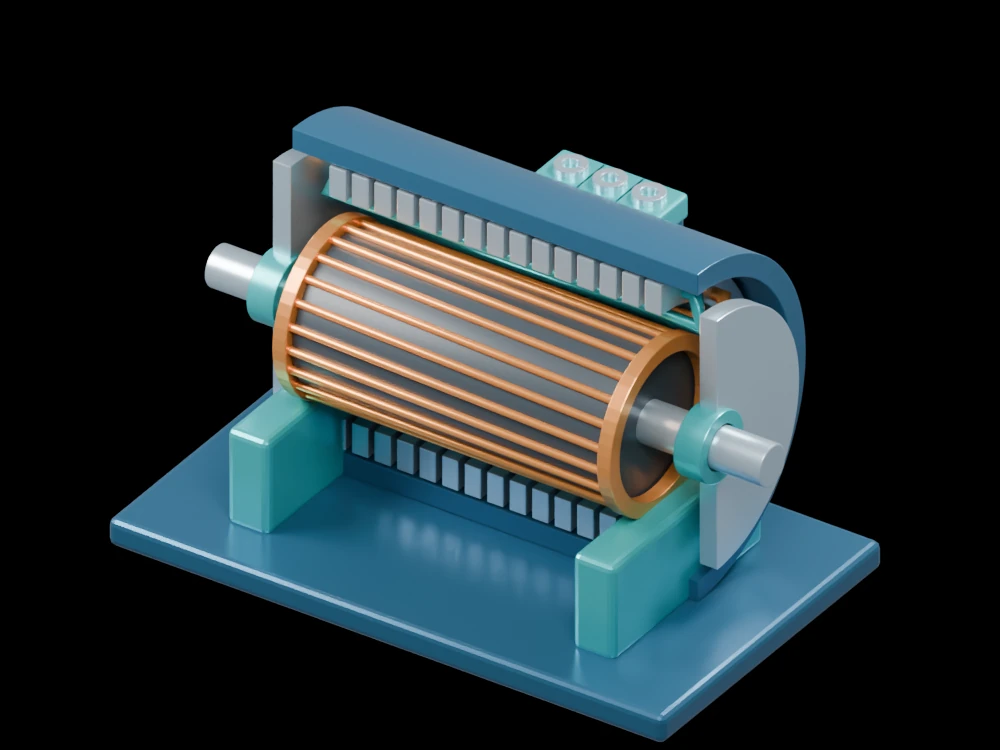
In the induction-motor model, locate the iron-containing magnetic path around the windings and rotor. These regions must guide a changing field while remaining structurally sound. The article explains a materials design principle relevant to that duty, rather than claiming the pictured educational motor contains the new alloy.
Explore the Three-phase induction motor model and its description, or read our earlier device-focused research explanation.
Primary citation: Liuliu Han, Fernando Maccari, Isnaldi R. Souza Filho et al.. A mechanically strong and ductile soft magnet with extremely low coercivity. Nature (2022). 10.1038/s41586-022-04935-3.
Related articles
 A rotating magnetic field steers crystallisation toward finer soft magnetsNanoprecipitates push ductile soft magnets toward two-gigapascal strengthMatched motor tests connect higher efficiency with lower heatTiny manufacturing deformations can disturb the magnetic structure of motor steel
 A magnetic composite tackles eddy-current and hysteresis losses togetherNarrow magnetic domains help an iron-rich ribbon waste less energyMagnetic-domain motion can send energy into the crystal latticeEngineered interfaces let magnetic particles couple without the usual loss penalty
 Physics-guided AI tracks pump cavitation as flow conditions changeAn accordion-inspired pump recreates complex flow waveforms
 Boron arsenide draws heat from working GaN transistorsA stretchable fibre becomes a pump that can be woven into clothingComplementary GaN logic puts both transistor types on one substrate
 A superalloy’s oxide layer becomes a lubricant at extreme temperaturesHydrogen can damage hot turbine alloys through a hidden chemical reaction
 Cooling channels built with the electronics remove heat closer to its sourceA vibrating resonator helps a DC converter step down voltage efficientlyBuilt-in crystal polarization helps GaN switches withstand higher voltagePrinted ceramic coatings reflect heat from curved metal surfacesA soft pump runs on energy collected by a triboelectric generatorA liquid-metal cooling elastomer changes shape to improve thermal contact
 Nanoscale spin rectifiers turn weak radio signals into useful powerA soft pump moves liquid without a rotating impellerA structured water film suppresses boiling bubbles while cooling hot airflowA superconducting chip brings full-wave rectification into the coldElemental tellurium turns radio signals into a tunable room-temperature outputTin telluride rectifies signals from megahertz to terahertz without external biasHeat drives a shape-memory cooling cycle in a small prototypeX-rays catch crystals turning while a turbine alloy is laser-remelted
 An electrically heated foam brings heat inside a catalyst bed
 Gearbox vibrations reveal clues to efficiency during operationA 100 kW solid-state transformer reaches 98.57% efficiency in testing
 A redesigned magnetic path cuts opening time in a solenoid study
 A DNA clutch lets a magnetic nanomotor engage and disengage its rotorElectric current drives a molecular rotor and changes its conductanceMicroscopy reveals which internal features hold a permanent magnet’s directionFriction consolidates brittle magnetic powders in a single processing step
Explore the models
Sources and further reading
- A mechanically strong and ductile soft magnet with extremely low coercivity Published 10 Aug 2022