

Rotating machinery · Research insights
X-rays catch crystals turning while a turbine alloy is laser-remelted
Real-time X-ray measurements reveal how unwanted grains can form during laser processing of single-crystal nickel superalloys.
Study published: 23 May 2023 · Nature Communications. Original research commentary by NPT Research.
A finished metal part hides the events that occurred while it was molten. For single-crystal turbine materials, preserving crystal orientation is especially important. Researchers used a powerful X-ray technique to observe a critical part of that process as it happened.
Latest breakthrough
During laser remelting of a nickel-based single-crystal superalloy, the team observed crystal rotation and the formation of stray grains. Their analysis connects rotation to deformation caused by uneven heating and cooling, and identifies sub-grain rotation associated with dislocation motion as a possible origin of small unwanted grains.
Read the original study: In situ observation of crystal rotation in Ni-based superalloy during additive manufacturing process.
How the study worked
The experiment used in situ synchrotron Laue diffraction to track crystallographic changes in real time. Thermomechanical finite-element modelling and molecular dynamics helped interpret the observations at different scales. This combination connected the temperature field, deformation and atomic-scale motion instead of relying only on a polished section of the final part.
The idea in everyday terms
Think of watching a choir lose synchronisation during a difficult passage, rather than examining a photograph after the concert. A single crystal has a shared atomic orientation; local rotation can disturb that coordination. The analogy concerns alignment, not a claim that atoms behave like independent performers.
Why it matters
For additive manufacturing and repair, observing when a defect originates is more useful than merely knowing it exists afterward. It can help guide experiments on thermal gradients and process settings. That manufacturing question sits beside printing protective coatings, where control of deposition also determines the final material function.
What the evidence does not establish
The paper provides evidence for a mechanism during the investigated remelting conditions. It does not deliver a universally defect-free repair recipe or certify a printed turbine blade. Translating the insight into production requires material-specific process windows, repeatability and service testing.
Explore the device
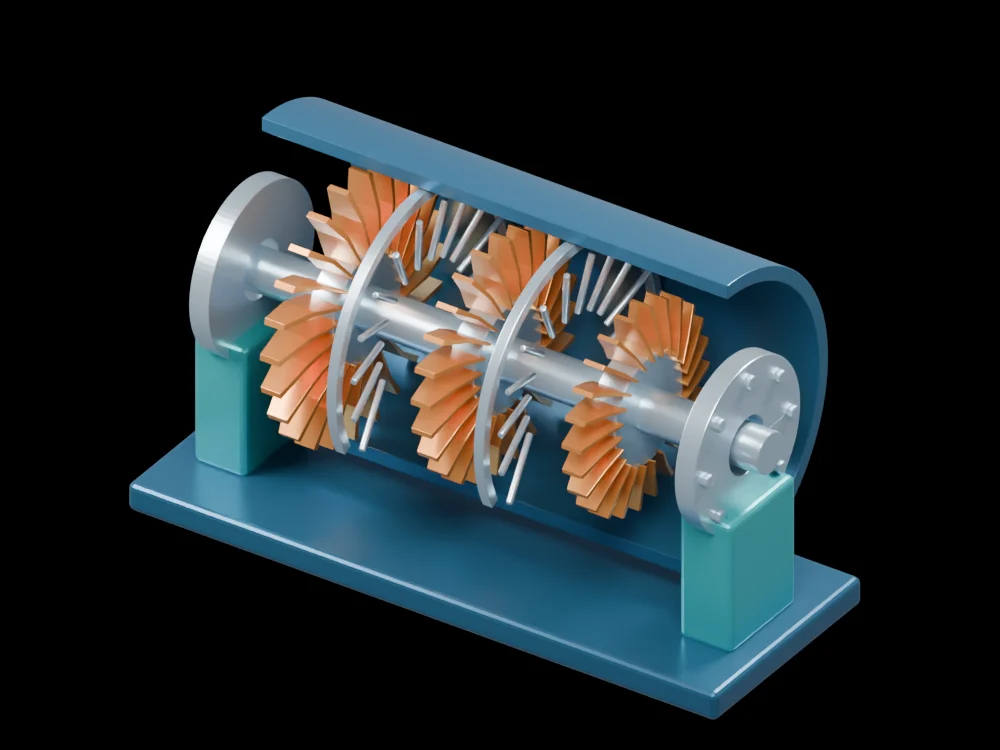
The axial turbine model makes the blade geometry easy to inspect, while this study shows what geometry alone cannot reveal. The orientation of the material inside a blade is another design variable. Self-lubricating superalloys illustrate a different way that processing can change performance without visibly changing the component’s overall form.
Explore the Axial turbine assembly model and its description, or read our earlier device-focused research explanation.
Primary citation: Dongsheng Zhang, Wei Liu, Yuxiao Li et al.. In situ observation of crystal rotation in Ni-based superalloy during additive manufacturing process. Nature Communications (2023). 10.1038/s41467-023-38727-8.
Related articles
 A superalloy’s oxide layer becomes a lubricant at extreme temperaturesPrinted ceramic coatings reflect heat from curved metal surfacesPrinted lattices strengthen turbine cooling in controlled rig testsHydrogen can damage hot turbine alloys through a hidden chemical reaction
 Cooling channels built with the electronics remove heat closer to its sourceA liquid-metal cooling elastomer changes shape to improve thermal contactA structured water film suppresses boiling bubbles while cooling hot airflowHeat drives a shape-memory cooling cycle in a small prototype
 An accordion-inspired pump recreates complex flow waveformsA stretchable fibre becomes a pump that can be woven into clothingA soft pump runs on energy collected by a triboelectric generatorA soft pump moves liquid without a rotating impeller
 A rotating magnetic field steers crystallisation toward finer soft magnetsAn alloy becomes mechanically strong while remaining magnetically softTiny manufacturing deformations can disturb the magnetic structure of motor steelNanoprecipitates push ductile soft magnets toward two-gigapascal strengthPhysics-guided AI tracks pump cavitation as flow conditions change
 A pilot heat pump reuses distillation heat and reveals a trade-offMatched motor tests connect higher efficiency with lower heatA numerical design twists exchanger walls to improve heat transfer