

Thermal systems · Research insights
A structured water film suppresses boiling bubbles while cooling hot airflow
Researchers use superhydrophilic micro- and nanostructures to sustain intense evaporation and demonstrate a high-temperature dew-point cooler.
Study published: 18 December 2025 · Nature Communications. Original research commentary by NPT Research.
Boiling bubbles can interrupt contact between liquid and a hot surface. Evaporation, however, can remove substantial heat when liquid remains well distributed. Researchers used a structured surface to control that difference and build an unusual evaporative cooling demonstration.
Latest breakthrough
The study confined water within hierarchical superhydrophilic structures and demonstrated steam generation without bubble formation at the boiling point. A dew-point evaporative cooler reduced a 437 °C inlet stream to below ambient temperature in its experiment. A separate lower-temperature test reduced air from 43 °C to 16.7 °C.
Read the original study: High temperature evaporative cooler utilizing boiling suppression at water’s boiling point.
How the study worked
The researchers experimentally examined the water-film behaviour and then tested the cooling architecture under different inlet conditions. The work connects a surface-scale phase-change phenomenon to a larger heat-exchange device, rather than assuming that a favourable surface property alone guarantees useful cooling.
The idea in everyday terms
A wet cloth cools as water evaporates, but its performance depends on remaining wet and having suitable air conditions. The engineered surface manages liquid at much smaller scales, while the device organises the heat and mass exchange. The analogy explains evaporation; it does not reproduce the full dew-point cooling arrangement.
Why it matters
The study suggests another way to manage intense thermal loads while controlling phase change. It complements liquid-channel cooling, where heat removal depends on a different flow architecture. Both demonstrate why surface and flow design must be considered together.
What the evidence does not establish
The temperature reductions are experimental operating points, not guarantees for every climate, humidity or heat source. Water consumption, air handling and the full energy balance must be considered. Cooling below ambient temperature does not imply cooling without an available thermodynamic driving force.
Explore the device
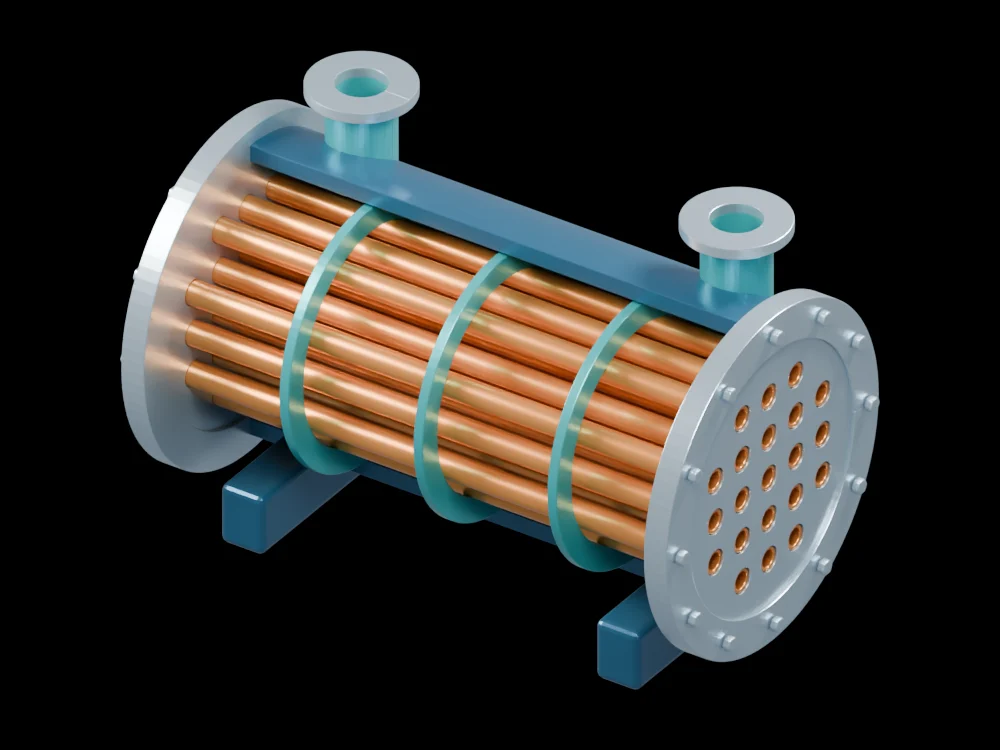
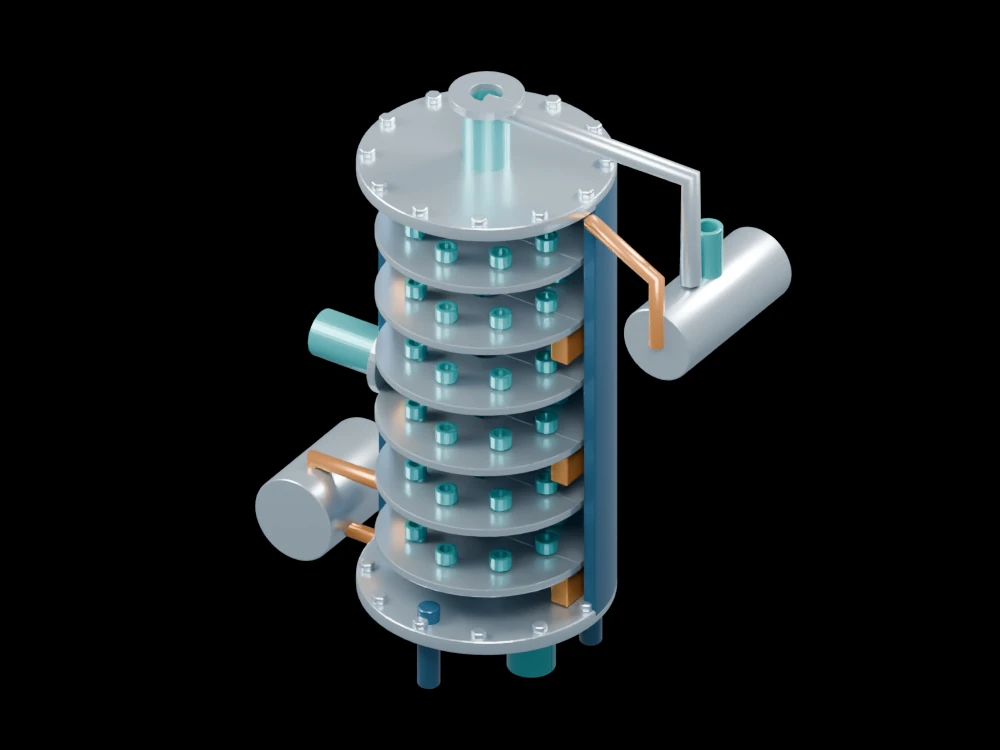
The shell-and-tube model introduces heat exchange between organised streams. This paper uses a different device geometry and includes evaporation, so its result cannot be assigned directly to that model. Heat-driven elastocaloric cooling offers a contrasting way to use thermal conditions to obtain a cooling effect.
Explore the Shell-and-tube heat exchanger model and its description, or read our earlier device-focused research explanation.
Primary citation: Ranran Fang, Zeyu Sun, Quan Chen et al.. High temperature evaporative cooler utilizing boiling suppression at water’s boiling point. Nature Communications (2025). 10.1038/s41467-025-67717-1.
Related articles
 Cooling channels built with the electronics remove heat closer to its sourceHeat drives a shape-memory cooling cycle in a small prototypeA numerical design twists exchanger walls to improve heat transferA liquid-metal cooling elastomer changes shape to improve thermal contact
 A superalloy’s oxide layer becomes a lubricant at extreme temperaturesHydrogen can damage hot turbine alloys through a hidden chemical reactionPrinted ceramic coatings reflect heat from curved metal surfacesX-rays catch crystals turning while a turbine alloy is laser-remelted
 An accordion-inspired pump recreates complex flow waveformsA stretchable fibre becomes a pump that can be woven into clothingA soft pump runs on energy collected by a triboelectric generatorA soft pump moves liquid without a rotating impellerPrinted lattices strengthen turbine cooling in controlled rig tests
 A rotating magnetic field steers crystallisation toward finer soft magnetsAn alloy becomes mechanically strong while remaining magnetically softTiny manufacturing deformations can disturb the magnetic structure of motor steelNanoprecipitates push ductile soft magnets toward two-gigapascal strengthPhysics-guided AI tracks pump cavitation as flow conditions change
 A pilot heat pump reuses distillation heat and reveals a trade-offMatched motor tests connect higher efficiency with lower heat