

Rotating machinery · Research insights
A superalloy’s oxide layer becomes a lubricant at extreme temperatures
A Nature Communications study turns controlled oxidation into a low-friction surface strategy for hot superalloys, with lessons for turbine contact regions.
Study published: 20 November 2024 · Nature Communications. Original research commentary by NPT Research.
Friction becomes especially difficult to manage when heat destroys conventional lubricants. Instead of treating every oxide as unwanted corrosion, researchers investigated whether the chemistry produced at a hot alloy surface could help the surfaces slide.
Latest breakthrough
Tests on additively manufactured Inconel showed that tailored spinel oxide layers supported friction coefficients of roughly 0.10–0.32 between 600 and 900 °C. The study links this behaviour to the oxide’s relatively low resistance to shear and its stability under the tested conditions.
Read the original study: Spinel oxide enables high-temperature self-lubrication in superalloys.
How the study worked
High-temperature sliding experiments were combined with materials characterization and calculations. The researchers investigated oxide formation and stress- and temperature-dependent phase changes, then used thermodynamic and first-principles modelling to explore promising oxide compositions. The central question was which surface chemistry could remain useful while hot and loaded.
The idea in everyday terms
Imagine a path that develops its own sacrificial, easily sliding top layer. Movement then happens partly within that layer instead of tearing deeply into the supporting surface. This helps explain self-lubrication, although an engineered oxide film must also survive pressure, wear and repeated exposure; it is not an unlimited supply of oil.
Why it matters
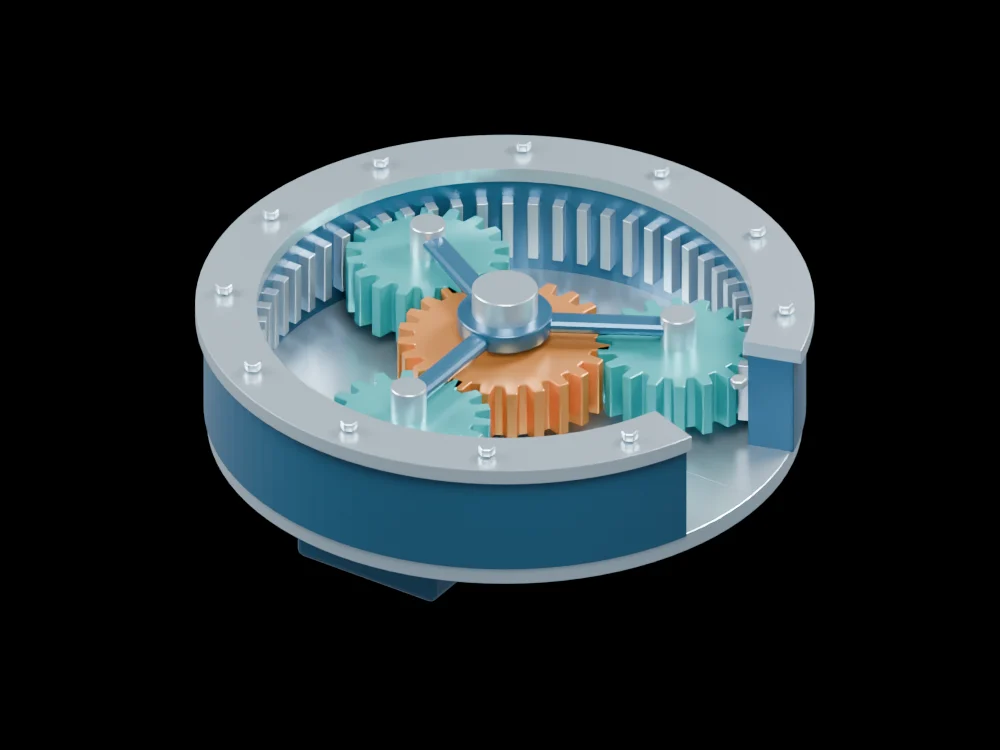
Hot contact regions in mechanical equipment could benefit from materials that manage friction through their own surface chemistry. Reducing wear can matter as much as reducing instantaneous energy loss. The approach differs from structural superlubricity in graphite, where the geometry and atomic contact of the surfaces are central.
What the evidence does not establish
The measured friction range belongs to the reported materials and test conditions. It does not establish a complete turbine bearing, maintenance interval or whole-engine efficiency gain. Contact stress, atmosphere, cycling and the ability to renew the oxide would need assessment in the intended component.
Explore the device
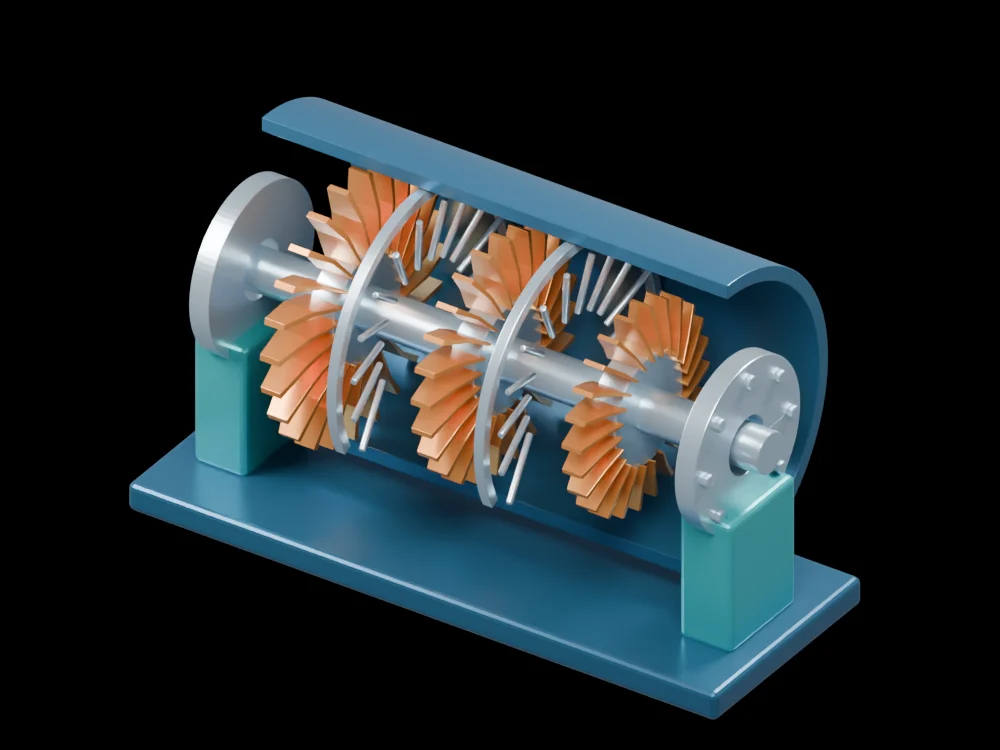
Use the turbine model to separate the flow path from the mechanical support system. This study concerns hot material contacts, rather than a new blade profile. Read alongside hydrogen-induced alloy damage to see why the same environment can help one surface process while harming another.
Explore the Axial turbine assembly model and its description, or read our earlier device-focused research explanation.
Primary citation: Zhengyu Zhang, Eitan Hershkovitz, Qi An et al.. Spinel oxide enables high-temperature self-lubrication in superalloys. Nature Communications (2024). 10.1038/s41467-024-54482-w.
Related articles
 Hydrogen can damage hot turbine alloys through a hidden chemical reactionPrinted lattices strengthen turbine cooling in controlled rig tests
 Nanotextured surfaces help graphite maintain an extremely low-friction contactPrinted ceramic coatings reflect heat from curved metal surfacesX-rays catch crystals turning while a turbine alloy is laser-remelted
 Cooling channels built with the electronics remove heat closer to its sourceA liquid-metal cooling elastomer changes shape to improve thermal contactA structured water film suppresses boiling bubbles while cooling hot airflowHeat drives a shape-memory cooling cycle in a small prototype
 An accordion-inspired pump recreates complex flow waveformsA stretchable fibre becomes a pump that can be woven into clothingA soft pump runs on energy collected by a triboelectric generatorA soft pump moves liquid without a rotating impeller
 A rotating magnetic field steers crystallisation toward finer soft magnetsAn alloy becomes mechanically strong while remaining magnetically softTiny manufacturing deformations can disturb the magnetic structure of motor steelNanoprecipitates push ductile soft magnets toward two-gigapascal strengthPhysics-guided AI tracks pump cavitation as flow conditions change
 A pilot heat pump reuses distillation heat and reveals a trade-offMatched motor tests connect higher efficiency with lower heatA numerical design twists exchanger walls to improve heat transfer
Explore the models
Sources and further reading
- Spinel oxide enables high-temperature self-lubrication in superalloys Published 20 Nov 2024