

Power electronics · Research insights
A vibrating resonator helps a DC converter step down voltage efficiently
A hybrid piezoelectric and switched-capacitor converter reports 96.2% peak efficiency at 48-to-4.8 V conversion, opening another route beyond magnetic components.
Study published: 17 March 2026 · Nature Communications. Original research commentary by NPT Research.
A conventional buck converter stores energy in an inductor while rapidly switching its connection to the supply. A piezoelectric resonator offers another storage mechanism: controlled mechanical vibration. The challenge is moving charge efficiently when the input and output voltages differ substantially.
Latest breakthrough
The researchers combined a piezoelectric resonator with flying capacitors and multiple output paths. Their integrated converter achieved a reported peak efficiency of 96.2% at a 48-to-4.8 V operating point. The topology also improved current handling relative to the baseline resonator arrangement discussed in the paper.
Read the original study: A hybrid piezoelectric resonator-based DC-DC converter.
How the study worked
The team designed and tested a chip in a 180 nm high-voltage CMOS process. Capacitors altered how charge moves through the resonator and output network, reducing redistribution losses. Circuit measurements evaluated the resulting conversion behaviour, while the mounting strategy addressed the practical use of the resonating element.
The idea in everyday terms
An inductor resembles a flywheel that smooths a pulsed energy supply. A piezoelectric resonator is closer to a carefully driven tuning fork: energy moves between electrical and mechanical forms. Neither component produces extra energy; each temporarily stores and returns it, and the switches determine where that energy goes.
Why it matters
Alternative energy-storage elements could help shrink selected power supplies and change their manufacturing options. But the surrounding switches and controller still matter. GaN complementary logic addresses the control building blocks, while improved transistor cooling addresses heat removal.
What the evidence does not establish
Peak efficiency is one operating result, not a promise over every voltage, load or temperature. The paper’s hybrid converter is not identical to the gallery’s inductive buck circuit. Resonator behaviour, packaging and control must all be considered before choosing an architecture for a product.
Explore the device
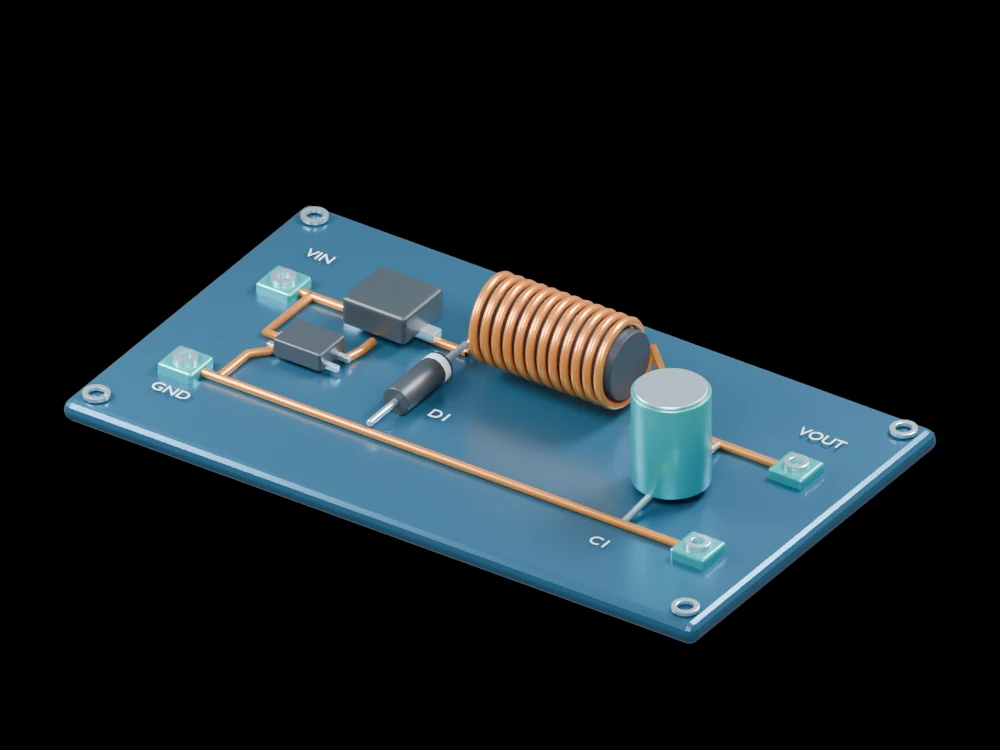
In the buck model, identify the switch, inductor and output capacitor. Then ask which energy-storage role the resonator changes and which circuit duties remain. This makes the new topology easier to understand without suggesting that the educational model reproduces the experimental chip.
Explore the DC buck converter model and its description, or read our earlier device-focused research explanation.
Primary citation: Jae-Young Ko, Wen-Chin B. Liu, Patrick P. Mercier. A hybrid piezoelectric resonator-based DC-DC converter. Nature Communications (2026). 10.1038/s41467-026-70494-0.
Related articles
 Boron arsenide draws heat from working GaN transistorsComplementary GaN logic puts both transistor types on one substrateA two-phase buck converter tackles the light-load efficiency problemBuilt-in crystal polarization helps GaN switches withstand higher voltage
 Nanoscale spin rectifiers turn weak radio signals into useful powerA superconducting chip brings full-wave rectification into the coldElemental tellurium turns radio signals into a tunable room-temperature outputTin telluride rectifies signals from megahertz to terahertz without external bias
 A 100 kW solid-state transformer reaches 98.57% efficiency in testingA magnetic composite tackles eddy-current and hysteresis losses togetherNarrow magnetic domains help an iron-rich ribbon waste less energyMagnetic-domain motion can send energy into the crystal latticeEngineered interfaces let magnetic particles couple without the usual loss penaltyA quantum material rectifies signals from radio to terahertz bands
 A rotating magnetic field steers crystallisation toward finer soft magnetsAn alloy becomes mechanically strong while remaining magnetically softTiny manufacturing deformations can disturb the magnetic structure of motor steelNanoprecipitates push ductile soft magnets toward two-gigapascal strength
 An electrically heated foam brings heat inside a catalyst bed
 A redesigned magnetic path cuts opening time in a solenoid study
Explore the models
Sources and further reading
- A hybrid piezoelectric resonator-based DC-DC converter Published 17 Mar 2026