

Electromagnetics · Research insights
A magnetic composite tackles eddy-current and hysteresis losses together
A bulk-and-interface insulation strategy improves high-frequency FeSiAl composites for magnetic components such as transformers and inductors.
Study published: 29 October 2025 · Nature Communications. Original research commentary by NPT Research.
A magnetic core should guide a changing field without wasting much energy as heat. At high frequency, electrical currents within and between particles can add substantial losses. Improving insulation helps, but the magnetic response must remain useful as well.
Latest breakthrough
The study combined a tin-modified FeSiAl region with an alumina surface layer. The internal modification raised resistivity and reduced coercivity, while the surface layer electrically separated particles. Measurements demonstrated reduced loss and useful permeability across the tested high-frequency conditions.
Read the original study: High-frequency FeSiAl-based soft magnetic composites via simultaneously suppressed eddy and hysteresis losses.
How the study worked
The researchers used diffusion-based material processing to engineer the particle interiors and interfaces together. Structural characterization and frequency-dependent magnetic measurements assessed the result. This separates three mechanisms: currents within particles, currents between particles and losses associated with reversing magnetisation.
The idea in everyday terms
A city can reduce unwanted traffic by changing both neighbourhood streets and the crossings between neighbourhoods. Treating only one level leaves other routes open. In the composite, the unwanted traffic is electrical circulation that turns energy into heat, while the desired magnetic response still has to pass through the material.
Why it matters
High-frequency magnetic components can be compact, but their losses must be controlled at the actual operating conditions. This work offers a coordinated materials strategy. Spin-engineered interfaces address a related complication: electrical separation can also weaken magnetic coupling.
What the evidence does not establish
The reported material measurements do not establish a complete transformer efficiency or a universal frequency rating. Flux density, waveform, temperature and geometry affect loss. A material suited to one converter frequency may be unsuitable for a different transformer design.
Explore the device
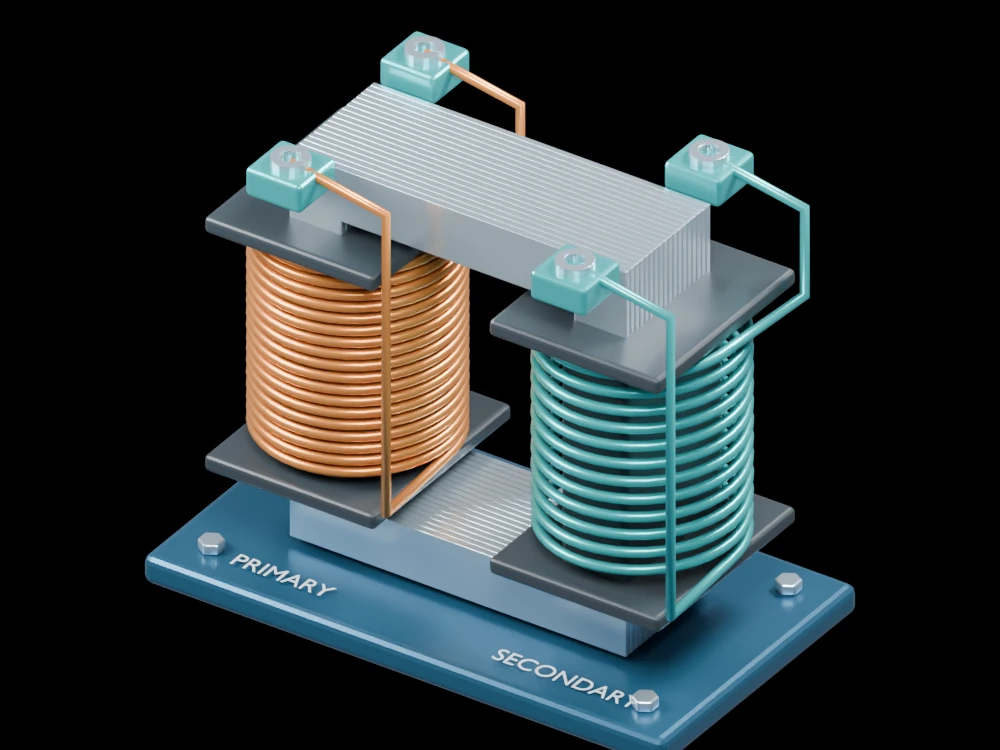
The transformer model shows windings around a shared magnetic path. This paper concerns the microscopic structure of a possible core material, rather than the winding arrangement. Low-loss ribbon research offers another route based on controlling domains in a different form of soft magnetic material.
Explore the Power transformer model and its description, or read our earlier device-focused research explanation.
Primary citation: Hongxia Li, Yixing Li, Rongzhi Zhao et al.. High-frequency FeSiAl-based soft magnetic composites via simultaneously suppressed eddy and hysteresis losses. Nature Communications (2025). 10.1038/s41467-025-64794-0.
Related articles
 Narrow magnetic domains help an iron-rich ribbon waste less energyEngineered interfaces let magnetic particles couple without the usual loss penaltyA 100 kW solid-state transformer reaches 98.57% efficiency in testingMagnetic-domain motion can send energy into the crystal lattice
 Boron arsenide draws heat from working GaN transistorsComplementary GaN logic puts both transistor types on one substrateA vibrating resonator helps a DC converter step down voltage efficientlyBuilt-in crystal polarization helps GaN switches withstand higher voltage
 A rotating magnetic field steers crystallisation toward finer soft magnets
 Nanoscale spin rectifiers turn weak radio signals into useful powerAn alloy becomes mechanically strong while remaining magnetically softA superconducting chip brings full-wave rectification into the coldElemental tellurium turns radio signals into a tunable room-temperature outputTin telluride rectifies signals from megahertz to terahertz without external biasTiny manufacturing deformations can disturb the magnetic structure of motor steelNanoprecipitates push ductile soft magnets toward two-gigapascal strengthA quantum material rectifies signals from radio to terahertz bandsA two-phase buck converter tackles the light-load efficiency problem
 Physics-guided AI tracks pump cavitation as flow conditions changeMatched motor tests connect higher efficiency with lower heat
 An electrically heated foam brings heat inside a catalyst bed
 Gearbox vibrations reveal clues to efficiency during operation
 A redesigned magnetic path cuts opening time in a solenoid studyDense liquid-metal coils combine soft actuation, sensing and communicationElastic electromagnetic mechanisms give small robots muscle-like motionLiquid-metal networks turn a flat elastomer into programmable 3D surfacesSoft robots steer their shape by combining local electromagnetic vectors