

Power electronics · Research insights
Elemental tellurium turns radio signals into a tunable room-temperature output
Researchers demonstrate a strong nonlinear Hall response and wireless rectification in tellurium, using an electric gate to adjust the effect.
Study published: 29 June 2024 · Nature Communications. Original research commentary by NPT Research.
A useful electronic effect must survive more than an ideal laboratory temperature. Tellurium offers an appealing test case because it is an elemental semiconductor, and its response can be adjusted electrically. The study connects these practical features to a different form of rectification.
Latest breakthrough
Researchers observed a pronounced nonlinear Hall effect in thin tellurium flakes at room temperature. Electrostatic gating enhanced the response, with a reported second-harmonic output reaching 2.8 mV at 300 K. They also demonstrated tunable wireless rectification in the radiofrequency range.
Read the original study: Giant nonlinear Hall and wireless rectification effects at room temperature in the elemental semiconductor tellurium.
How the study worked
The team measured nonlinear electrical transport while changing the gate conditions, then examined the mechanism behind the response. Their analysis identified extrinsic scattering as dominant and highlighted surface symmetry breaking. This matters because different nonlinear Hall devices need not produce their output through the same microscopic route.
The idea in everyday terms
A gate electrode can be pictured as a control that changes how easily a crowd moves through a passage without supplying the crowd itself. In the semiconductor, it changes the electronic conditions. The analogy is useful for tunability, but the directional response depends on quantum and scattering physics rather than people choosing a path.
Why it matters
Room-temperature, electrically adjustable operation makes an unusual transport effect more relevant to circuits. It also gives researchers another platform for testing which mechanisms are robust. The distinction becomes clearer beside the SnTe broadband rectifier, whose reported explanation centres on Berry curvature.
What the evidence does not establish
The millivolt-scale result does not establish high delivered power or a finished charging product. Device geometry, impedance matching and the load determine how much energy can actually be used. The paper demonstrates a material and device principle, not a replacement for every conventional diode.
Explore the device
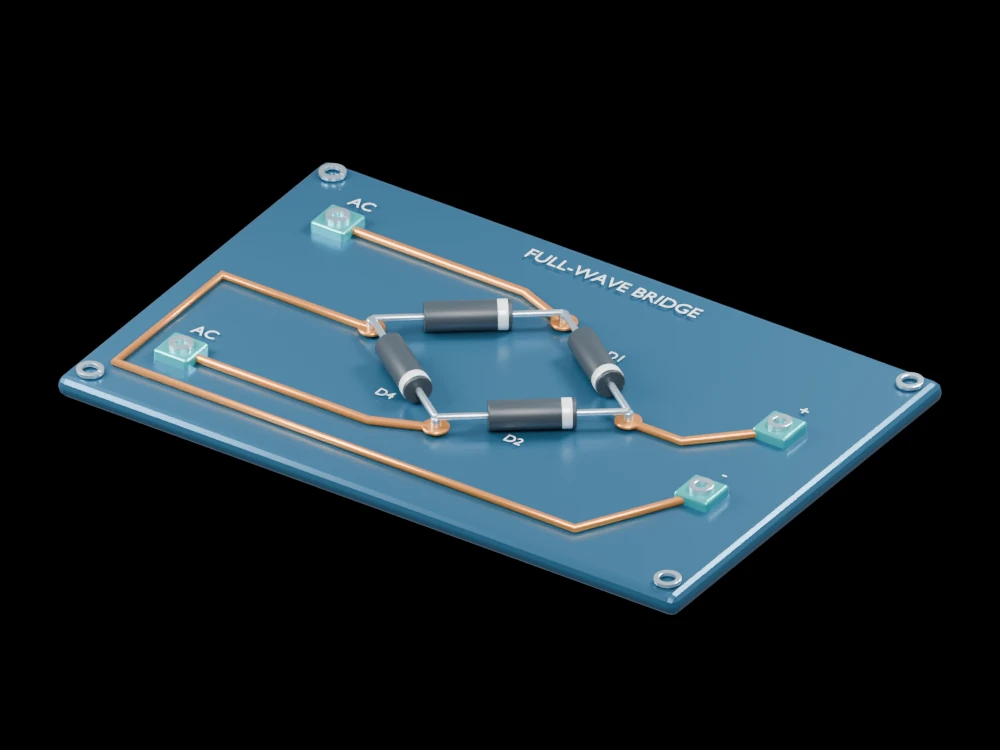
The bridge model illustrates the familiar circuit-level approach to rectification. This article instead asks whether the material itself can supply useful asymmetry. A superconducting full-wave bridge preserves more of the conventional topology while changing the physical element inside it.
Explore the Full-wave bridge rectifier model and its description, or read our earlier device-focused research explanation.
Primary citation: Bin Cheng, Yang Gao, Zhi Zheng et al.. Giant nonlinear Hall and wireless rectification effects at room temperature in the elemental semiconductor tellurium. Nature Communications (2024). 10.1038/s41467-024-49706-y.
Related articles
 A superconducting chip brings full-wave rectification into the coldTin telluride rectifies signals from megahertz to terahertz without external biasA quantum material rectifies signals from radio to terahertz bands
 Boron arsenide draws heat from working GaN transistorsComplementary GaN logic puts both transistor types on one substrateA vibrating resonator helps a DC converter step down voltage efficientlyBuilt-in crystal polarization helps GaN switches withstand higher voltageNanoscale spin rectifiers turn weak radio signals into useful power
 A 100 kW solid-state transformer reaches 98.57% efficiency in testingA magnetic composite tackles eddy-current and hysteresis losses togetherNarrow magnetic domains help an iron-rich ribbon waste less energyMagnetic-domain motion can send energy into the crystal latticeEngineered interfaces let magnetic particles couple without the usual loss penalty
 A rotating magnetic field steers crystallisation toward finer soft magnetsAn alloy becomes mechanically strong while remaining magnetically softTiny manufacturing deformations can disturb the magnetic structure of motor steelNanoprecipitates push ductile soft magnets toward two-gigapascal strengthA two-phase buck converter tackles the light-load efficiency problem
 An electrically heated foam brings heat inside a catalyst bed
 A redesigned magnetic path cuts opening time in a solenoid study