

Power electronics · Research insights
Tin telluride rectifies signals from megahertz to terahertz without external bias
A Nature Nanotechnology study uses the nonlinear Hall effect in SnTe thin films to demonstrate unusually broad-frequency, zero-bias rectification.
Study published: 11 August 2025 · Nature Nanotechnology. Original research commentary by NPT Research.
A rectifier that works well at one frequency can perform poorly at another. Junction capacitance and threshold behaviour become major obstacles when signals are both fast and weak. Researchers explored a material response that produces rectification without relying on the usual diode junction.
Latest breakthrough
The team demonstrated zero-bias rectification in wafer-scale, oriented tin-telluride films from 23 MHz to 1 THz. Measurements reached sensitivity down to −60 dBm in selected radiofrequency bands. A wireless thermistor demonstration showed a practical small-load use of the harvested output.
Read the original study: Ultrabroadband nonlinear Hall rectifier using SnTe.
How the study worked
Angle-dependent transport measurements and first-principles calculations supported a Berry-curvature-dipole explanation of the nonlinear Hall response. The researchers also investigated arrays and rectenna designs. Those tests connect the microscopic electrical response to circuit arrangements that can increase usable output.
The idea in everyday terms
An ordinary symmetric response averages an alternating push to zero. A nonlinear response can leave a nonzero average, much as a differently shaped channel can favour net transport during repeated disturbances. This is a conceptual picture, not a literal fluid model of electron motion or a violation of energy conservation.
Why it matters
A broad operating range could make energy-harvesting and sensing circuits less dependent on one narrow signal band. Material growth over a wafer is also relevant to manufacturability. Room-temperature tellurium rectification shows why understanding the mechanism matters alongside headline bandwidth.
What the evidence does not establish
Broadband operation does not mean uniform efficiency across the entire range. The most sensitive operating points and the sensor demonstration have specific conditions. A thermistor-scale power result should not be described as a wireless supply for household equipment or high-power machinery.
Explore the device
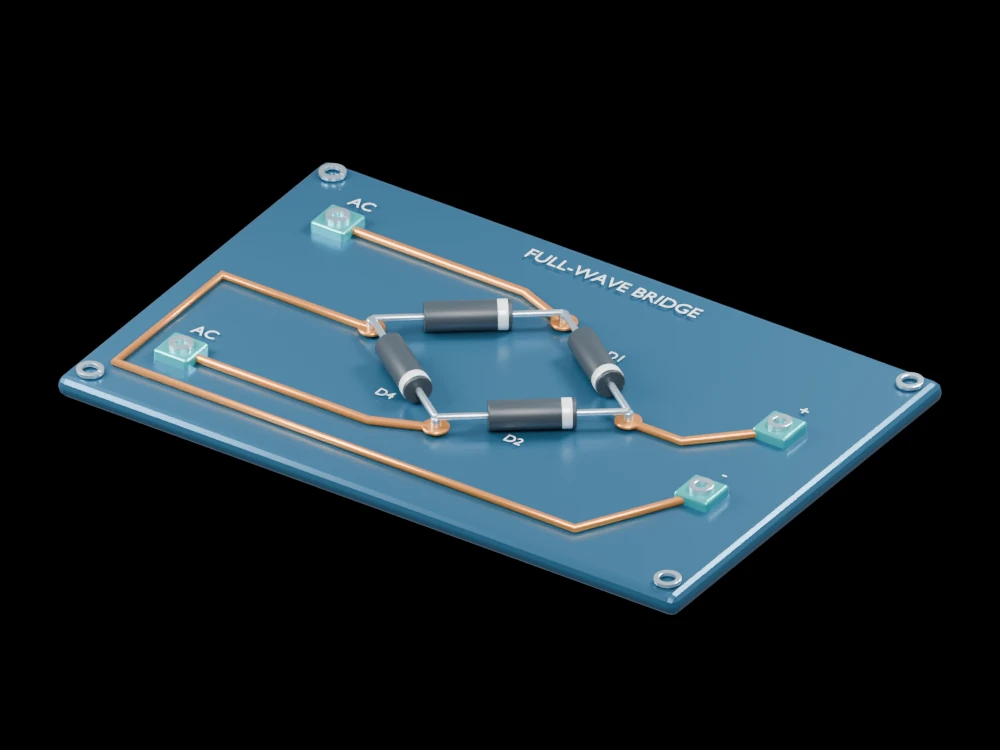
Use the bridge model to identify the conversion objective, then compare the four-junction circuit with a material whose nonlinear response performs the conversion. Spin-based harvesting is another route to small signals, with different magnetic dynamics and circuit constraints.
Explore the Full-wave bridge rectifier model and its description, or read our earlier device-focused research explanation.
Primary citation: Fanrui Hu, Pengnan Zhao, Lihuan Yang et al.. Ultrabroadband nonlinear Hall rectifier using SnTe. Nature Nanotechnology (2025). 10.1038/s41565-025-01993-2.
Related articles
 Nanoscale spin rectifiers turn weak radio signals into useful powerElemental tellurium turns radio signals into a tunable room-temperature outputA quantum material rectifies signals from radio to terahertz bands
 Boron arsenide draws heat from working GaN transistorsComplementary GaN logic puts both transistor types on one substrateA vibrating resonator helps a DC converter step down voltage efficientlyBuilt-in crystal polarization helps GaN switches withstand higher voltageA superconducting chip brings full-wave rectification into the cold
 A 100 kW solid-state transformer reaches 98.57% efficiency in testingA magnetic composite tackles eddy-current and hysteresis losses togetherNarrow magnetic domains help an iron-rich ribbon waste less energyMagnetic-domain motion can send energy into the crystal latticeEngineered interfaces let magnetic particles couple without the usual loss penalty
 A rotating magnetic field steers crystallisation toward finer soft magnetsAn alloy becomes mechanically strong while remaining magnetically softTiny manufacturing deformations can disturb the magnetic structure of motor steelNanoprecipitates push ductile soft magnets toward two-gigapascal strengthA two-phase buck converter tackles the light-load efficiency problem
 An electrically heated foam brings heat inside a catalyst bed
 A redesigned magnetic path cuts opening time in a solenoid study
Explore the models
Sources and further reading
- Ultrabroadband nonlinear Hall rectifier using SnTe Published 11 Aug 2025