

Electromagnetics · Research insights
Magnetic-domain motion can send energy into the crystal lattice
Micromagnetic simulations clarify how magnetostriction contributes to energy loss in nanocrystalline soft magnetic materials.
Study published: 20 May 2022 · NPG Asia Materials. Original research commentary by NPT Research.
A transformer core can heat even when its material is magnetically soft. Understanding the loss requires following energy through more than electrical resistance. A modelling study examined how changing magnetisation interacts with the crystal lattice through magnetostriction.
Latest breakthrough
The researchers developed a micromagnetic formulation for randomly oriented nanocrystallites that includes magnetostriction. Simulations under an oscillating magnetic field showed energy from moving domain walls transferring into elastic energy in the lattice. This exposes a mechanism relevant to the design of low-loss magnetic materials.
Read the original study: Role of magnetostriction on power losses in nanocrystalline soft magnets.
How the study worked
The work calculated the effective magnetic fields associated with magnetostrictive interactions and incorporated them into a simulation program. Random crystal orientations were treated explicitly. Simulated magnetic cycles then allowed the researchers to trace how domain motion and mechanical response interact.
The idea in everyday terms
A vibrating window can take energy from a passing sound wave even without anything striking it directly. Similarly, coupled magnetic and elastic behaviour allows energy to move between different forms. The analogy illustrates coupling; magnetostriction involves microscopic strain associated with magnetisation rather than ordinary sound shaking a pane.
Why it matters
Understanding a loss pathway helps researchers ask better materials-design questions. It complements experimental work on domain-engineered low-loss ribbons and manufacturing-induced magnetic changes. In each case, mechanical and magnetic behaviour cannot be treated as entirely separate.
What the evidence does not establish
This is a simulation-based mechanistic study, not a measurement of a newly manufactured transformer. Its conclusions depend on the model and material assumptions. Quantitative device design still requires relevant experiments and the contribution of other losses.
Explore the device
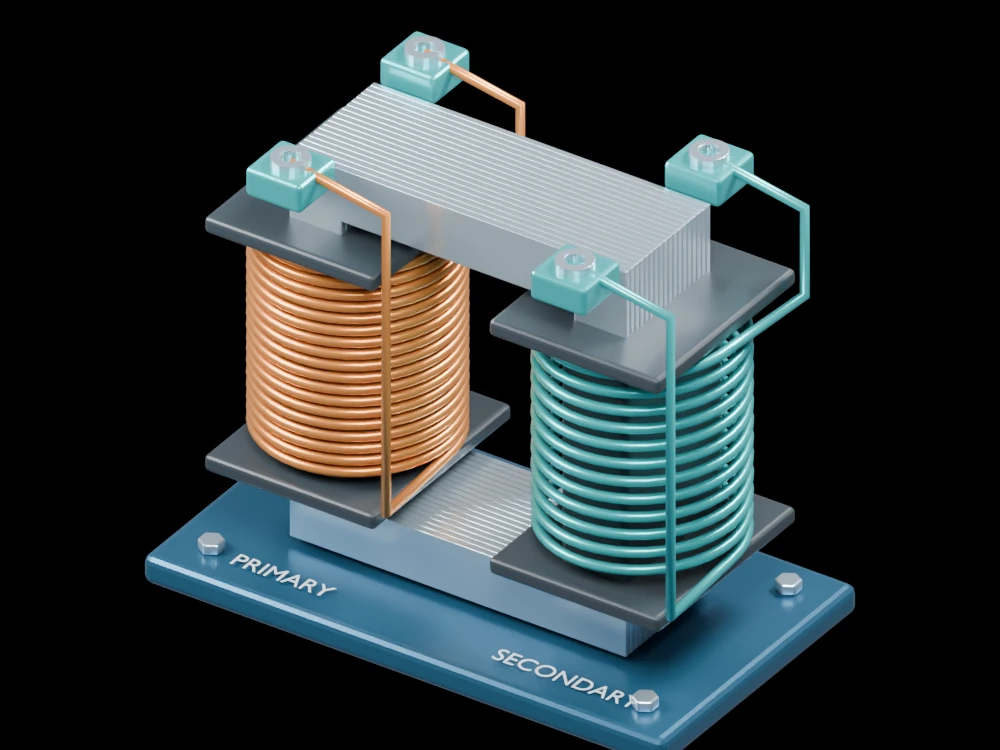
Use the transformer model to identify the core that repeatedly carries changing flux. The paper adds the internal magnetic and elastic processes hidden by that simple geometry. It helps explain why a single specification such as coercivity cannot fully describe how a core behaves during repeated operation.
Explore the Power transformer model and its description, or read our earlier device-focused research explanation.
Primary citation: Hiroshi Tsukahara, Hiroshi Imamura, Chiharu Mitsumata et al.. Role of magnetostriction on power losses in nanocrystalline soft magnets. NPG Asia Materials (2022). 10.1038/s41427-022-00388-2.
Related articles
 Narrow magnetic domains help an iron-rich ribbon waste less energy
 Tiny manufacturing deformations can disturb the magnetic structure of motor steelA 100 kW solid-state transformer reaches 98.57% efficiency in testingA magnetic composite tackles eddy-current and hysteresis losses togetherEngineered interfaces let magnetic particles couple without the usual loss penalty
 Boron arsenide draws heat from working GaN transistorsComplementary GaN logic puts both transistor types on one substrateA vibrating resonator helps a DC converter step down voltage efficientlyBuilt-in crystal polarization helps GaN switches withstand higher voltageA rotating magnetic field steers crystallisation toward finer soft magnets
 Nanoscale spin rectifiers turn weak radio signals into useful powerAn alloy becomes mechanically strong while remaining magnetically softA superconducting chip brings full-wave rectification into the coldElemental tellurium turns radio signals into a tunable room-temperature outputTin telluride rectifies signals from megahertz to terahertz without external biasNanoprecipitates push ductile soft magnets toward two-gigapascal strengthA quantum material rectifies signals from radio to terahertz bandsA two-phase buck converter tackles the light-load efficiency problem
 Physics-guided AI tracks pump cavitation as flow conditions changeMatched motor tests connect higher efficiency with lower heat
 An electrically heated foam brings heat inside a catalyst bed
 Gearbox vibrations reveal clues to efficiency during operation
 A redesigned magnetic path cuts opening time in a solenoid studyDense liquid-metal coils combine soft actuation, sensing and communicationElastic electromagnetic mechanisms give small robots muscle-like motionLiquid-metal networks turn a flat elastomer into programmable 3D surfacesSoft robots steer their shape by combining local electromagnetic vectors
Explore the models
Sources and further reading
- Role of magnetostriction on power losses in nanocrystalline soft magnets Published 20 May 2022