

Electromagnetics · Research insights
Narrow magnetic domains help an iron-rich ribbon waste less energy
Researchers combine nanostructure and magnetic-domain engineering to reduce the core loss of iron-rich soft magnetic ribbons.
Study published: 3 September 2025 · Nature Communications. Original research commentary by NPT Research.
Magnetic material is organised into domains, and those domains change as a transformer or inductor operates. Their motion contributes to energy loss. Researchers investigated how partial crystallisation and internal stress could shape the domains into a more favourable arrangement.
Latest breakthrough
The study reports a 55% core-loss reduction in its comparison, reaching about 75 W/kg at 10 kHz and 1 T. The authors connect the improvement to narrow stripe-shaped domains produced through nanostructure and high-frequency domain engineering in iron-rich ribbons.
Read the original study: Ultra-low core loss in Fe-enriched soft magnetic ribbons enabled by nanostructure and high-frequency domain engineering.
How the study worked
The team controlled partial nanocrystallisation within an amorphous matrix and examined the resulting stress, anisotropy and domain structure. Magnetic-loss measurements at specified frequency and flux density linked the structural changes to performance. The key result is the connection between processing, domain geometry and loss.
The idea in everyday terms
A large crowd changing direction at once can create more disruption than smaller coordinated groups. Magnetic domains are not people, but the analogy helps explain why their size and arrangement can influence the energy needed for repeated change. The exact loss still depends on the material’s electromagnetic behaviour.
Why it matters
Reducing core loss can lessen unwanted heating and create new options for compact magnetic components. The processing strategy complements rotating-field crystallisation control, which influences how fine structures form. Both studies show that composition alone does not determine a soft magnet’s usefulness.
What the evidence does not establish
The 55% reduction belongs to the paper’s comparison and test conditions. It must not be applied directly to household electricity bills or transformer efficiency. Winding losses, operating waveform, cooling and the chosen flux density would change the whole-device result.
Explore the device
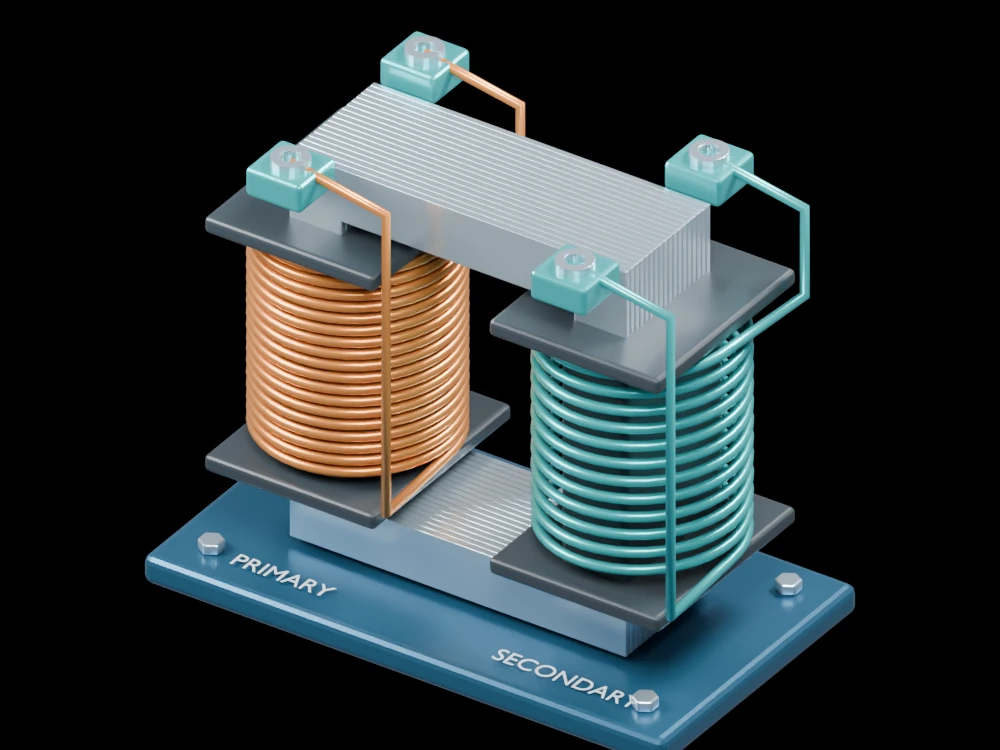
Trace the shared magnetic path in the transformer model and imagine it being driven through repeated cycles. This is the duty that motivates lower-loss core materials. Magnetostriction modelling explains another route through which moving magnetic domains can transfer energy into the material.
Explore the Power transformer model and its description, or read our earlier device-focused research explanation.
Primary citation: Ravi Gautam, Shozo Hiramoto, Nikita Kulesh et al.. Ultra-low core loss in Fe-enriched soft magnetic ribbons enabled by nanostructure and high-frequency domain engineering. Nature Communications (2025). 10.1038/s41467-025-63139-1.
Related articles
 Magnetic-domain motion can send energy into the crystal lattice
 A rotating magnetic field steers crystallisation toward finer soft magnetsA 100 kW solid-state transformer reaches 98.57% efficiency in testingA magnetic composite tackles eddy-current and hysteresis losses togetherEngineered interfaces let magnetic particles couple without the usual loss penalty
 Boron arsenide draws heat from working GaN transistorsComplementary GaN logic puts both transistor types on one substrateA vibrating resonator helps a DC converter step down voltage efficientlyBuilt-in crystal polarization helps GaN switches withstand higher voltage
 Nanoscale spin rectifiers turn weak radio signals into useful powerAn alloy becomes mechanically strong while remaining magnetically softA superconducting chip brings full-wave rectification into the coldElemental tellurium turns radio signals into a tunable room-temperature outputTin telluride rectifies signals from megahertz to terahertz without external biasTiny manufacturing deformations can disturb the magnetic structure of motor steelNanoprecipitates push ductile soft magnets toward two-gigapascal strengthA quantum material rectifies signals from radio to terahertz bandsA two-phase buck converter tackles the light-load efficiency problem
 Physics-guided AI tracks pump cavitation as flow conditions changeMatched motor tests connect higher efficiency with lower heat
 An electrically heated foam brings heat inside a catalyst bed
 Gearbox vibrations reveal clues to efficiency during operation
 A redesigned magnetic path cuts opening time in a solenoid studyDense liquid-metal coils combine soft actuation, sensing and communicationElastic electromagnetic mechanisms give small robots muscle-like motionLiquid-metal networks turn a flat elastomer into programmable 3D surfacesSoft robots steer their shape by combining local electromagnetic vectors