

Power transmission · Research insights
Nanotextured surfaces help graphite maintain an extremely low-friction contact
Researchers stabilise microscale structural superlubricity by controlling how a graphite flake’s edges interact with the opposing surface.
Study published: 22 May 2023 · Nature Communications. Original research commentary by NPT Research.
A very smooth surface does not guarantee low friction. At small scales, the edges of a sliding contact can dominate its behaviour. Researchers found that deliberately structuring the opposing surface could help prevent an important failure route in graphite-based superlubricity.
Latest breakthrough
The team demonstrated low-friction sliding between microscale graphite flakes and nanostructured silicon under ambient conditions. The reported differential friction coefficient was of order 10⁻⁴, with no observable wear in the measurements. Edge warping helped remove unfavourable contact between the flake edge and substrate.
Read the original study: Robust microscale structural superlubricity between graphite and nanostructured surface.
How the study worked
The researchers measured friction and examined the contact configuration on the structured surfaces. Their analysis connected the concentrated force and flake deformation to reduced edge interaction. This made the contact geometry, rather than roughness alone, central to explaining the observed sliding behaviour.
The idea in everyday terms
A sheet can glide across a surface until one corner catches. Lifting that corner can matter more than polishing the entire floor. The graphite experiment involves nanoscale forces and crystalline surfaces, but the analogy explains why a small edge can determine whether the whole contact slides smoothly.
Why it matters
Reliable low-friction contacts could benefit small mechanical systems if they survive realistic loads and environments. The work challenges an overly simple rule that smoother always means better. Hot-alloy self-lubrication reaches a similar engineering goal through surface chemistry rather than this contact geometry.
What the evidence does not establish
The study does not demonstrate a lubricating treatment for ordinary steel gearbox teeth. The dimensions, materials, loads and observed wear interval are specific to the experiments. Scaling the effect to practical bearings or transmissions requires additional evidence.
Explore the device
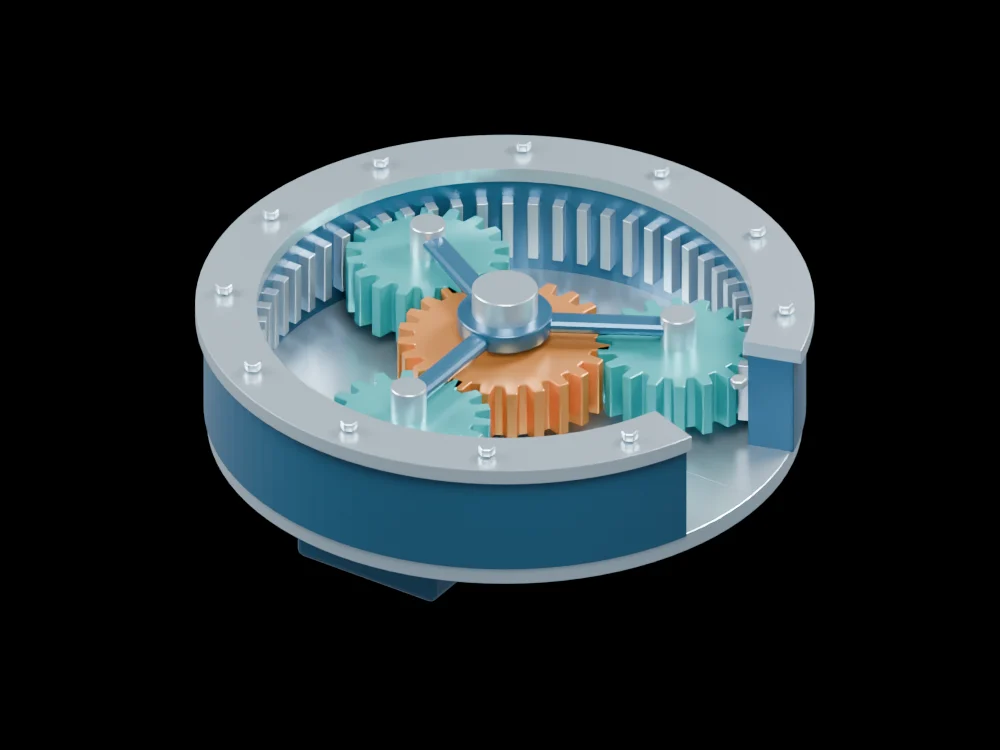
The planetary-gearbox model makes repeated tooth contact easy to see. Use that contact as a starting point for asking where friction originates, then recognise the much smaller and different surfaces studied here. Reconfigurable microgear machines illustrate the kind of small mechanism in which contact control becomes especially consequential.
Explore the Planetary gearbox model and its description, or read our earlier device-focused research explanation.
Primary citation: Xuanyu Huang, Tengfei Li, Jin Wang et al.. Robust microscale structural superlubricity between graphite and nanostructured surface. Nature Communications (2023). 10.1038/s41467-023-38680-6.
Related articles
 Projected light assembles and drives reconfigurable microscopic machinesGearbox vibrations reveal clues to efficiency during operation
 A superalloy’s oxide layer becomes a lubricant at extreme temperaturesLight drives microscopic gear trains through patterned metasurfacesA soft robot arm stays bendable while transmitting continuous torque
 A camera learns the motion map needed to control very different robotsA new representation makes changing robot contacts easier to predict
 Dense liquid-metal coils combine soft actuation, sensing and communication
 A DNA clutch lets a magnetic nanomotor engage and disengage its rotorElastic electromagnetic mechanisms give small robots muscle-like motionElectric current drives a molecular rotor and changes its conductance
 An engineered environment changes a microscopic engine’s power–efficiency trade-offLiquid-metal networks turn a flat elastomer into programmable 3D surfacesMagnetic measurements expose early fatigue changes in tested metalsMicroscopy reveals which internal features hold a permanent magnet’s directionChanging the character of noise shifts a microscopic engine’s best operating speedRobots learn a predictive body model by watching their own movementsA robot can prevent slipping by changing its path instead of only squeezing harderSoft robots steer their shape by combining local electromagnetic vectorsFriction consolidates brittle magnetic powders in a single processing stepSwitching between unstable modes can stabilise a mechanical oscillator
 An accordion-inspired pump recreates complex flow waveformsA stretchable fibre becomes a pump that can be woven into clothingA soft pump runs on energy collected by a triboelectric generatorA soft pump moves liquid without a rotating impellerChanging a motor's magnetic geometry tackles a narrow noise peak
 Correcting encoder signals improves tiny-motion measurementsA modular robot arm succeeds in 91.67% of 240 test trialsA configurable joint reveals how small gaps turn motion into impacts
Explore the models
Sources and further reading
- Robust microscale structural superlubricity between graphite and nanostructured surface Published 22 May 2023