

Automation · Research insights
A new representation makes changing robot contacts easier to predict
Researchers use Koopman operators to organise contact dynamics in an embedded space, enabling real-time predictive control in robot demonstrations.
Study published: 19 June 2026 · Nature Communications. Original research commentary by NPT Research.
A robotic arm behaves differently before and after it touches an object. Sliding, pushing and separating create further changes. These transitions make planning difficult because the controller must anticipate more than one smooth mode of motion.
Latest breakthrough
The researchers used Koopman operators to represent changing contact dynamics in a globally linear embedded model. Their method enabled convex model predictive control in a legged robot and real-time dynamic pushing with a manipulator. Viscoelastic contact provides the physical basis for the representation developed in the study.
Read the original study: Koopman global linearization of contact dynamics for robot locomotion and manipulation enables elaborate control.
How the study worked
The work combines analysis of contact behaviour with a transformed model used by a predictive controller. The controller evaluates future action sequences over horizons containing multiple contact changes. Robot demonstrations test whether this representation supports useful decisions within the available computation time.
The idea in everyday terms
A complicated route can become easier to plan when drawn on a better map. Changing coordinates does not flatten the real hills; it makes their relationships easier to calculate. Likewise, the embedded model simplifies the control calculation without making the physical robot’s contacts literally linear.
Why it matters
Faster, more structured prediction can help robots handle tasks where contact is central. It builds on a different question from learning free-space motion from a camera. A useful body model must eventually be connected to the environment in which that body acts.
What the evidence does not establish
The reported demonstrations do not establish universal control for every collision, material or contact condition. Model assumptions and estimation errors remain important. Linear behaviour in the embedding space should not be confused with the claim that all physical contact dynamics are simple.
Explore the device
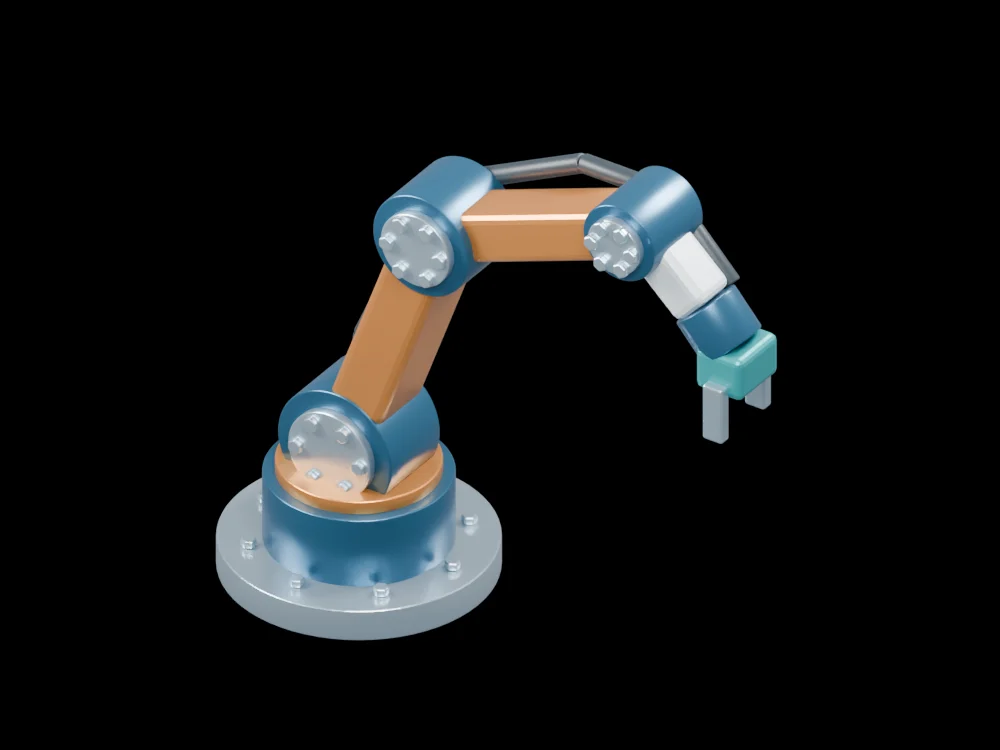
The robotic-arm model helps identify the chain of joints leading to an end effector. This study addresses what happens when that end effector interacts dynamically with an object. Trajectory-based grasp stabilisation offers a complementary example of using prediction to improve contact-rich manipulation.
Explore the Industrial robotic arm model and its description, or read our earlier device-focused research explanation.
Primary citation: C. O’Neill, J. Terrones, H. H. Asada. Koopman global linearization of contact dynamics for robot locomotion and manipulation enables elaborate control. Nature Communications (2026). 10.1038/s41467-026-72485-7.
Related articles
 A camera learns the motion map needed to control very different robotsA robot can prevent slipping by changing its path instead of only squeezing harderA modular robot arm succeeds in 91.67% of 240 test trialsRobots learn a predictive body model by watching their own movements
 Dense liquid-metal coils combine soft actuation, sensing and communication
 A DNA clutch lets a magnetic nanomotor engage and disengage its rotorElastic electromagnetic mechanisms give small robots muscle-like motionElectric current drives a molecular rotor and changes its conductance
 Nanotextured surfaces help graphite maintain an extremely low-friction contactProjected light assembles and drives reconfigurable microscopic machinesLiquid-metal networks turn a flat elastomer into programmable 3D surfacesMicroscopy reveals which internal features hold a permanent magnet’s directionLight drives microscopic gear trains through patterned metasurfacesSoft robots steer their shape by combining local electromagnetic vectorsFriction consolidates brittle magnetic powders in a single processing stepA soft robot arm stays bendable while transmitting continuous torque
 An engineered environment changes a microscopic engine’s power–efficiency trade-offMagnetic measurements expose early fatigue changes in tested metalsChanging the character of noise shifts a microscopic engine’s best operating speedSwitching between unstable modes can stabilise a mechanical oscillator
 Correcting encoder signals improves tiny-motion measurementsGearbox vibrations reveal clues to efficiency during operationA redesigned magnetic path cuts opening time in a solenoid study