

Electromagnetics · Research insights
Soft robots steer their shape by combining local electromagnetic vectors
Researchers use actively controlled electromagnetic contributions within soft robots to obtain varied three-dimensional motion and locomotion.
Study published: 12 January 2023 · Nature Communications. Original research commentary by NPT Research.
Adding more actuators is not the only way to make a robot move in more ways. Another route is to control how the forces already present combine. Researchers investigated soft electromagnetic robots whose local contributions can be redirected and synthesised.
Latest breakthrough
The study introduced self-vectoring electromagnetic soft robots with adjustable internal electromagnetic vectors in actuator subdomains. Demonstrations included three-dimensional shape changes, multiple locomotion modes and rapid transitions between modes in passive magnetic fields.
Read the original study: Self-vectoring electromagnetic soft robots with high operational dimensionality.
How the study worked
The team designed local electromagnetic actuation and coordinated its control across the soft structure. Experiments tested how different combinations produced shape and movement. The approach focuses on the controllable dimensionality of the force system rather than treating every actuator as a fixed-direction source.
The idea in everyday terms
Several rowers can turn a boat by changing the direction and timing of their strokes, even if the number of rowers stays the same. The robot similarly combines local actions into a larger movement. The analogy concerns vector combination; the actual forces arise from electrical currents and magnetic fields.
Why it matters
More adaptable actuation can broaden the behaviour available from a compact soft system. It complements flexible coil construction, which expands the available hardware shapes. Control and structure must work together if a soft robot is to perform more than one carefully arranged motion.
What the evidence does not establish
The reported behaviours depend on the field environment, geometry and control setup. They do not imply unrestricted locomotion or autonomy in arbitrary surroundings. Power supply, heating, load capacity and robustness remain practical constraints.
Explore the device
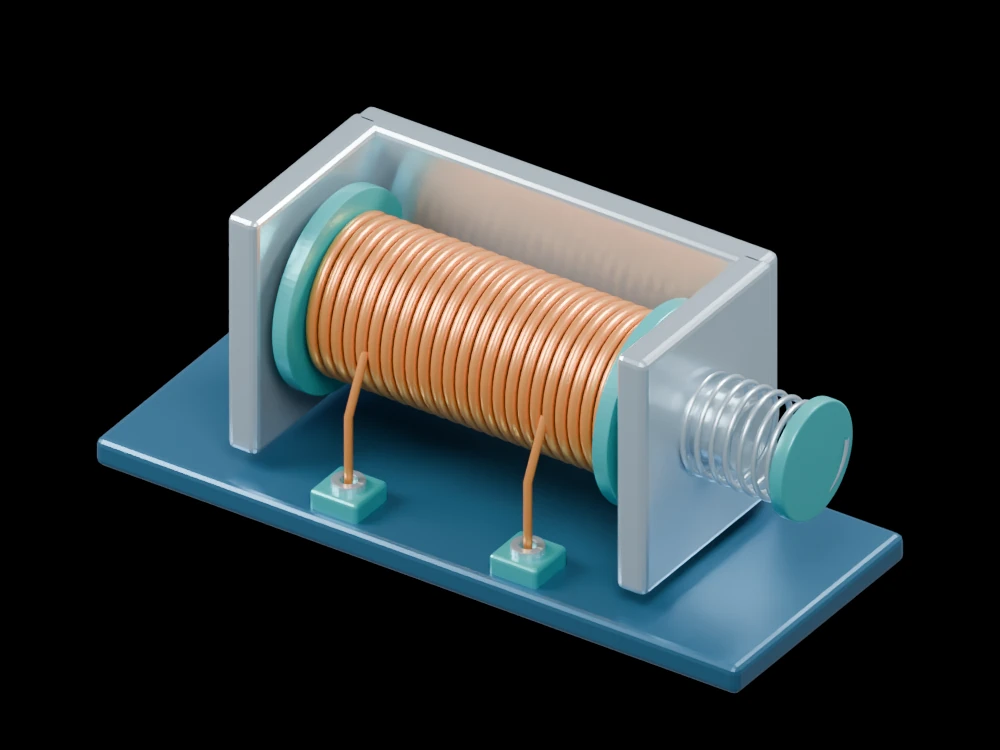
The solenoid model illustrates a predominantly single-axis actuator. This research changes the way multiple electromagnetic contributions are organised to produce richer motion. Muscle-inspired electromagnetic mechanisms provide a different approach based on the interaction between magnetic force and elastic structure.
Explore the Solenoid actuator model and its description, or read our earlier device-focused research explanation.
Primary citation: Wenbo Li, Huyue Chen, Zhiran Yi et al.. Self-vectoring electromagnetic soft robots with high operational dimensionality. Nature Communications (2023). 10.1038/s41467-023-35848-y.
Related articles
 Dense liquid-metal coils combine soft actuation, sensing and communicationElastic electromagnetic mechanisms give small robots muscle-like motionA redesigned magnetic path cuts opening time in a solenoid studyLiquid-metal networks turn a flat elastomer into programmable 3D surfaces
 A camera learns the motion map needed to control very different robotsA new representation makes changing robot contacts easier to predict
 A DNA clutch lets a magnetic nanomotor engage and disengage its rotorElectric current drives a molecular rotor and changes its conductance
 Nanotextured surfaces help graphite maintain an extremely low-friction contactProjected light assembles and drives reconfigurable microscopic machinesMicroscopy reveals which internal features hold a permanent magnet’s directionLight drives microscopic gear trains through patterned metasurfacesRobots learn a predictive body model by watching their own movementsA robot can prevent slipping by changing its path instead of only squeezing harderFriction consolidates brittle magnetic powders in a single processing stepA soft robot arm stays bendable while transmitting continuous torque
 An accordion-inspired pump recreates complex flow waveforms
 An engineered environment changes a microscopic engine’s power–efficiency trade-offA stretchable fibre becomes a pump that can be woven into clothingMagnetic measurements expose early fatigue changes in tested metalsChanging the character of noise shifts a microscopic engine’s best operating speedA soft pump runs on energy collected by a triboelectric generatorA soft pump moves liquid without a rotating impellerSwitching between unstable modes can stabilise a mechanical oscillatorChanging a motor's magnetic geometry tackles a narrow noise peak
 Correcting encoder signals improves tiny-motion measurementsA modular robot arm succeeds in 91.67% of 240 test trialsA configurable joint reveals how small gaps turn motion into impacts
 A magnetic composite tackles eddy-current and hysteresis losses togetherNarrow magnetic domains help an iron-rich ribbon waste less energyMagnetic-domain motion can send energy into the crystal latticeEngineered interfaces let magnetic particles couple without the usual loss penalty
Explore the models
Sources and further reading
- Self-vectoring electromagnetic soft robots with high operational dimensionality Published 12 Jan 2023