

Electrical machines · Research insights
Friction consolidates brittle magnetic powders in a single processing step
A Nature Communications study couples deformation, heating and chemical transformation to consolidate samarium–cobalt powders.
Study published: 13 August 2025 · Nature Communications. Original research commentary by NPT Research.
A powerful magnet is not just a chemical formula. Its usefulness depends on how powders become a dense component with the right internal structure. Brittle magnetic powders complicate that manufacturing process, motivating a route that combines several operations in one step.
Latest breakthrough
The researchers used friction consolidation on samarium–cobalt powders. Deformation and locally generated heat supported densification and chemical transformation without external thermal input. The study links changes in secondary phases and microstructure to changes in magnetic response, offering a compact processing route for brittle powders.
Read the original study: In-situ thermo-mechano-chemical transformation and consolidation of Sm-Co powders via a single-step route for bulk magnet fabrication.
How the study worked
The team examined how local strain and temperature affected consolidation and phase evolution. Materials characterization and magnetic measurements connected the processing conditions to the resulting structure. This is important because a dense-looking part can still contain phases that reduce its intended magnetic performance.
The idea in everyday terms
Making a strong loaf depends on how ingredients are mixed and transformed, not simply on owning the right flour. Magnet manufacture also depends on processing history. The analogy stops at that principle: friction consolidation involves deformation and solid-state chemical reactions, not an organic cooking process.
Why it matters
A more controllable route from powder to magnet could improve manufacturing options for devices that rely on permanent magnetic fields. Microscopy of magnetic pinning centres explains why the internal arrangement matters after consolidation. Both studies connect manufacturing to magnetic function rather than treating a magnet as a uniform block.
What the evidence does not establish
The results do not establish a complete motor, a commercial production cost or a universal energy-saving percentage. Starting powder chemistry, atmosphere and processing conditions affect the outcome. A motor application would require suitable geometry, repeatability and operating-temperature performance.
Explore the device
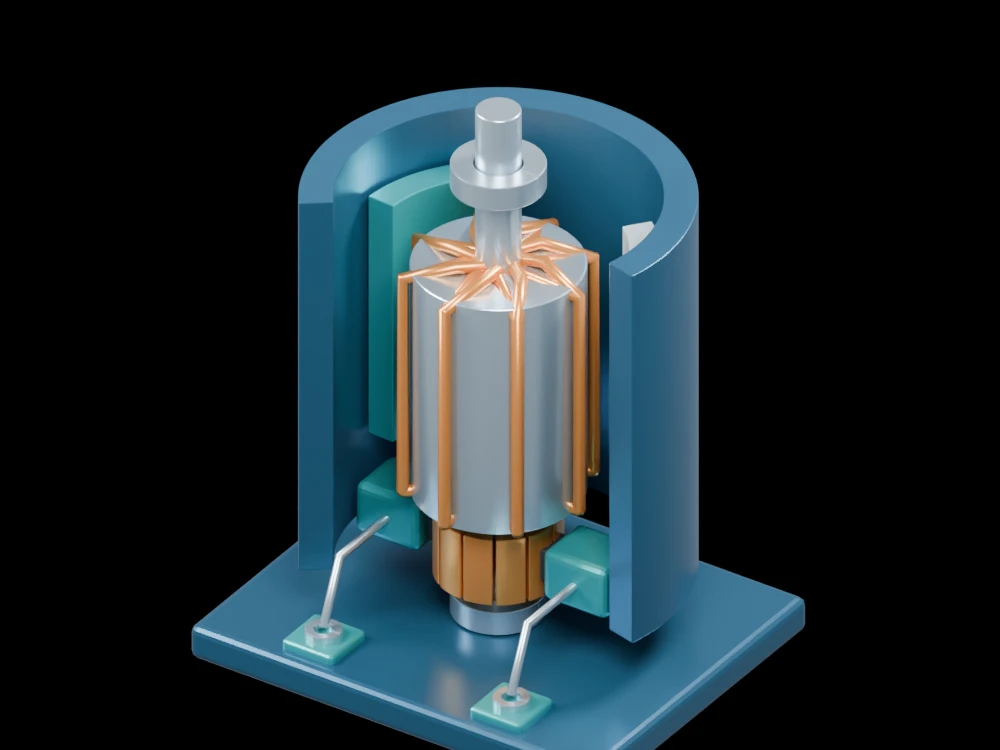
Look at the stationary magnetic parts around the rotor in the brushed DC motor model. The model explains their role in producing torque; this paper addresses how one class of magnetic material can be manufactured. Soft-magnet design provides the contrasting materials problem for parts that must repeatedly change their magnetisation.
Explore the Brushed DC motor model and its description, or read our earlier device-focused research explanation.
Primary citation: Aniruddha Malakar, Andrew Martin, Farhan Ishrak et al.. In-situ thermo-mechano-chemical transformation and consolidation of Sm-Co powders via a single-step route for bulk magnet fabrication. Nature Communications (2025). 10.1038/s41467-025-62804-9.
Related articles
 Microscopy reveals which internal features hold a permanent magnet’s directionChanging a motor's magnetic geometry tackles a narrow noise peak
 An alloy becomes mechanically strong while remaining magnetically softA DNA clutch lets a magnetic nanomotor engage and disengage its rotorElectric current drives a molecular rotor and changes its conductance
 A camera learns the motion map needed to control very different robotsA new representation makes changing robot contacts easier to predict
 Dense liquid-metal coils combine soft actuation, sensing and communicationElastic electromagnetic mechanisms give small robots muscle-like motion
 An engineered environment changes a microscopic engine’s power–efficiency trade-off
 Nanotextured surfaces help graphite maintain an extremely low-friction contactProjected light assembles and drives reconfigurable microscopic machinesLiquid-metal networks turn a flat elastomer into programmable 3D surfacesMagnetic measurements expose early fatigue changes in tested metalsLight drives microscopic gear trains through patterned metasurfacesChanging the character of noise shifts a microscopic engine’s best operating speedRobots learn a predictive body model by watching their own movementsA robot can prevent slipping by changing its path instead of only squeezing harderSoft robots steer their shape by combining local electromagnetic vectorsA soft robot arm stays bendable while transmitting continuous torqueSwitching between unstable modes can stabilise a mechanical oscillator
 An accordion-inspired pump recreates complex flow waveformsA stretchable fibre becomes a pump that can be woven into clothingA soft pump runs on energy collected by a triboelectric generatorA soft pump moves liquid without a rotating impellerGearbox vibrations reveal clues to efficiency during operationA configurable joint reveals how small gaps turn motion into impactsA redesigned magnetic path cuts opening time in a solenoid studyA rotating magnetic field steers crystallisation toward finer soft magnetsTiny manufacturing deformations can disturb the magnetic structure of motor steelNanoprecipitates push ductile soft magnets toward two-gigapascal strength