

Machine mechanisms · Research insights
An engineered environment changes a microscopic engine’s power–efficiency trade-off
A colloidal Stirling-engine experiment adjusts relaxation during selected cycle stages, revealing a bounded route to improved performance.
Study published: 27 October 2023 · Nature Communications. Original research commentary by NPT Research.
Running an engine faster generally leaves less time for its internal processes to settle. That helps explain why more power can come at the cost of efficiency. Researchers tested whether changing how a microscopic engine interacts with its environment could alter this balance.
Latest breakthrough
The team used electrophoretic noise to shorten relaxation during selected constant-volume stages of a colloidal Stirling cycle. Over a range of cycle times, the experiment reversed the usual power–efficiency trend and exceeded its quasi-static reference efficiency. This result belongs to the engineered, nonequilibrium experimental system.
Read the original study: Overcoming power-efficiency tradeoff in a micro heat engine by engineered system-bath interactions.
How the study worked
The researchers controlled the cycle timing and system–bath interaction, then measured work and efficiency across operating rates. Selectively changing the relaxation process allowed them to test a physical intervention rather than merely search for a better timing schedule in an otherwise unchanged engine.
The idea in everyday terms
A production line may be limited by one waiting stage. Making that stage settle faster can improve the whole cycle without speeding every operation equally. The engine analogy concerns relaxation and timing; an engineered noise source also brings an energy-accounting question that a simple queue picture cannot capture.
Why it matters
The study helps explain how small machines behave when their environments are actively engineered. It offers a useful contrast with changing the statistics of reservoir noise. Both show why a thermal environment can be a design variable in microscopic experiments.
What the evidence does not establish
The findings do not violate thermodynamics or establish a free efficiency increase for a car engine. Any complete system assessment must account for the resources used to generate and control the environment. The colloidal device has no conventional piston and crankshaft.
Explore the device
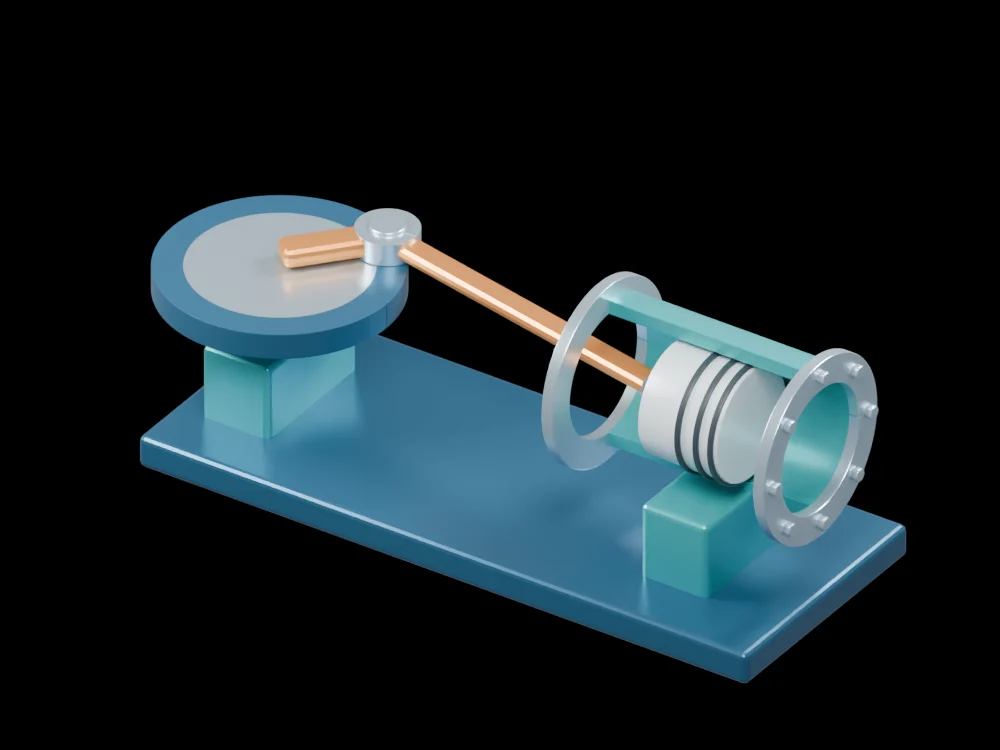
The slider–crank model explains how a macroscopic piston can convert reciprocating motion into rotation. This paper concerns the thermodynamic cycle behind work production at a different scale, not a new crank geometry. The comparison is useful precisely because it separates energy conversion from the mechanism that transmits motion.
Explore the Slider–crank mechanism model and its description, or read our earlier device-focused research explanation.
Primary citation: Sudeesh Krishnamurthy, Rajesh Ganapathy, A. K. Sood. Overcoming power-efficiency tradeoff in a micro heat engine by engineered system-bath interactions. Nature Communications (2023). 10.1038/s41467-023-42350-y.
Related articles
 Changing the character of noise shifts a microscopic engine’s best operating speedA configurable joint reveals how small gaps turn motion into impactsMagnetic measurements expose early fatigue changes in tested metalsSwitching between unstable modes can stabilise a mechanical oscillator
 A DNA clutch lets a magnetic nanomotor engage and disengage its rotorElectric current drives a molecular rotor and changes its conductance
 Nanotextured surfaces help graphite maintain an extremely low-friction contactProjected light assembles and drives reconfigurable microscopic machinesMicroscopy reveals which internal features hold a permanent magnet’s directionLight drives microscopic gear trains through patterned metasurfacesFriction consolidates brittle magnetic powders in a single processing stepA soft robot arm stays bendable while transmitting continuous torqueChanging a motor's magnetic geometry tackles a narrow noise peak
 An accordion-inspired pump recreates complex flow waveforms
 A camera learns the motion map needed to control very different robotsA new representation makes changing robot contacts easier to predict
 Dense liquid-metal coils combine soft actuation, sensing and communicationElastic electromagnetic mechanisms give small robots muscle-like motionA stretchable fibre becomes a pump that can be woven into clothingLiquid-metal networks turn a flat elastomer into programmable 3D surfacesRobots learn a predictive body model by watching their own movementsA robot can prevent slipping by changing its path instead of only squeezing harderA soft pump runs on energy collected by a triboelectric generatorSoft robots steer their shape by combining local electromagnetic vectorsA soft pump moves liquid without a rotating impellerGearbox vibrations reveal clues to efficiency during operation