

Electrical machines · Research insights
Microscopy reveals which internal features hold a permanent magnet’s direction
Multiscale measurements of a samarium–cobalt magnet clarify how copper arrangement and intragranular structure control magnetic-domain pinning.
Study published: 20 December 2025 · Nature Communications. Original research commentary by NPT Research.
A permanent magnet must resist unwanted reversal of its magnetic state. Engineers call that resistance coercivity. Understanding where reversal starts and what stops it can guide design more effectively than treating the entire magnet as one uniform material.
Latest breakthrough
The researchers mapped a samarium–cobalt-based magnet across multiple scales. They found that copper composition and atomic arrangement influence domain pinning. Reversal at grain boundaries could remain local rather than controlling the whole magnet’s coercivity, highlighting the importance of the structure inside the grains.
Read the original study: Identifying grain boundary and intragranular pinning centres in Sm2(Co,Fe,Cu,Zr)17 permanent magnets to guide performance optimisation.
How the study worked
Advanced microscopy and microanalysis were combined with nanoscale magnetic-induction mapping. Micromagnetic simulations tested the interpretation of the observed structures. Comparing regions with different composition helped distinguish a visible boundary effect from the features that govern the bulk magnetic response.
The idea in everyday terms
A door may start to move at one hinge without the entire building opening. In a magnet, a small region can reverse while surrounding structures block further propagation. The useful concept is containment of a change; magnetic domains are collective arrangements of magnetisation, not tiny mechanical doors.
Why it matters
Identifying the influential internal features can help researchers target processing and composition more precisely. This is particularly relevant beside new consolidation methods, which alter those features during manufacture. Better understanding can reduce trial-and-error work even before a new product exists.
What the evidence does not establish
The findings concern the investigated pinning-type magnet and should not be generalised to every permanent-magnet family. They do not show a finished motor with a measured efficiency increase. Changes that improve coercivity must also be balanced with magnetisation, temperature stability and manufacturability.
Explore the device
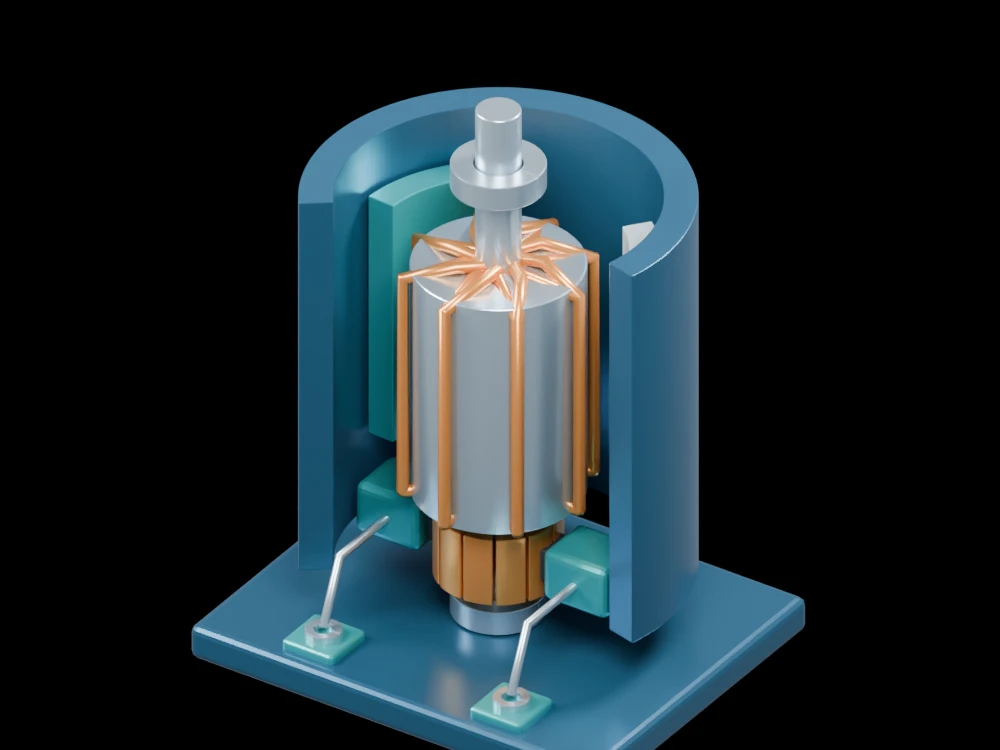
The DC motor model shows why a stable magnetic field is useful around a rotating armature. This paper explains one microscopic basis for that stability. The design objective contrasts with soft magnetic alloys, where easy reversal is deliberately sought to reduce repeated-cycle losses.
Explore the Brushed DC motor model and its description, or read our earlier device-focused research explanation.
Primary citation: Stefan Giron, Nikita Polin, Esmaeil Adabifiroozjaei et al.. Identifying grain boundary and intragranular pinning centres in Sm2(Co,Fe,Cu,Zr)17 permanent magnets to guide performance optimisation. Nature Communications (2025). 10.1038/s41467-025-67773-7.
Related articles
 Friction consolidates brittle magnetic powders in a single processing stepChanging a motor's magnetic geometry tackles a narrow noise peak
 An alloy becomes mechanically strong while remaining magnetically softA DNA clutch lets a magnetic nanomotor engage and disengage its rotorElectric current drives a molecular rotor and changes its conductance
 A camera learns the motion map needed to control very different robotsA new representation makes changing robot contacts easier to predict
 Dense liquid-metal coils combine soft actuation, sensing and communicationElastic electromagnetic mechanisms give small robots muscle-like motion
 An engineered environment changes a microscopic engine’s power–efficiency trade-off
 Nanotextured surfaces help graphite maintain an extremely low-friction contactProjected light assembles and drives reconfigurable microscopic machinesLiquid-metal networks turn a flat elastomer into programmable 3D surfacesMagnetic measurements expose early fatigue changes in tested metalsLight drives microscopic gear trains through patterned metasurfacesChanging the character of noise shifts a microscopic engine’s best operating speedRobots learn a predictive body model by watching their own movementsA robot can prevent slipping by changing its path instead of only squeezing harderSoft robots steer their shape by combining local electromagnetic vectorsA soft robot arm stays bendable while transmitting continuous torqueSwitching between unstable modes can stabilise a mechanical oscillator
 An accordion-inspired pump recreates complex flow waveformsA stretchable fibre becomes a pump that can be woven into clothingA soft pump runs on energy collected by a triboelectric generatorA soft pump moves liquid without a rotating impellerGearbox vibrations reveal clues to efficiency during operationA configurable joint reveals how small gaps turn motion into impactsA redesigned magnetic path cuts opening time in a solenoid studyA rotating magnetic field steers crystallisation toward finer soft magnetsTiny manufacturing deformations can disturb the magnetic structure of motor steelNanoprecipitates push ductile soft magnets toward two-gigapascal strength