

Machine mechanisms · Research insights
Magnetic measurements expose early fatigue changes in tested metals
Researchers connect fatigue-induced magnetic-flux changes to material damage, using a large experimental programme to study life prediction and warning.
Study published: 16 March 2026 · Nature Communications. Original research commentary by NPT Research.
Repeated loading can damage metal long before a large crack becomes visible. Reliable early detection would be valuable in mechanisms that cycle thousands or millions of times. Researchers investigated whether magnetic interactions can amplify subtle signs of that damage.
Latest breakthrough
The study used an external magnetic field to probe fatigue-related changes in ferromagnetic metals. Across 193 samples and more than 3,700 cumulative testing hours, the team related magnetic-flux changes to weakening material interactions. The reported prediction models achieved R² above 0.9 in their evaluation and supported prefracture warning.
Read the original study: High-accuracy fatigue life prediction and early fracture warning for ferromagnetic metals via spin correlation amplification.
How the study worked
Repeated-load experiments supplied the damage history, while magnetic measurements tracked changes associated with fatigue. The analysis connected macroscopic life prediction with microstructural parameters. This combination tested whether an indirect physical signal could carry useful information about a developing mechanical failure.
The idea in everyday terms
A musical instrument can change its tone as a hidden joint loosens. The sound is an indirect clue, not the damage itself. Here the clue is magnetic response. The comparison explains sensing through a coupled property while preserving the need to calibrate that clue against actual damage.
Why it matters
Earlier warning could help maintenance teams investigate problems before fracture in suitable materials and operating conditions. It complements research linking mechanical changes to magnetic texture. Both exploit the connection between structural state and magnetism, although their aims and experiments differ.
What the evidence does not establish
R² is a model-fit measure, not a guarantee of 90% accurate warnings in every machine. The method concerns ferromagnetic metals and the tested loading conditions. Field deployment would need independent validation, false-alarm assessment and reliable access to the relevant component.
Explore the device
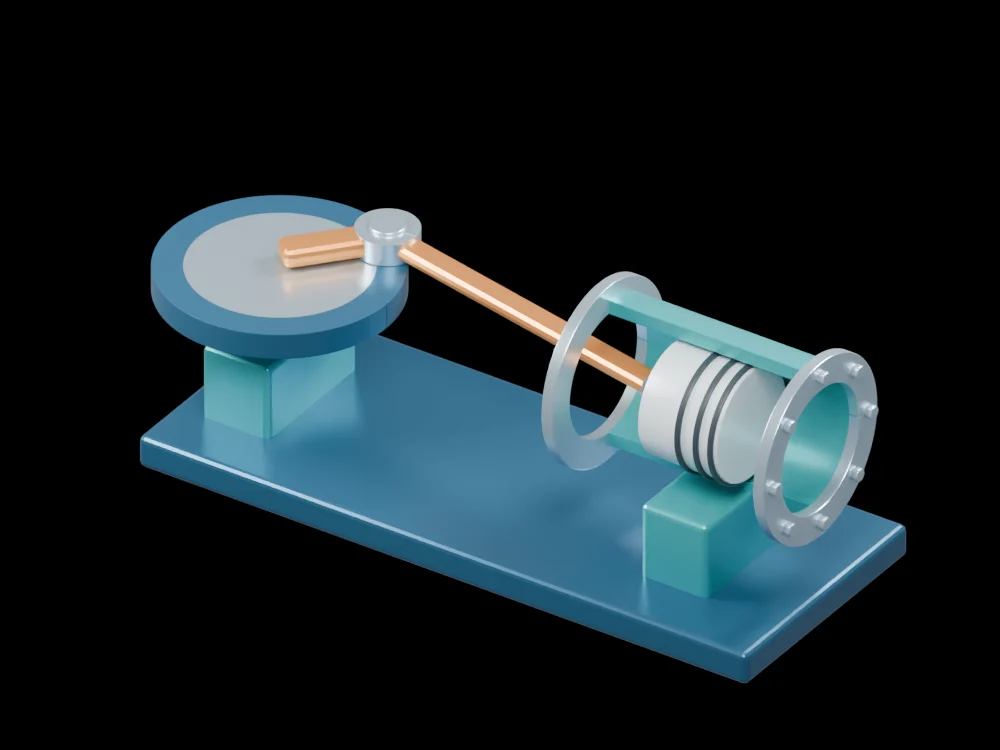
In the slider–crank model, follow the connecting rod and joints through the repeated load path. The paper does not test this gallery mechanism, but it addresses the fatigue-monitoring problem that such mechanisms can present. Oscillator stability research concerns the motion itself rather than the gradual accumulation of material damage.
Explore the Slider–crank mechanism model and its description, or read our earlier device-focused research explanation.
Primary citation: Benniu Zhang, Liangshuo Zhang, Xiaodong Wu et al.. High-accuracy fatigue life prediction and early fracture warning for ferromagnetic metals via spin correlation amplification. Nature Communications (2026). 10.1038/s41467-026-70290-w.
Related articles
 Switching between unstable modes can stabilise a mechanical oscillatorA configurable joint reveals how small gaps turn motion into impacts
 Tiny manufacturing deformations can disturb the magnetic structure of motor steelAn engineered environment changes a microscopic engine’s power–efficiency trade-offChanging the character of noise shifts a microscopic engine’s best operating speed
 A DNA clutch lets a magnetic nanomotor engage and disengage its rotorElectric current drives a molecular rotor and changes its conductance
 Nanotextured surfaces help graphite maintain an extremely low-friction contactProjected light assembles and drives reconfigurable microscopic machinesMicroscopy reveals which internal features hold a permanent magnet’s directionLight drives microscopic gear trains through patterned metasurfacesFriction consolidates brittle magnetic powders in a single processing stepA soft robot arm stays bendable while transmitting continuous torqueChanging a motor's magnetic geometry tackles a narrow noise peak
 An accordion-inspired pump recreates complex flow waveforms
 A camera learns the motion map needed to control very different robotsA new representation makes changing robot contacts easier to predict
 Dense liquid-metal coils combine soft actuation, sensing and communicationElastic electromagnetic mechanisms give small robots muscle-like motionA stretchable fibre becomes a pump that can be woven into clothingLiquid-metal networks turn a flat elastomer into programmable 3D surfacesRobots learn a predictive body model by watching their own movementsA robot can prevent slipping by changing its path instead of only squeezing harderA soft pump runs on energy collected by a triboelectric generatorSoft robots steer their shape by combining local electromagnetic vectorsA soft pump moves liquid without a rotating impellerGearbox vibrations reveal clues to efficiency during operation