

Power transmission · Research insights
Light drives microscopic gear trains through patterned metasurfaces
Researchers integrate optical driving structures with tiny gears, demonstrating gear trains and rack-and-pinion motion on a chip.
Study published: 20 August 2025 · Nature Communications. Original research commentary by NPT Research.
A tiny gear is not a useful machine unless something can drive it and transfer its motion reliably. As mechanisms shrink, attaching conventional motors becomes difficult. Researchers addressed that coupling problem by building optical driving structures directly into microscopic components.
Latest breakthrough
The study demonstrated gear trains powered by a driving gear containing a metasurface activated by a plane light wave. The machines reached sizes of tens of micrometres, with sub-micrometre motion precision. Rack-and-pinion devices converted rotation into other movements and controlled microscopic mirrors.
Read the original study: Microscopic geared metamachines.
How the study worked
The team combined lithographic fabrication with optical metasurface design, then tested the resulting mechanical assemblies. Light supplied the driving input locally, while contacting gears transmitted motion. The experiments examined coordinated machine functions rather than only the movement of an isolated particle.
The idea in everyday terms
A rooftop solar panel supplies electricity to a motor, whereas this system couples light directly to a specially patterned moving component. The familiar gear train then passes motion onward. This comparison separates the optical drive from the mechanical transmission without implying that the device is a miniature solar-powered household machine.
Why it matters
Integrated driving could help make small mechanisms easier to fabricate and combine on a chip. The significance is the assembly of useful functions: rotation, transmission and motion conversion. Optoelectronic-tweezer machines take a different approach to arranging and driving microscopic gears.
What the evidence does not establish
The demonstrations do not establish the load capacity or service life of an industrial gearbox. Optical access, friction, fabrication tolerances and the working environment still matter. Precision at small scale should not be confused with the ability to transmit large mechanical power.
Explore the device
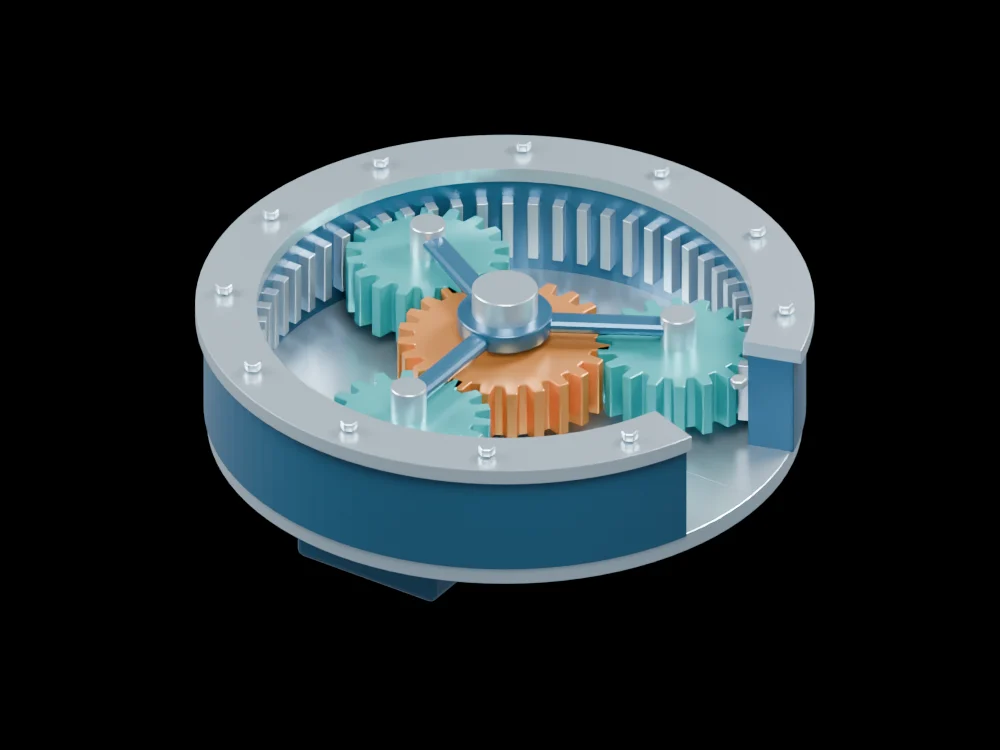
The planetary-gearbox model shows how tooth contact transfers motion among several parts. It is a teaching reference for transmission principles, not the same geometry as the optical devices. Compliant torque-transmitting joints show another way to preserve a machine function while changing the structure that performs it.
Explore the Planetary gearbox model and its description, or read our earlier device-focused research explanation.
Primary citation: Gan Wang, Marcel Rey, Antonio Ciarlo et al.. Microscopic geared metamachines. Nature Communications (2025). 10.1038/s41467-025-62869-6.
Related articles
 Projected light assembles and drives reconfigurable microscopic machinesA soft robot arm stays bendable while transmitting continuous torqueGearbox vibrations reveal clues to efficiency during operationNanotextured surfaces help graphite maintain an extremely low-friction contact
 A camera learns the motion map needed to control very different robotsA new representation makes changing robot contacts easier to predict
 Dense liquid-metal coils combine soft actuation, sensing and communication
 A DNA clutch lets a magnetic nanomotor engage and disengage its rotorElastic electromagnetic mechanisms give small robots muscle-like motionElectric current drives a molecular rotor and changes its conductance
 An engineered environment changes a microscopic engine’s power–efficiency trade-offLiquid-metal networks turn a flat elastomer into programmable 3D surfacesMagnetic measurements expose early fatigue changes in tested metalsMicroscopy reveals which internal features hold a permanent magnet’s directionChanging the character of noise shifts a microscopic engine’s best operating speedRobots learn a predictive body model by watching their own movementsA robot can prevent slipping by changing its path instead of only squeezing harderSoft robots steer their shape by combining local electromagnetic vectorsFriction consolidates brittle magnetic powders in a single processing stepSwitching between unstable modes can stabilise a mechanical oscillator
 An accordion-inspired pump recreates complex flow waveformsA stretchable fibre becomes a pump that can be woven into clothingA soft pump runs on energy collected by a triboelectric generatorA soft pump moves liquid without a rotating impellerChanging a motor's magnetic geometry tackles a narrow noise peak
 Correcting encoder signals improves tiny-motion measurementsA modular robot arm succeeds in 91.67% of 240 test trialsA configurable joint reveals how small gaps turn motion into impacts
Explore the models
Sources and further reading
- Microscopic geared metamachines Published 20 Aug 2025