

Machine mechanisms · Research insights
Switching between unstable modes can stabilise a mechanical oscillator
A Nature Communications study combines theory and a beam experiment to demonstrate stability without a stable mode or stable average.
Study published: 10 March 2026 · Nature Communications. Original research commentary by NPT Research.
A mechanism that is unstable in every fixed setting seems unlikely to become stable simply by switching settings. Dynamic systems can behave less intuitively. Researchers demonstrated an oscillator whose time-dependent operation creates stable windows despite the instability of its individual modes.
Latest breakthrough
The study analysed a modified Meissner oscillator with square-wave modulation of stiffness and damping. Both switched modes and their average were unstable, yet compact antiresonance windows enabled dynamic stabilisation. A cantilever-beam experiment with magnetic and aerodynamic forcing provided supporting evidence.
Read the original study: Dynamic stabilization of a mechanical oscillator in the absence of any stable feature.
How the study worked
Theoretical analysis established the stability windows, and the experimental oscillator tested the prediction. Modulating both stiffness and damping allowed the researchers to examine a case beyond the familiar explanation based on alternating stable and unstable configurations.
The idea in everyday terms
Balancing a moving object often depends on the timing of corrections rather than the quality of any frozen posture. The analogy explains why a sequence must be analysed as a sequence. It is not a recipe for stabilising any machine by arbitrary switching; the mathematical timing and system response are essential.
Why it matters
The work expands the range of dynamic mechanisms engineers can investigate in structures and robots. It is conceptually related to cycle-dependent engine behaviour, where averaging away the sequence also loses important information. The practical value begins with better models of timed operation.
What the evidence does not establish
The demonstrated stability windows belong to the analysed and tested oscillator. They do not establish unlimited robustness to disturbance, delay or parameter error. Active modulation also requires a physical implementation and an energy source; stability is not obtained without system constraints.
Explore the device
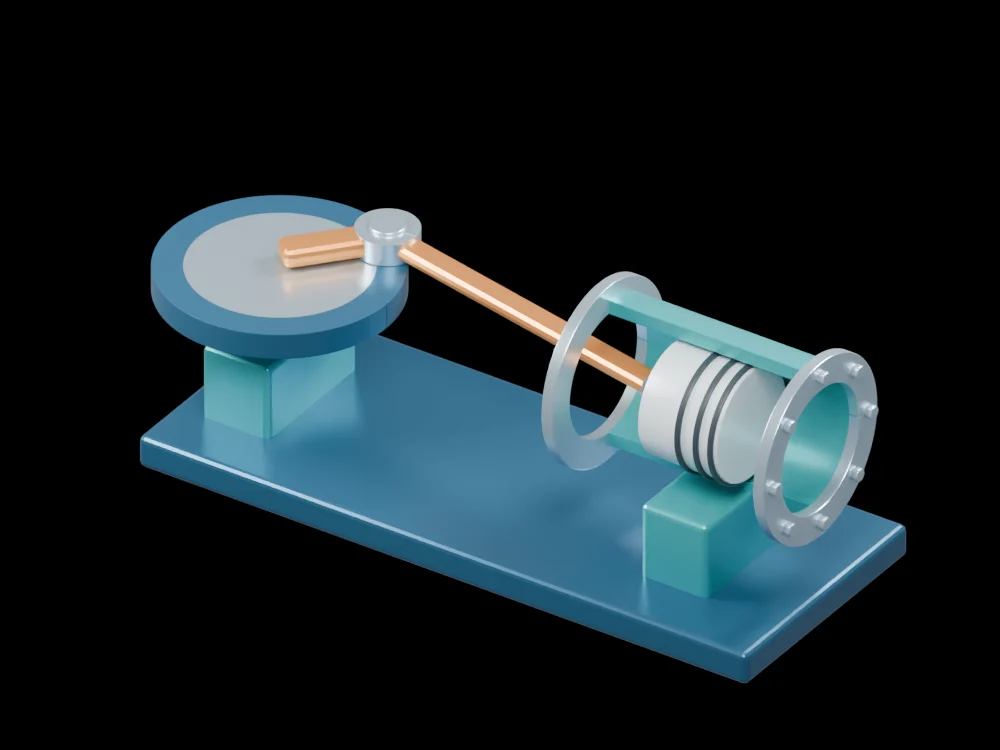
The slider–crank model offers a familiar periodic mechanism whose forces vary through a cycle. This paper investigates a different oscillator, so it should be used to understand dynamic stability rather than to infer a new crankshaft design. Fatigue monitoring addresses another consequence of repeated mechanical operation.
Explore the Slider–crank mechanism model and its description, or read our earlier device-focused research explanation.
Primary citation: David Xiedeng, Paolo Celli, Maurizio Porfiri. Dynamic stabilization of a mechanical oscillator in the absence of any stable feature. Nature Communications (2026). 10.1038/s41467-026-70493-1.
Related articles
 An engineered environment changes a microscopic engine’s power–efficiency trade-offMagnetic measurements expose early fatigue changes in tested metalsA configurable joint reveals how small gaps turn motion into impactsChanging the character of noise shifts a microscopic engine’s best operating speed
 A DNA clutch lets a magnetic nanomotor engage and disengage its rotorElectric current drives a molecular rotor and changes its conductance
 Nanotextured surfaces help graphite maintain an extremely low-friction contactProjected light assembles and drives reconfigurable microscopic machinesMicroscopy reveals which internal features hold a permanent magnet’s directionLight drives microscopic gear trains through patterned metasurfacesFriction consolidates brittle magnetic powders in a single processing stepA soft robot arm stays bendable while transmitting continuous torqueChanging a motor's magnetic geometry tackles a narrow noise peak
 An accordion-inspired pump recreates complex flow waveforms
 A camera learns the motion map needed to control very different robotsA new representation makes changing robot contacts easier to predict
 Dense liquid-metal coils combine soft actuation, sensing and communicationElastic electromagnetic mechanisms give small robots muscle-like motionA stretchable fibre becomes a pump that can be woven into clothingLiquid-metal networks turn a flat elastomer into programmable 3D surfacesRobots learn a predictive body model by watching their own movementsA robot can prevent slipping by changing its path instead of only squeezing harderA soft pump runs on energy collected by a triboelectric generatorSoft robots steer their shape by combining local electromagnetic vectorsA soft pump moves liquid without a rotating impellerGearbox vibrations reveal clues to efficiency during operation
Explore the models
Sources and further reading
- Dynamic stabilization of a mechanical oscillator in the absence of any stable feature Published 10 Mar 2026