

Automation · Research insights
A robot can prevent slipping by changing its path instead of only squeezing harder
Researchers show how predictive trajectory adjustment can improve grasp stability in selected manipulation tasks.
Study published: 22 July 2025 · Nature Machine Intelligence. Original research commentary by NPT Research.
When an object begins to slip, increasing grip force seems like the obvious response. But excessive force can be undesirable, and motion itself helps determine the forces on the object. Researchers investigated changing the trajectory as another way to stabilise a grasp.
Latest breakthrough
The study compared trajectory-based slip control with conventional grip-force adjustment. In specific tested scenarios, changing the motion performed better. A data-driven, action-conditioned forward model within model predictive control helped choose motions that reduced the likelihood of slip.
Read the original study: Bioinspired trajectory modulation for effective slip control in robot manipulation.
How the study worked
The researchers developed and compared control policies under manipulation conditions. The predictive model estimated consequences of candidate actions, allowing the controller to adjust movement before completing the task. The comparison isolates a different control variable: how the object is moved, rather than only how firmly it is held.
The idea in everyday terms
Carrying a full cup smoothly can prevent spilling more effectively than gripping it harder. Slip is not the same phenomenon as spilling, but the example explains why acceleration and trajectory matter. The useful lesson is to change the action that creates the disturbance instead of responding only at the contact.
Why it matters
This expands the design space for handling delicate or uncertain objects. It also complements mechanically compliant robot arms, which manage interaction through hardware. Reliable manipulation may need both suitable physical compliance and well-chosen motion.
What the evidence does not establish
Trajectory modulation did not replace grip-force control in every situation. The result depends on the task, contact and predictive model. It should not be presented as permission to ignore adequate gripping force or friction when designing a manipulator.
Explore the device
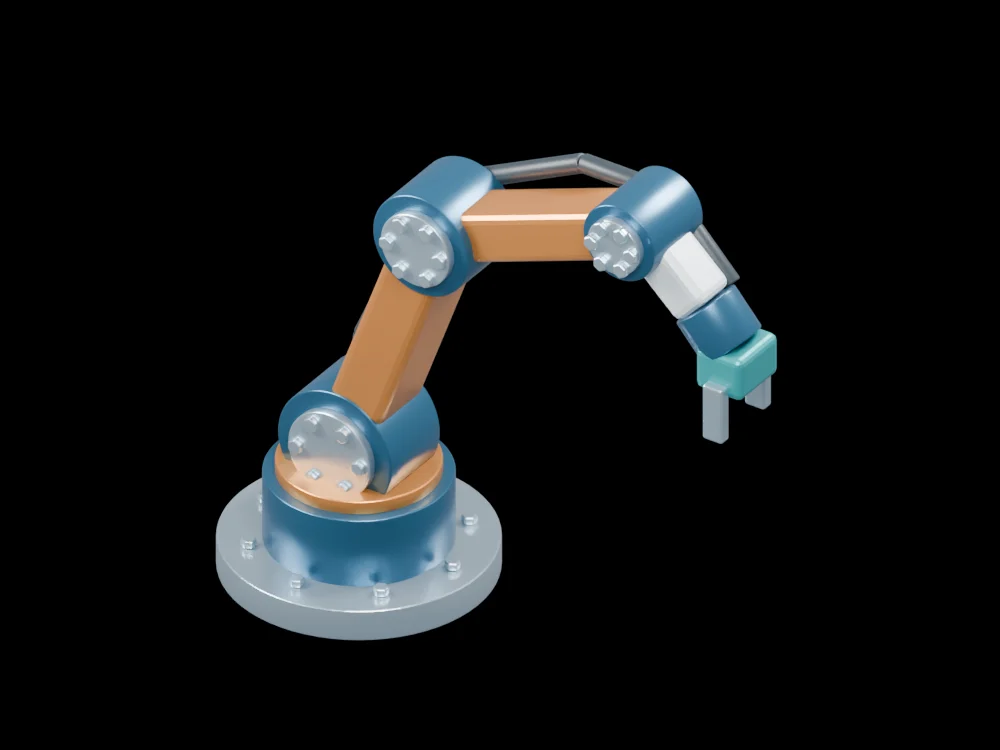
In the robotic-arm model, the gripper’s path is produced by coordinated motion of several joints. This paper explains why that path affects the object as well as the robot. Predictive control across contact changes addresses another aspect of the same interaction problem.
Explore the Industrial robotic arm model and its description, or read our earlier device-focused research explanation.
Primary citation: Kiyanoush Nazari, Willow Mandil, Marco Santello et al.. Bioinspired trajectory modulation for effective slip control in robot manipulation. Nature Machine Intelligence (2025). 10.1038/s42256-025-01062-2.
Related articles
 A new representation makes changing robot contacts easier to predict
 A soft robot arm stays bendable while transmitting continuous torqueA modular robot arm succeeds in 91.67% of 240 test trialsA camera learns the motion map needed to control very different robotsRobots learn a predictive body model by watching their own movements
 Dense liquid-metal coils combine soft actuation, sensing and communication
 A DNA clutch lets a magnetic nanomotor engage and disengage its rotorElastic electromagnetic mechanisms give small robots muscle-like motionElectric current drives a molecular rotor and changes its conductanceNanotextured surfaces help graphite maintain an extremely low-friction contactProjected light assembles and drives reconfigurable microscopic machinesLiquid-metal networks turn a flat elastomer into programmable 3D surfacesMicroscopy reveals which internal features hold a permanent magnet’s directionLight drives microscopic gear trains through patterned metasurfacesSoft robots steer their shape by combining local electromagnetic vectorsFriction consolidates brittle magnetic powders in a single processing step
 An engineered environment changes a microscopic engine’s power–efficiency trade-offMagnetic measurements expose early fatigue changes in tested metalsChanging the character of noise shifts a microscopic engine’s best operating speedSwitching between unstable modes can stabilise a mechanical oscillator
 Correcting encoder signals improves tiny-motion measurementsGearbox vibrations reveal clues to efficiency during operationA redesigned magnetic path cuts opening time in a solenoid study
Explore the models
Sources and further reading
- Bioinspired trajectory modulation for effective slip control in robot manipulation Published 22 Jul 2025