

Power transmission · Research insights
Projected light assembles and drives reconfigurable microscopic machines
Optoelectronic tweezers coordinate microgears, torque and speed amplifiers, and rack-and-pinion valves in a Nature Communications study.
Study published: 9 September 2021 · Nature Communications. Original research commentary by NPT Research.
Shrinking a machine creates two problems at once: its parts must be fabricated, and those parts must be positioned and driven. Optoelectronic tweezers offer a way to organise motion using patterns of light instead of fixed mechanical connections to a large external motor.
Latest breakthrough
The researchers used circular microgears as building blocks for several functions. Demonstrations included multi-component gear trains that amplified torque or speed, a micro-feed-roller for controlled particle trajectories, and rack-and-pinion structures acting as microfluidic valves.
Read the original study: Reconfigurable multi-component micromachines driven by optoelectronic tweezers.
How the study worked
The team used optoelectronic-tweezer actuation to manipulate and drive the components, then assembled them into functional combinations. Testing these combinations showed how a single component concept could support different mechanical tasks through arrangement and control.
The idea in everyday terms
Think of a tabletop construction kit whose drive instructions can be changed by projecting a new pattern. The analogy captures reconfiguration, but the actual actuation relies on electrically mediated forces produced by the optoelectronic system. Light is part of the control mechanism, not an invisible rigid tool pushing each gear.
Why it matters
Reconfigurability can make a miniature machine useful for more than one fixed task. It also provides a route to exploring assemblies before committing to permanent layouts. Metasurface-driven gear trains offer a complementary approach in which optical driving structures are integrated with the moving parts.
What the evidence does not establish
The results are demonstrations in the experimental platform, not evidence that arbitrary microscopic objects can be controlled in any environment. Optical, electrical and fluidic conditions constrain operation. Torque or speed amplification also involves trade-offs; a gear arrangement does not multiply energy.
Explore the device
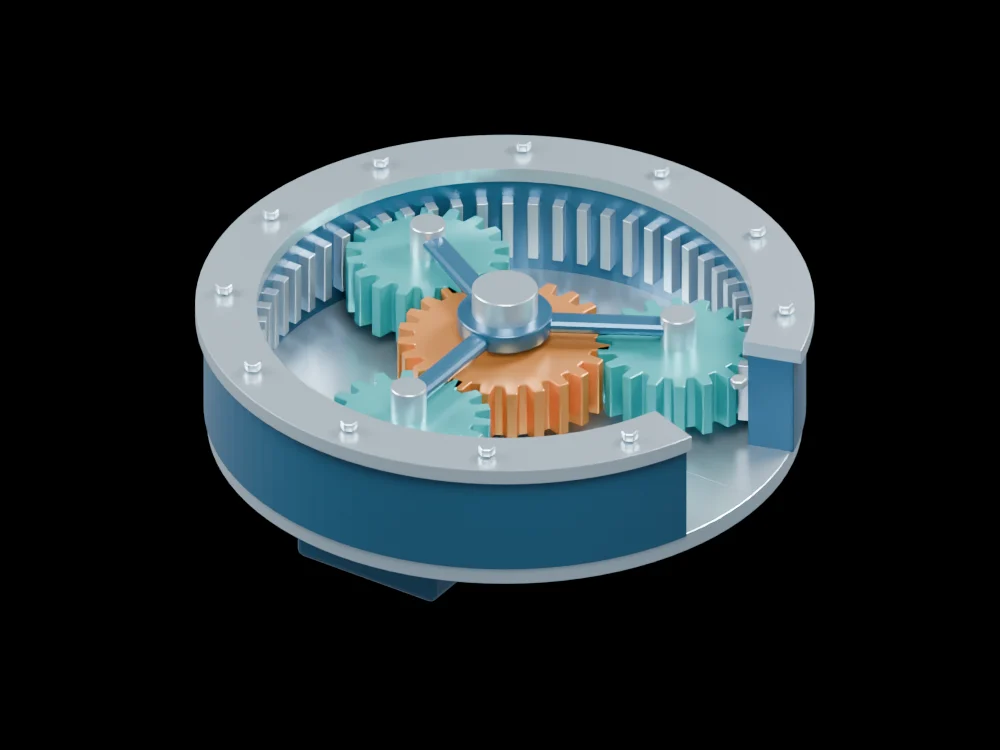
In the planetary-gearbox model, holding or driving different members changes the motion relationship. That familiar idea helps explain why combining microgears produces new functions. Soft torque-transmitting joints extend the same lesson: the arrangement of mechanical elements can matter as much as the choice of material.
Explore the Planetary gearbox model and its description, or read our earlier device-focused research explanation.
Primary citation: Shuailong Zhang, Mohamed Elsayed, Ran Peng et al.. Reconfigurable multi-component micromachines driven by optoelectronic tweezers. Nature Communications (2021). 10.1038/s41467-021-25582-8.
Related articles
 Light drives microscopic gear trains through patterned metasurfacesA soft robot arm stays bendable while transmitting continuous torqueGearbox vibrations reveal clues to efficiency during operationNanotextured surfaces help graphite maintain an extremely low-friction contact
 A camera learns the motion map needed to control very different robotsA new representation makes changing robot contacts easier to predict
 Dense liquid-metal coils combine soft actuation, sensing and communication
 A DNA clutch lets a magnetic nanomotor engage and disengage its rotorElastic electromagnetic mechanisms give small robots muscle-like motionElectric current drives a molecular rotor and changes its conductance
 An engineered environment changes a microscopic engine’s power–efficiency trade-offLiquid-metal networks turn a flat elastomer into programmable 3D surfacesMagnetic measurements expose early fatigue changes in tested metalsMicroscopy reveals which internal features hold a permanent magnet’s directionChanging the character of noise shifts a microscopic engine’s best operating speedRobots learn a predictive body model by watching their own movementsA robot can prevent slipping by changing its path instead of only squeezing harderSoft robots steer their shape by combining local electromagnetic vectorsFriction consolidates brittle magnetic powders in a single processing stepSwitching between unstable modes can stabilise a mechanical oscillator
 An accordion-inspired pump recreates complex flow waveformsA stretchable fibre becomes a pump that can be woven into clothingA soft pump runs on energy collected by a triboelectric generatorA soft pump moves liquid without a rotating impellerChanging a motor's magnetic geometry tackles a narrow noise peak
 Correcting encoder signals improves tiny-motion measurementsA modular robot arm succeeds in 91.67% of 240 test trialsA configurable joint reveals how small gaps turn motion into impacts
Explore the models
Sources and further reading
- Reconfigurable multi-component micromachines driven by optoelectronic tweezers Published 9 Sept 2021