

Electromagnetics · Research insights
Elastic electromagnetic mechanisms give small robots muscle-like motion
A Nature Communications study combines magnetic actuation and elastic structure to demonstrate low-voltage contraction and several locomotion modes.
Study published: 24 July 2025 · Nature Communications. Original research commentary by NPT Research.
Small autonomous robots have little room for heavy motors, complex supplies or large transmissions. A useful actuator must combine force, movement and manageable power requirements. Researchers designed an electromagnetic mechanism whose elastic structure contributes directly to its operation.
Latest breakthrough
The study reported muscle-like contraction with a large contraction ratio, rapid response and operation below 4 V in its tests. Stable states could be maintained without continuous power input. Insect-scale prototypes demonstrated crawling, swimming and jumping using the elasto-electromagnetic mechanism.
Read the original study: Muscle-inspired elasto-electromagnetic mechanism in autonomous insect robots.
How the study worked
The team structured elastomeric materials to interact with electromagnetic forces, then characterized the resulting actuation. Integrating the mechanism into small robots tested whether its force and deformation could produce useful locomotion. The demonstrations connect component behaviour to complete moving prototypes.
The idea in everyday terms
A spring-assisted latch can hold a position after the initial push has ended. Similarly, an elastic structure can help an actuator retain a state instead of demanding continuous effort. The analogy explains mechanical assistance; transitions, sensing and locomotion still require energy.
Why it matters
The work shows how material structure can reduce the burden on the electrical drive. It complements vector-controlled soft robots, which obtain varied motion through coordinated local forces. The two approaches address different aspects of making electromagnetic actuation more adaptable.
What the evidence does not establish
Low operating voltage is not the same as low total power or guaranteed safety in every setting. The reported force, frequency and contraction values describe tested conditions and should not be assumed to coincide at one operating point. Application-specific endurance and load testing remain necessary.
Explore the device
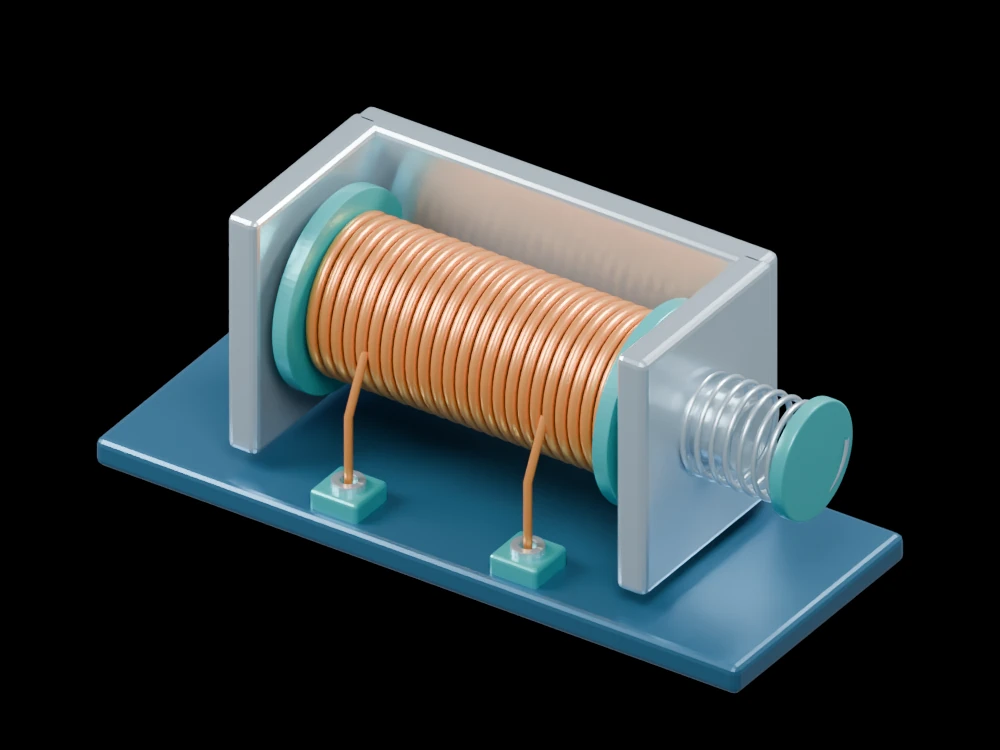
The solenoid model shows the conventional coil-and-moving-part arrangement. This study adds elastic structure as an active design element instead of treating it only as a return spring. Compliant torque-transmitting joints illustrate the wider principle that carefully designed flexibility can contribute useful machine function.
Explore the Solenoid actuator model and its description, or read our earlier device-focused research explanation.
Primary citation: Changyu Xu, Yajun Cao, Jingyang Zhao et al.. Muscle-inspired elasto-electromagnetic mechanism in autonomous insect robots. Nature Communications (2025). 10.1038/s41467-025-62182-2.
Related articles
 Soft robots steer their shape by combining local electromagnetic vectors
 A soft robot arm stays bendable while transmitting continuous torqueA redesigned magnetic path cuts opening time in a solenoid studyDense liquid-metal coils combine soft actuation, sensing and communicationLiquid-metal networks turn a flat elastomer into programmable 3D surfaces
 A camera learns the motion map needed to control very different robotsA new representation makes changing robot contacts easier to predict
 A DNA clutch lets a magnetic nanomotor engage and disengage its rotorElectric current drives a molecular rotor and changes its conductanceNanotextured surfaces help graphite maintain an extremely low-friction contactProjected light assembles and drives reconfigurable microscopic machinesMicroscopy reveals which internal features hold a permanent magnet’s directionLight drives microscopic gear trains through patterned metasurfacesRobots learn a predictive body model by watching their own movementsA robot can prevent slipping by changing its path instead of only squeezing harderFriction consolidates brittle magnetic powders in a single processing step
 An accordion-inspired pump recreates complex flow waveforms
 An engineered environment changes a microscopic engine’s power–efficiency trade-offA stretchable fibre becomes a pump that can be woven into clothingMagnetic measurements expose early fatigue changes in tested metalsChanging the character of noise shifts a microscopic engine’s best operating speedA soft pump runs on energy collected by a triboelectric generatorA soft pump moves liquid without a rotating impellerSwitching between unstable modes can stabilise a mechanical oscillatorChanging a motor's magnetic geometry tackles a narrow noise peak
 Correcting encoder signals improves tiny-motion measurementsA modular robot arm succeeds in 91.67% of 240 test trialsA configurable joint reveals how small gaps turn motion into impacts
 A magnetic composite tackles eddy-current and hysteresis losses togetherNarrow magnetic domains help an iron-rich ribbon waste less energyMagnetic-domain motion can send energy into the crystal latticeEngineered interfaces let magnetic particles couple without the usual loss penalty
Explore the models
Sources and further reading
- Muscle-inspired elasto-electromagnetic mechanism in autonomous insect robots Published 24 Jul 2025