

Machine mechanisms · Research insights
Changing the character of noise shifts a microscopic engine’s best operating speed
Researchers show that the statistics of an engineered reservoir influence irreversibility and maximum-power timing in a colloidal Stirling engine.
Study published: 13 August 2021 · Nature Communications. Original research commentary by NPT Research.
Noise is usually treated as an unwanted disturbance. For a microscopic engine, random environmental kicks are part of the physical setting in which work is produced. A study examined what changes when those kicks follow a different statistical pattern.
Latest breakthrough
The researchers operated a colloidal Stirling engine between an engineered memoryless non-Gaussian bath and a Gaussian one. At slow operation, its behaviour approached the thermal reference. At faster cycles, irreversibility appeared earlier and the speed associated with maximum power shifted.
Read the original study: Tuning the performance of a micrometer-sized Stirling engine through reservoir engineering.
How the study worked
The experiment controlled the reservoir statistics and measured engine performance as the cycle rate changed. Comparing the slow and faster regimes separated quasi-static behaviour from finite-time effects. The key variable was the distribution of fluctuations, rather than simply the average temperature of a conventional reservoir.
The idea in everyday terms
Two roads can have the same average traffic but very different bursts and gaps. A timed delivery service may perform differently on each. Likewise, matching an average environmental quantity does not necessarily match the timing consequences of its fluctuations. The analogy helps distinguish statistical shape from a single average.
Why it matters
The study provides a way to think about designing and evaluating small machines in nonstandard environments. Selective relaxation control explores another intervention in the relationship between a microscopic engine and its surroundings. These are distinct experiments rather than interchangeable efficiency claims.
What the evidence does not establish
The result does not mean ordinary noise improves every engine, nor does it establish a macroscopic fuel-saving percentage. The experimental reservoirs are engineered, and their preparation matters to any full energy accounting. A colloidal Stirling engine is a controlled model system, not a miniature combustion engine.
Explore the device
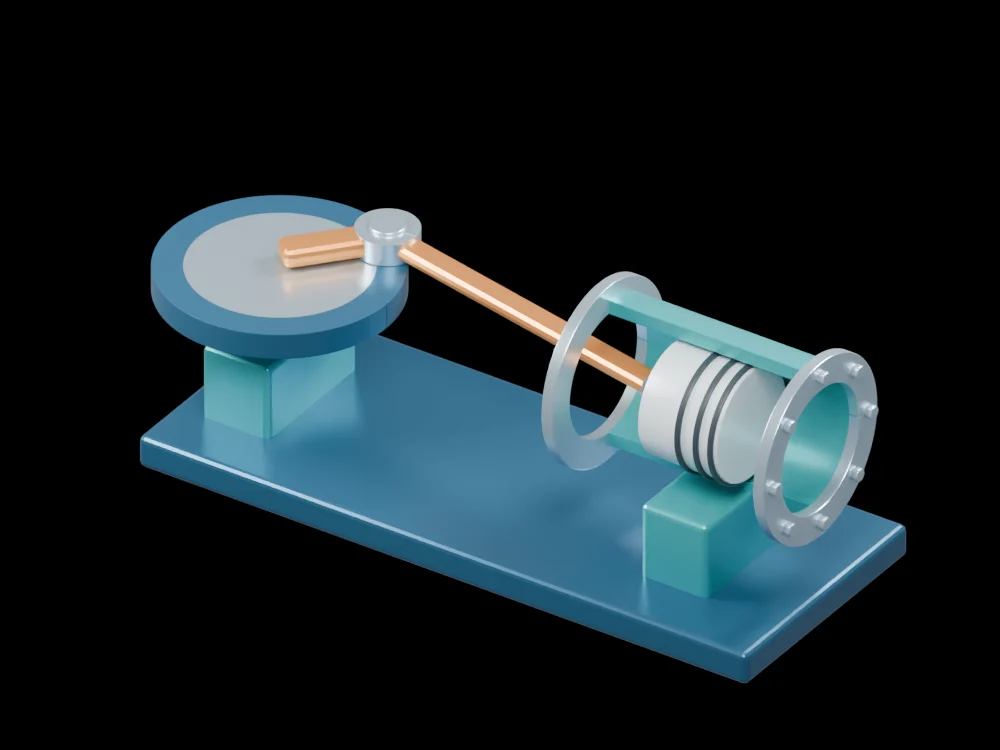
The slider–crank assembly helps separate the motion-transmission mechanism from the thermal cycle that might drive it. This paper concerns the latter at microscopic scale. Dynamically stabilised oscillators offer another example of how time-dependent behaviour can matter more than a static average.
Explore the Slider–crank mechanism model and its description, or read our earlier device-focused research explanation.
Primary citation: Niloyendu Roy, Nathan Leroux, A. K. Sood et al.. Tuning the performance of a micrometer-sized Stirling engine through reservoir engineering. Nature Communications (2021). 10.1038/s41467-021-25230-1.
Related articles
 An engineered environment changes a microscopic engine’s power–efficiency trade-offSwitching between unstable modes can stabilise a mechanical oscillatorA configurable joint reveals how small gaps turn motion into impactsMagnetic measurements expose early fatigue changes in tested metals
 A DNA clutch lets a magnetic nanomotor engage and disengage its rotorElectric current drives a molecular rotor and changes its conductance
 Nanotextured surfaces help graphite maintain an extremely low-friction contactProjected light assembles and drives reconfigurable microscopic machinesMicroscopy reveals which internal features hold a permanent magnet’s directionLight drives microscopic gear trains through patterned metasurfacesFriction consolidates brittle magnetic powders in a single processing stepA soft robot arm stays bendable while transmitting continuous torqueChanging a motor's magnetic geometry tackles a narrow noise peak
 An accordion-inspired pump recreates complex flow waveforms
 A camera learns the motion map needed to control very different robotsA new representation makes changing robot contacts easier to predict
 Dense liquid-metal coils combine soft actuation, sensing and communicationElastic electromagnetic mechanisms give small robots muscle-like motionA stretchable fibre becomes a pump that can be woven into clothingLiquid-metal networks turn a flat elastomer into programmable 3D surfacesRobots learn a predictive body model by watching their own movementsA robot can prevent slipping by changing its path instead of only squeezing harderA soft pump runs on energy collected by a triboelectric generatorSoft robots steer their shape by combining local electromagnetic vectorsA soft pump moves liquid without a rotating impellerGearbox vibrations reveal clues to efficiency during operation